DR&SS, Coffee Research Institute, Chipinge, Zimbabwe.
PLoS One. 2013 Aug 27;8(8):e73432. doi: 10.1371/journal.pone.0073432. eCollection 2013.
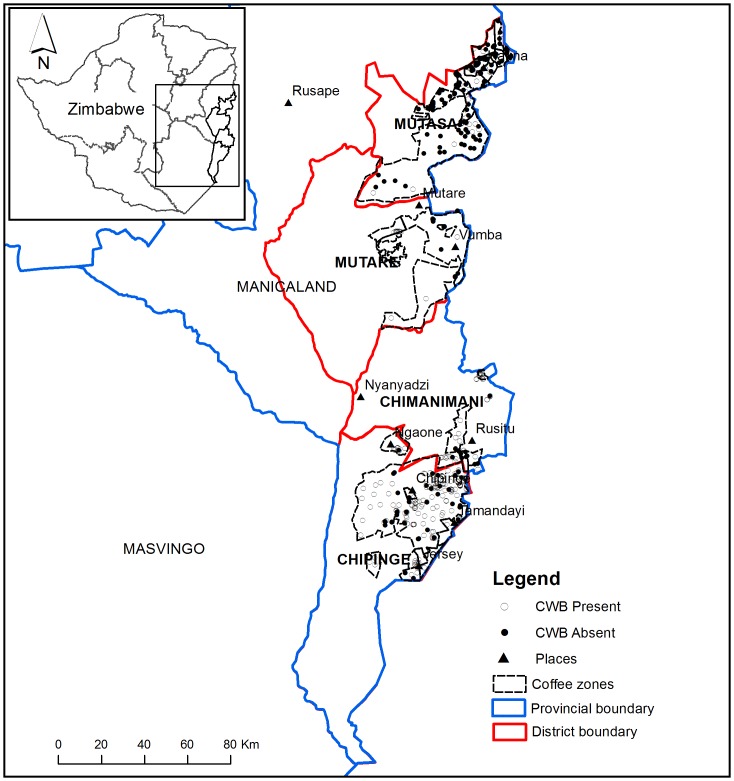
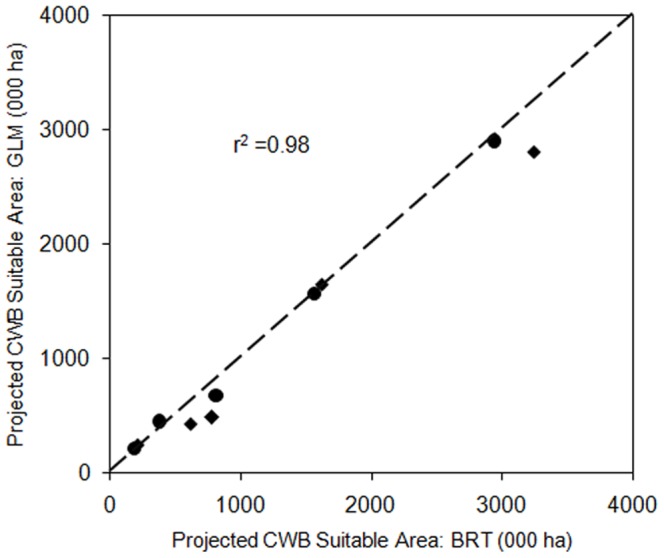
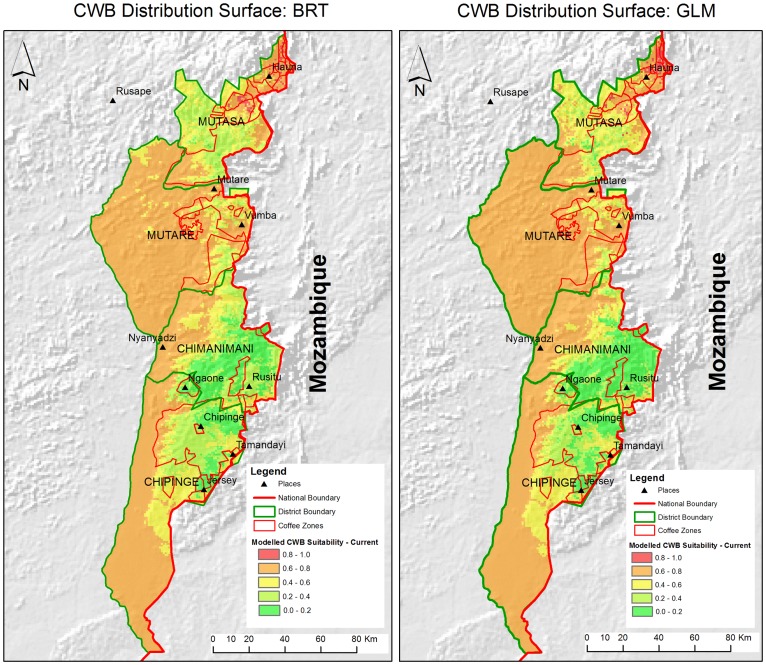
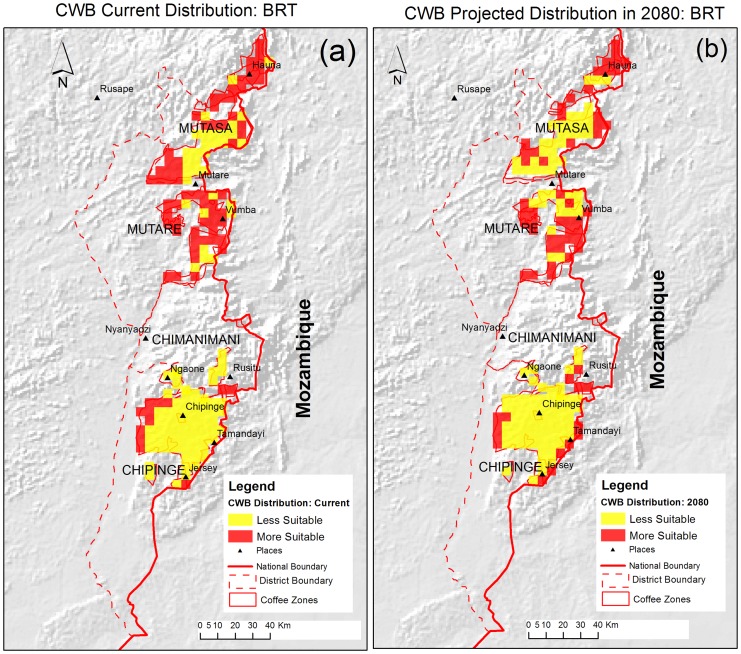
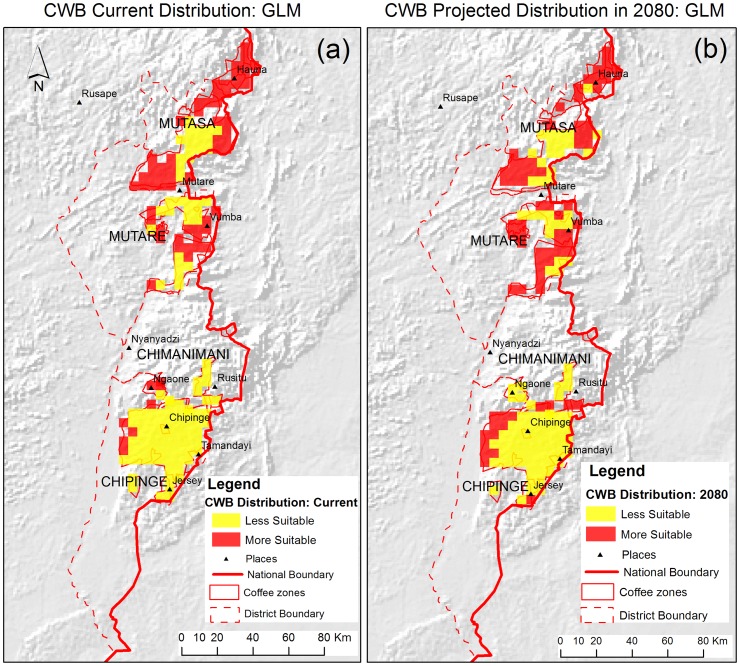
The production of agricultural commodities faces increased risk of pests, diseases and other stresses due to climate change and variability. This study assesses the potential distribution of agricultural pests under projected climatic scenarios using evidence from the African coffee white stem borer (CWB), Monochamus leuconotus (Pascoe) (Coleoptera: Cerambycidae), an important pest of coffee in Zimbabwe. A species distribution modeling approach utilising Boosted Regression Trees (BRT) and Generalized Linear Models (GLM) was applied on current and projected climate data obtained from the WorldClim database and occurrence data (presence and absence) collected through on-farm biological surveys in Chipinge, Chimanimani, Mutare and Mutasa districts in Zimbabwe. Results from both the BRT and GLM indicate that precipitation-related variables are more important in determining species range for the CWB than temperature related variables. The CWB has extensive potential habitats in all coffee areas with Mutasa district having the largest model average area suitable for CWB under current and projected climatic conditions. Habitat ranges for CWB will increase under future climate scenarios for Chipinge, Chimanimani and Mutare districts while it will decrease in Mutasa district. The highest percentage change in area suitable for the CWB was for Chimanimani district with a model average of 49.1% (3 906 ha) increase in CWB range by 2080. The BRT and GLM predictions gave similar predicted ranges for Chipinge, Chimanimani and Mutasa districts compared to the high variation in current and projected habitat area for CWB in Mutare district. The study concludes that suitable area for CWB will increase significantly in Zimbabwe due to climate change and there is need to develop adaptation mechanisms.
由于气候变化和变异性,农业商品的生产面临着越来越多的害虫、疾病和其他压力的风险。本研究利用来自津巴布韦重要咖啡害虫——咖啡白茎象甲(CWB)(鞘翅目:天牛科)的证据,评估了在预测气候情景下农业害虫的潜在分布情况。本研究采用基于证据的物种分布模型(Biomod)方法,利用 Boosted Regression Trees(BRT)和 Generalized Linear Models(GLM),对从世界气候数据库获得的当前和预测气候数据以及通过在津巴布韦奇平格、奇马马尼、穆塔雷和穆塔萨地区进行的农场生物调查收集的出现数据(存在和缺失)进行了分析。BRT 和 GLM 的结果均表明,降水相关变量比温度相关变量更能决定 CWB 的物种分布范围。在当前和预测的气候条件下,CWB 在所有咖啡种植区都有广泛的潜在栖息地,穆塔萨区的模型平均面积最大,适合 CWB。在未来气候情景下,CWB 的栖息地范围将在奇平格、奇马马尼和穆塔雷地区增加,而在穆塔萨地区则会减少。在未来 2080 年,最适合 CWB 的区域的百分比变化最大的是奇马马尼区,模型平均增加了 49.1%(3906 公顷)的 CWB 范围。与穆塔雷区 CWB 当前和预测的栖息地面积的高度变化相比,BRT 和 GLM 预测为奇平格、奇马马尼和穆塔雷区提供了类似的预测范围。本研究得出的结论是,由于气候变化,津巴布韦 CWB 的适宜面积将显著增加,因此需要制定适应机制。