Kingston University and St. George's University of London, United Kingdom.
PLoS Med. 2013 Aug;10(8):e1001505. doi: 10.1371/journal.pmed.1001505. Epub 2013 Aug 27.
Dementia is one of the most disabling and burdensome diseases. Incontinence in people with dementia is distressing, adds to carer burden, and influences decisions to relocate people to care homes. Successful and safe management of incontinence in people with dementia presents additional challenges. The aim of this study was to investigate the rates of first diagnosis in primary care of urinary and faecal incontinence among people aged 60-89 with dementia, and the use of medication or indwelling catheters for urinary incontinence.
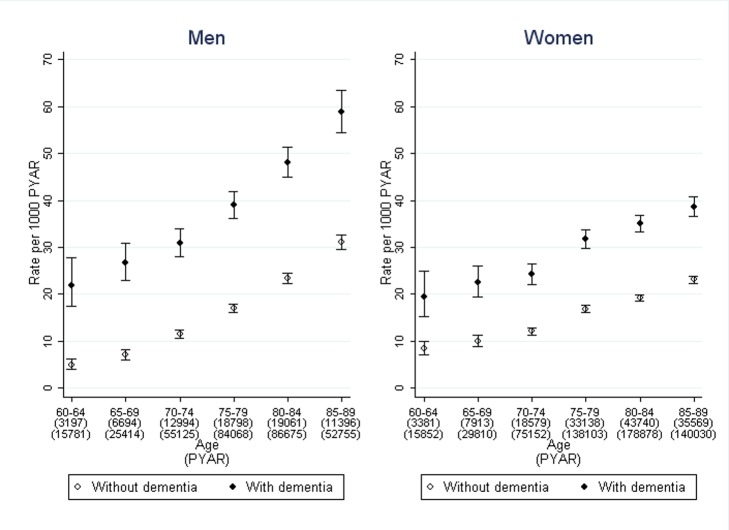
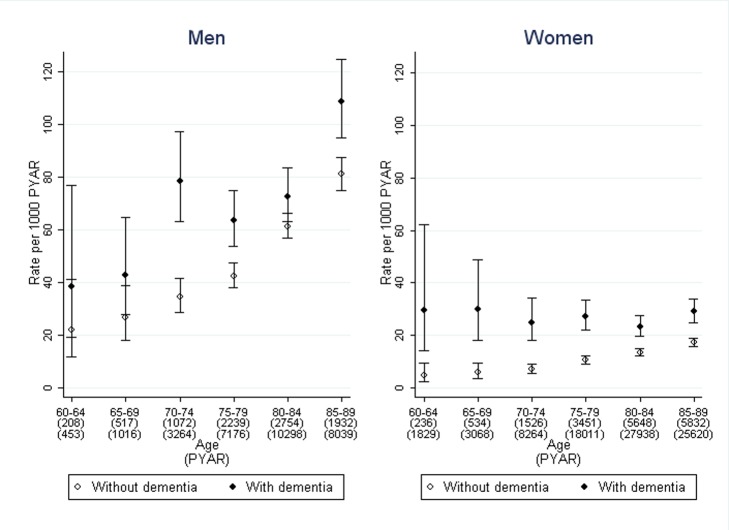
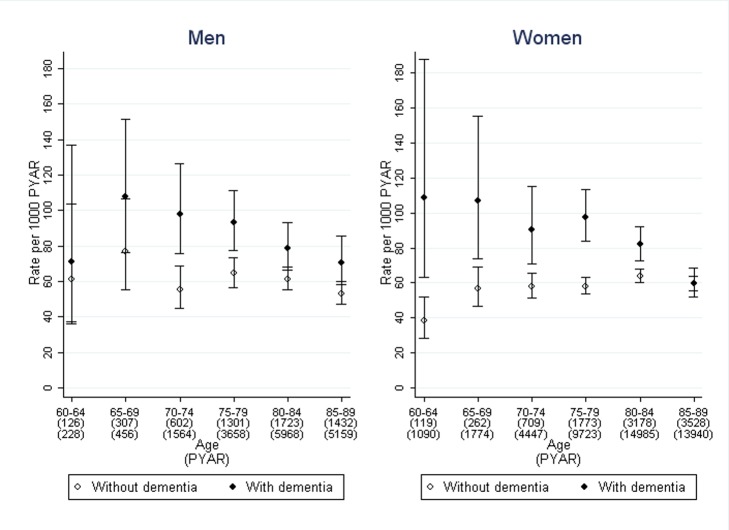
We extracted data on 54,816 people aged 60-89 with dementia and an age-gender stratified sample of 205,795 people without dementia from 2001 to 2010 from The Health Improvement Network (THIN), a United Kingdom primary care database. THIN includes data on patients and primary care consultations but does not identify care home residents. Rate ratios were adjusted for age, sex, and co-morbidity using multilevel Poisson regression. The rates of first diagnosis per 1,000 person-years at risk (95% confidence interval) for urinary incontinence in the dementia cohort, among men and women, respectively, were 42.3 (40.9-43.8) and 33.5 (32.6-34.5). In the non-dementia cohort, the rates were 19.8 (19.4-20.3) and 18.6 (18.2-18.9). The rates of first diagnosis for faecal incontinence in the dementia cohort were 11.1 (10.4-11.9) and 10.1 (9.6-10.6). In the non-dementia cohort, the rates were 3.1 (2.9-3.3) and 3.6 (3.5-3.8). The adjusted rate ratio for first diagnosis of urinary incontinence was 3.2 (2.7-3.7) in men and 2.7 (2.3-3.2) in women, and for faecal incontinence was 6.0 (5.1-7.0) in men and 4.5 (3.8-5.2) in women. The adjusted rate ratio for pharmacological treatment of urinary incontinence was 2.2 (1.4-3.7) for both genders, and for indwelling urinary catheters was 1.6 (1.3-1.9) in men and 2.3 (1.9-2.8) in women.
Compared with those without a dementia diagnosis, those with a dementia diagnosis have approximately three times the rate of diagnosis of urinary incontinence, and more than four times the rate of faecal incontinence, in UK primary care. The clinical management of urinary incontinence in people with dementia with medication and particularly the increased use of catheters is concerning and requires further investigation. Please see later in the article for the Editors' Summary.
痴呆是最具致残性和负担性的疾病之一。痴呆患者的失禁令人痛苦,增加了照护者的负担,并影响了将患者转移到养老院的决定。成功且安全地管理痴呆患者的失禁还存在其他挑战。本研究旨在调查在 60-89 岁患有痴呆症的人群中,初级保健中首次诊断尿失禁和粪便失禁的比率,以及治疗尿失禁时使用药物或留置导尿管的情况。
我们从 2001 年至 2010 年从英国初级保健数据库 The Health Improvement Network(THIN)中提取了 54816 名 60-89 岁患有痴呆症的患者和 205795 名年龄性别分层的无痴呆症患者的数据。THIN 包含患者和初级保健咨询的数据,但不识别养老院居民。使用多层泊松回归调整了年龄、性别和合并症对每 1000 人年风险的比率(95%置信区间)。在痴呆队列中,男性和女性首次诊断尿失禁的比率分别为 42.3(40.9-43.8)和 33.5(32.6-34.5)。在非痴呆队列中,比率分别为 19.8(19.4-20.3)和 18.6(18.2-18.9)。在痴呆队列中,首次诊断粪便失禁的比率为 11.1(10.4-11.9),女性为 10.1(9.6-10.6)。在非痴呆队列中,比率分别为 3.1(2.9-3.3)和 3.6(3.5-3.8)。男性首次诊断尿失禁的调整后比率为 3.2(2.7-3.7),女性为 2.7(2.3-3.2),男性首次诊断粪便失禁的调整后比率为 6.0(5.1-7.0),女性为 4.5(3.8-5.2)。男性接受药物治疗尿失禁的调整后比率为 2.2(1.4-3.7),留置导尿管的比率为 1.6(1.3-1.9),女性为 2.3(1.9-2.8)。
与没有痴呆诊断的患者相比,在英国初级保健中,有痴呆诊断的患者诊断为尿失禁的比率约为三倍,诊断为粪便失禁的比率约为四倍。痴呆患者的尿失禁临床管理包括药物治疗,尤其是留置导尿管的使用,令人担忧,需要进一步调查。请在文章后面查看编辑摘要。