Department of Biological Sciences, University of Cincinnati, Cincinnati, Ohio, United States of America.
PLoS One. 2013 Aug 27;8(8):e72506. doi: 10.1371/journal.pone.0072506. eCollection 2013.
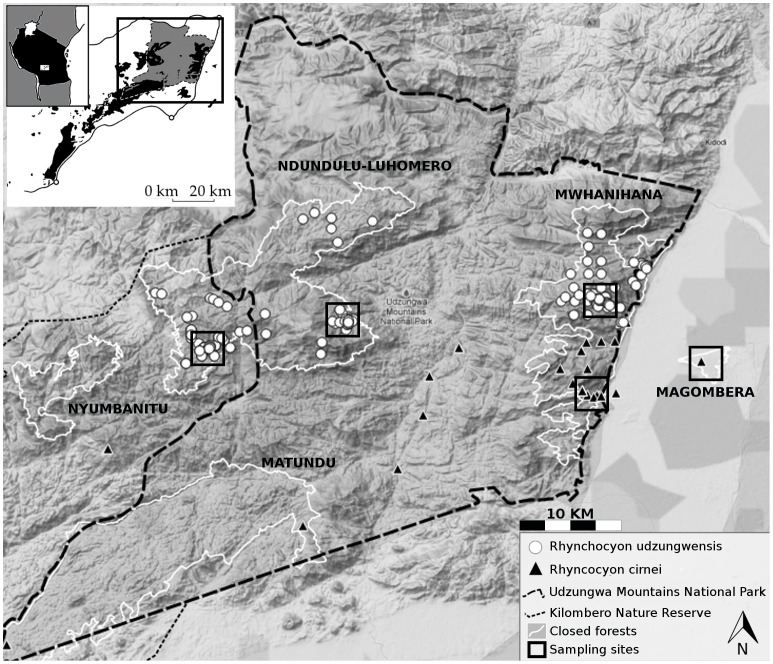
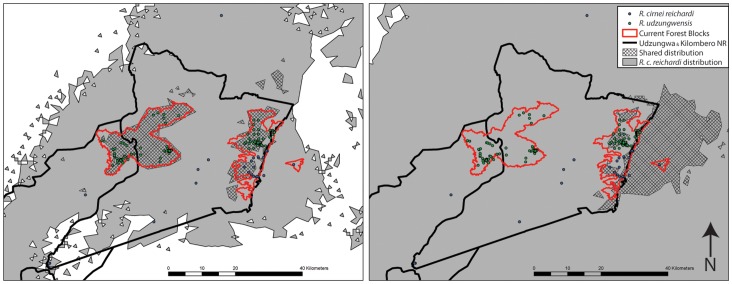
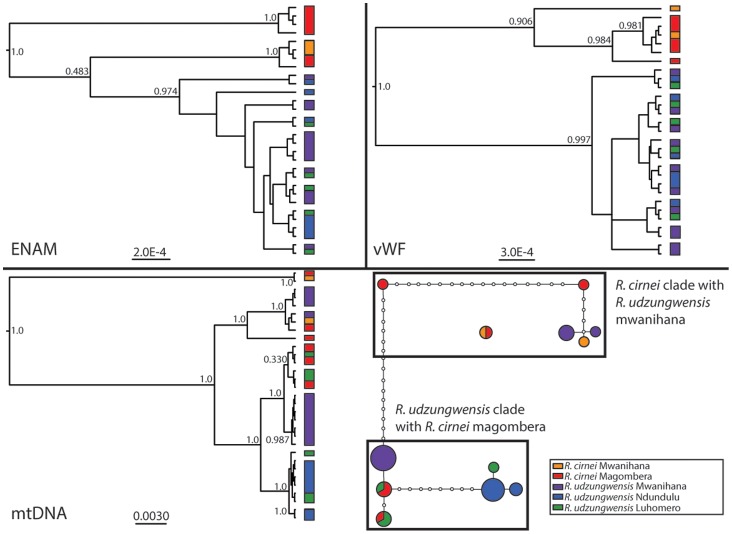
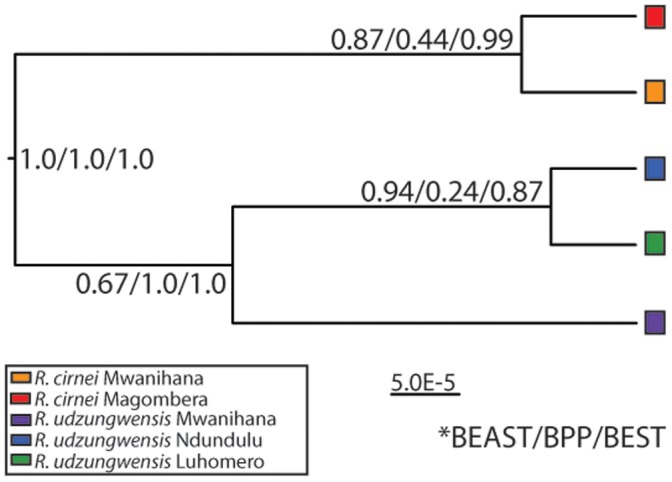
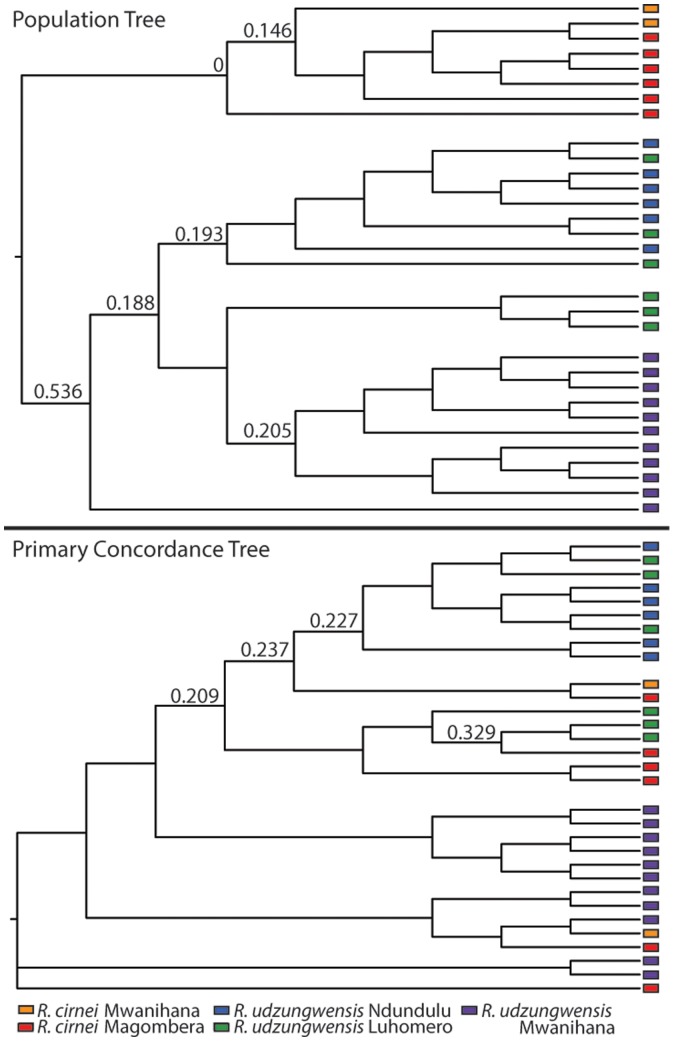
Rhynchocyon udzungwensis is a recently described and poorly understood sengi (giant elephant-shrew) endemic to two small montane forests in Southern Tanzania, and surrounded in lower forests by R. cirnei reichardi. In this study, we investigate the molecular genetic relationship between R. udzungwensis and R. c. reichardi, and the possible role that shifting species distributions in response to climate fluctuations may have played in shaping their evolutionary history. Rhynchocyon udzungwensis and R. c. reichardi individuals were sampled from five localities for genetic analyses. Three mitochondrial and two nuclear loci were used to construct species trees for delimitation and to determine whether introgression was detectable either from ancient or ongoing hybridization. All species-tree results show R. udzungwensis and R. c. reichardi as distinct lineages, though mtDNA shows evidence of introgression in some populations. Nuclear loci of each species were monophyletic, implying introgression is exclusively historical. Because we found evidence of introgression, we used distribution data and species distribution modelling for present, glacial, and interglacial climate cycles to predict how shifting species distributions may have facilitated hybridization in some populations. Though interpretations are affected by the limited range of these species, a likely scenario is that the mtDNA introgression found in eastern mid-elevation populations was facilitated by low numbers of R. udzungwensis that expanded into lowland heavily occupied R. c. reichardi areas during interglacial climate cycles. These results imply that relationships within the genus Rhynchocyon may be confounded by porous species boundaries and introgression, even if species are not currently sympatric.
乌宗古隆背鼩猬是一种最近才被描述且了解甚少的象鼩,仅分布于坦桑尼亚南部的两个小山地森林中,在较低海拔的森林中,还生存着里氏隆背鼩猬瑞氏亚种。在这项研究中,我们调查了乌宗古隆背鼩猬和里氏隆背鼩猬瑞氏亚种之间的分子遗传关系,以及它们的分布范围可能因气候变化而发生变化,这对它们的进化历史可能产生的影响。我们从五个不同的地点采集了乌宗古隆背鼩猬和里氏隆背鼩猬瑞氏亚种的个体样本,用于遗传分析。我们使用了三个线粒体和两个核基因座构建了物种树,以确定物种的划分,并确定是否可以检测到古老或正在进行的杂交过程中的基因渐渗。所有的物种树结果都表明,乌宗古隆背鼩猬和里氏隆背鼩猬瑞氏亚种是不同的谱系,尽管线粒体 DNA 显示在一些种群中存在基因渐渗的证据。每个物种的核基因座都是单系的,这意味着基因渐渗是纯粹的历史现象。由于我们发现了基因渐渗的证据,我们使用了分布数据和物种分布模型,对现在、冰期和间冰期气候循环进行了预测,以确定物种分布范围的变化如何在某些种群中促进了杂交。尽管这些物种的分布范围有限,解释受到限制,但一个可能的情景是,在间冰期气候循环中,数量较少的乌宗古隆背鼩猬扩展到低海拔地区,那里是里氏隆背鼩猬瑞氏亚种高度占据的地区,这导致了东部中海拔种群中发现的线粒体 DNA 基因渐渗。这些结果表明,即使物种目前不是同域分布,隆背鼩属内的种间关系也可能因物种边界的多孔性和基因渐渗而变得复杂。