Alexander Dominik D, Bailey William H, Perez Vanessa, Mitchell Meghan E, Su Steave
Exponent, Health Sciences, 17000 Science Drive, Suite 200, Bowie, MD 20715, USA.
J Negat Results Biomed. 2013 Sep 9;12:14. doi: 10.1186/1477-5751-12-14.
From a mechanistic or physical perspective there is no basis to suspect that electric charges on clusters of air molecules (air ions) would have beneficial or deleterious effects on respiratory function. Yet, there is a large lay and scientific literature spanning 80 years that asserts exposure to air ions affects the respiratory system and has other biological effects.
This review evaluates the scientific evidence in published human experimental studies regarding the effects of exposure to air ions on respiratory performance and symptoms.
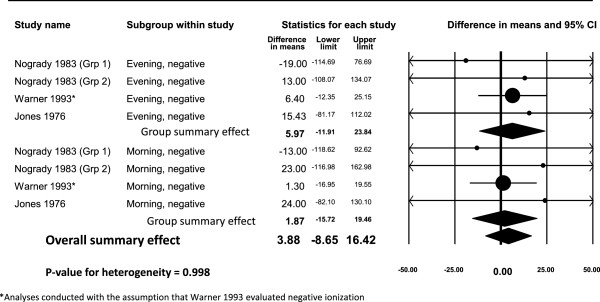
We identified 23 studies (published 1933-1993) that met our inclusion criteria. Relevant data pertaining to study population characteristics, study design, experimental methods, statistical techniques, and study results were assessed. Where relevant, random effects meta-analysis models were utilized to quantify similar exposure and outcome groupings.
The included studies examined the therapeutic benefits of exposure to negative air ions on respiratory outcomes, such as ventilatory function and asthmatic symptoms. Study specific sample sizes ranged between 7 and 23, and studies varied considerably by subject characteristics (e.g., infants with asthma, adults with emphysema), experimental method, outcomes measured (e.g., subjective symptoms, sensitivity, clinical pulmonary function), analytical design, and statistical reporting.
Despite numerous experimental and analytical differences across studies, the literature does not clearly support a beneficial role in exposure to negative air ions and respiratory function or asthmatic symptom alleviation. Further, collectively, the human experimental studies do not indicate a significant detrimental effect of exposure to positive air ions on respiratory measures. Exposure to negative or positive air ions does not appear to play an appreciable role in respiratory function.
从机械学或物理学角度来看,没有理由怀疑空气分子簇(空气离子)上的电荷会对呼吸功能产生有益或有害影响。然而,有大量跨越80年的非专业和科学文献断言,暴露于空气离子会影响呼吸系统并产生其他生物学效应。
本综述评估已发表的人体实验研究中关于暴露于空气离子对呼吸性能和症状影响的科学证据。
我们确定了23项符合纳入标准的研究(发表于1933年至1993年)。评估了与研究人群特征、研究设计、实验方法、统计技术和研究结果相关的数据。在相关情况下,使用随机效应荟萃分析模型来量化相似的暴露和结果分组。
纳入的研究考察了暴露于负空气离子对呼吸结果(如通气功能和哮喘症状)的治疗益处。各研究的样本量在7至23之间,研究在受试者特征(如哮喘婴儿、肺气肿成人)、实验方法、测量的结果(如主观症状、敏感性、临床肺功能)、分析设计和统计报告方面差异很大。
尽管各研究在实验和分析方面存在诸多差异,但文献并未明确支持暴露于负空气离子对呼吸功能或哮喘症状缓解有有益作用。此外,总体而言,人体实验研究并未表明暴露于正空气离子对呼吸指标有显著有害影响。暴露于负或正空气离子似乎在呼吸功能中不起明显作用。