KEMRI/Wellcome Trust Research Programme, Box 43640-00100, Nairobi, Kenya; Aidspan, Nairobi, Kenya.
Soc Sci Med. 2013 Nov;97(100):220-7. doi: 10.1016/j.socscimed.2013.08.020. Epub 2013 Aug 27.
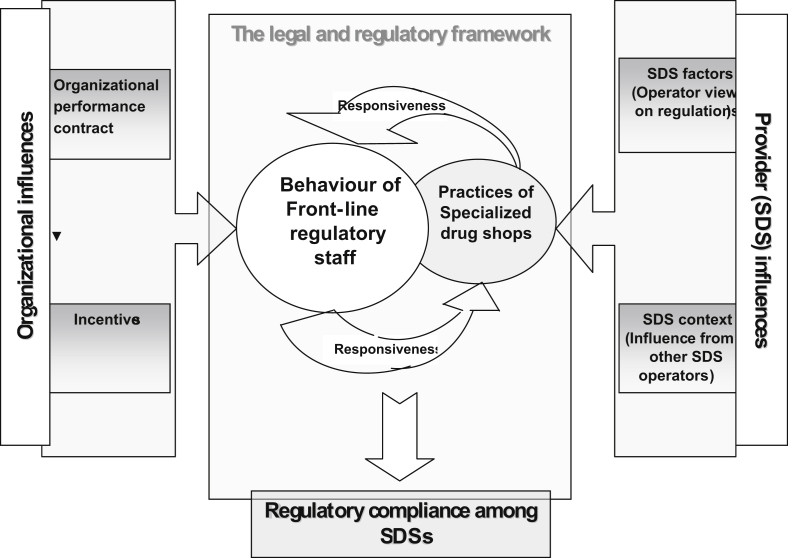
The problem of poor regulatory compliance has been widely reported across private health providers in developing countries. Less known are the underlying reasons for poor compliance, especially with regards to the roles played by front-line regulatory staff, and the regulatory institution as a whole. We designed a qualitative study to address this gap, with the study questions and tools drawing on a conceptual framework informed by theoretical literature on regulation. Data were collected from specialized drug shops (SDSs) in two rural districts in Western Kenya in 2011 through eight focus group discussions, and from regulatory staff from organizations governing the pharmaceutical sector through a total of 24 in-depth interviews. We found that relationships between front-line regulators and SDS operators were a strong influence on regulatory behaviour, often resulting in non-compliance and perverse outcomes such as corruption. It emerged that separate regulatory streams operated in urban and rural locations, based mainly on differing relationships between the front-line regulators and SDS operators, and on broader factors such as the competition environment and community expectations. Effective incentive structures for regulatory staff were either absent, or poorly linked to performance in regulatory organizations, resulting in divergences between the purposes of the regulatory organization and activities of front-line staff. Given the rural-urban differences in the practice environment, the introduction of lower retail practice requirements for rural SDSs could be considered. This would allow illegally operated shops to be brought within the regulatory framework, facilitating good quality provision of essential commodities to marginalized areas, without lowering the practice requirements for the better complying urban SDSs. In addition, regulatory organizations need to devise incentives that better link the level of effort to rewards such as professional advancement of regulatory staff.
在发展中国家,私营医疗服务提供者普遍存在监管合规性差的问题。但鲜为人知的是,造成合规性差的根本原因,尤其是一线监管人员和整个监管机构所扮演的角色。我们设计了一项定性研究来解决这一差距,研究问题和工具借鉴了监管理论文献中的概念框架。2011 年,我们在肯尼亚西部的两个农村地区的专门药品店(SDS)收集了数据,通过 8 次焦点小组讨论,并从管理制药部门的组织中的监管人员那里收集了总共 24 次深入访谈。我们发现,一线监管人员和 SDS 经营者之间的关系对监管行为有很大影响,往往导致不合规和腐败等不良后果。事实证明,在城乡地区,独立的监管渠道运作,主要基于一线监管人员和 SDS 经营者之间的不同关系,以及竞争环境和社区期望等更广泛的因素。监管人员的有效激励结构要么不存在,要么与监管组织中的绩效联系不紧密,导致监管组织的目的和一线工作人员的活动之间存在分歧。鉴于实践环境在城乡之间的差异,可以考虑为农村 SDS 降低零售实践要求。这将使非法经营的商店能够纳入监管框架,促进向贫困地区提供基本商品的高质量供应,而不会降低合规性较好的城市 SDS 的实践要求。此外,监管组织需要设计激励措施,更好地将监管人员的努力程度与专业发展等奖励联系起来。