Kaminska Karolina, Martinetti Gladys, Lucchini Renzo, Kaya Gürkan, Mainetti Carlo
Department of Dermatology, Regional Hospital of Bellinzona, Bellinzona, Geneva, Switzerland.
Case Rep Dermatol. 2013 Aug 7;5(2):203-9. doi: 10.1159/000354533. eCollection 2013.
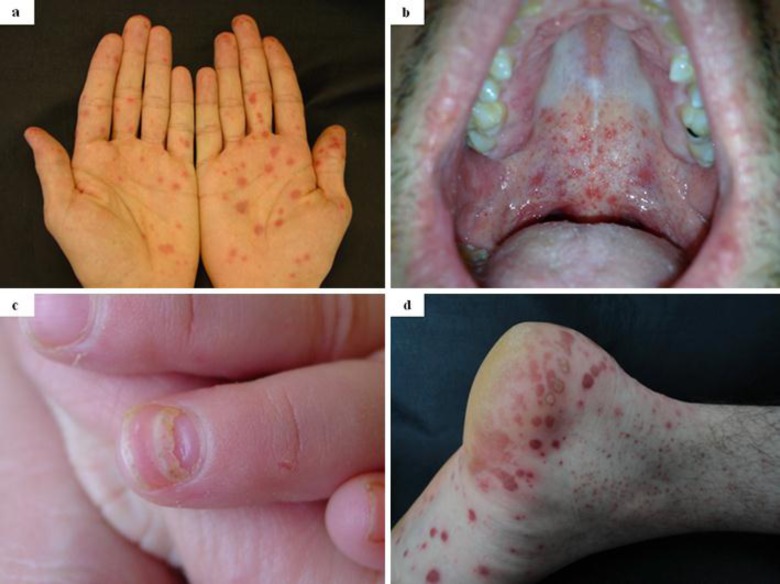
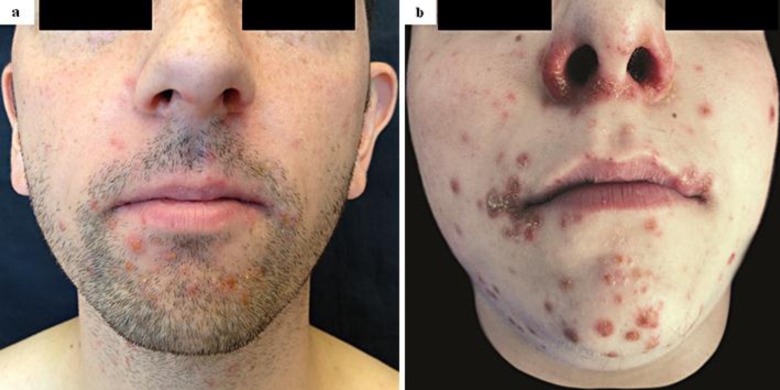
Hand, foot and mouth disease (HFMD) is a highly contagious viral infection characterized by typical maculopapular or vesicular eruptions on the hands and feet and in the oral cavity. It affects predominantly children and/or immunocompromised adults. It usually follows a benign and self-limiting course. However, HFMD cases with severe or lethal complications such as encephalitis, meningitis, pulmonary edema and myocarditis have also been reported, mostly in children, but also in adults. High infectivity of HFMD has contributed to several large outbreaks of this disease in recent decades in East and Southeast Asia, the United States and Finland. The most common pathogens were Coxsackievirus A16, Enterovirus 71 and, recently, also Coxsackieviruses A6 and A10. Differences in the course of HFMD have been observed, depending on the virus type. Recently, many cases of atypical HFMD have been described in the literature with unusual morphology and/or localization of skin lesions. Atypical HFMD manifestations including vesiculobullous exanthema, often on the trunk or extremities, and perioral zone involvement were often caused by Coxsackievirus A6 infections. We present 3 cases of familial transmission of HFMD caused by Coxsackievirus A6 with some atypical features, benign course and complete recovery among immunocompetent adults.
手足口病(HFMD)是一种具有高度传染性的病毒感染,其特征为在手、足和口腔出现典型的斑丘疹或水疱疹。它主要影响儿童和/或免疫功能低下的成年人。通常呈良性且自限性病程。然而,也有报道称手足口病病例会出现严重或致命的并发症,如脑炎、脑膜炎、肺水肿和心肌炎,大多发生在儿童,但也有成人病例。手足口病的高传染性导致近几十年来在东亚、东南亚、美国和芬兰多次大规模暴发该疾病。最常见的病原体是柯萨奇病毒A16、肠道病毒71,最近还有柯萨奇病毒A6和A10。根据病毒类型的不同,手足口病的病程也有所差异。最近,文献中描述了许多非典型手足口病病例,其皮肤病变形态和/或部位异常。非典型手足口病表现包括水疱大疱性皮疹,常出现在躯干或四肢,以及口周区域受累,这些通常由柯萨奇病毒A6感染引起。我们报告了3例由柯萨奇病毒A6引起的手足口病家庭传播病例,具有一些非典型特征,病程良性,免疫功能正常的成年人完全康复。