Cho Sooyoung, Kim Youn-Jin, Kim Dong-Yeon, Chung Soon-Sup
Department of Anesthesiology and Pain Medicine, Ewha Womans University School of Medicine, Seoul, Korea.
J Korean Surg Soc. 2013 Sep;85(3):128-33. doi: 10.4174/jkss.2013.85.3.128. Epub 2013 Aug 26.
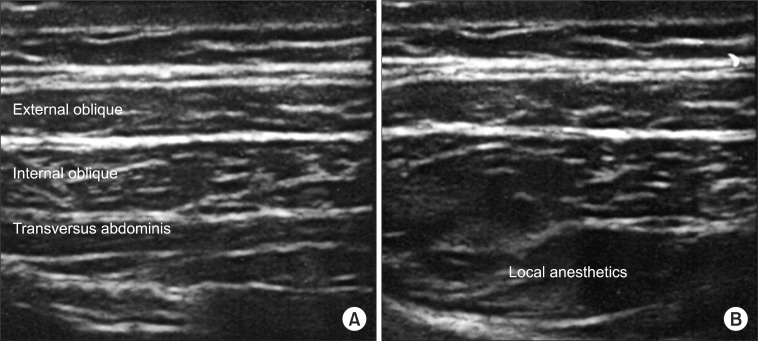
Transversus abdominis plane (TAP) block is a newly developed and effective peripheral block involving the nerves of the anterior abdominal wall for lower abdominal surgery. We evaluated the postoperative analgesic efficacy of ultrasound-guided TAP block using 20 mL of 0.5% levobupivacaine in patients undergoing open appendectomy.
Forty-four patients undergoing appendectomy were assigned either to undergo a right sided-TAP block (group I, n = 22), or to receive standard care (group II, n = 22). All patients received standard anesthetics, and the TAP block group received ultrasound-guided right side TAP block using 20 mL of 0.5% levobupivacaine after induction of anesthesia. All patients received acetaminophen, and nonsteroidal anti-inflammatory drug as required during the 48 postoperative hours. Each patients was assessed for time to first rescue analgesia, verbal numerical rating pain scores (VNRS), number of rescue analgesic demands, nausea, vomiting, pruritus, and drowsiness by a blinded investigator at 0, 1, 3, 6, 12, 24 and 48 hours postoperatively.
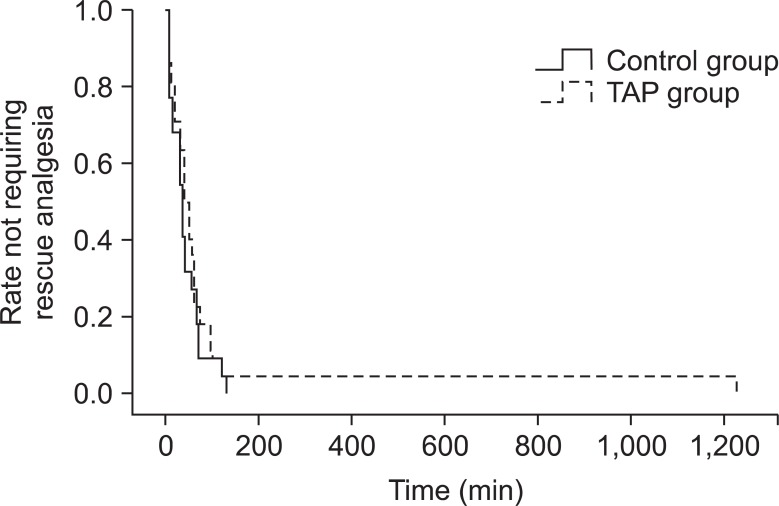
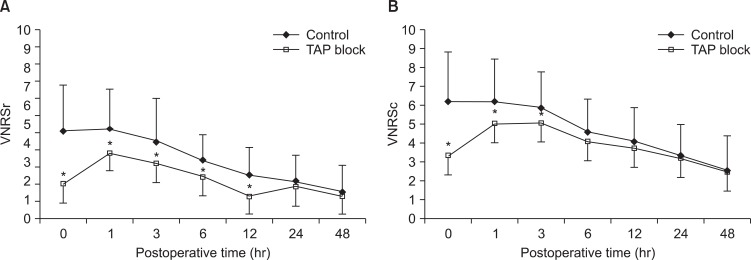
The TAP block group with levobupivacaine compared to the control group reduced VNRS significantly up to 12 hours postoperatively. There were no significant differences in time to first analgesia, number of rescue analgesics demands, nausea, vomiting, pruritus and drowsiness between the groups. There were no complications attributable to the TAP block.
Ultrasound-guided TAP block using 20 mL of 0.5% levobupivacaine provided effective postoperative analgesia during the 12 postoperative hours after an open appendectomy.
腹横肌平面(TAP)阻滞是一种新开发的、有效的外周阻滞方法,涉及下腹手术中腹壁前部的神经。我们评估了在接受开腹阑尾切除术的患者中使用20毫升0.5%左旋布比卡因进行超声引导下TAP阻滞的术后镇痛效果。
44例接受阑尾切除术的患者被分为两组,一组接受右侧TAP阻滞(第一组,n = 22),另一组接受标准护理(第二组,n = 22)。所有患者均接受标准麻醉,TAP阻滞组在麻醉诱导后使用20毫升0.5%左旋布比卡因进行超声引导下右侧TAP阻滞。所有患者在术后48小时内按需服用对乙酰氨基酚和非甾体类抗炎药。由一名不知情的研究者在术后0、1、3、6、12、24和48小时对每位患者进行首次补救镇痛时间、言语数字评分疼痛评分(VNRS)、补救镇痛需求次数、恶心、呕吐、瘙痒和嗜睡情况的评估。
与对照组相比,左旋布比卡因TAP阻滞组在术后12小时内显著降低了VNRS。两组在首次镇痛时间、补救镇痛需求次数、恶心、呕吐、瘙痒和嗜睡方面无显著差异。没有可归因于TAP阻滞的并发症。
使用20毫升0.5%左旋布比卡因进行超声引导下TAP阻滞在开腹阑尾切除术后12小时内提供了有效的术后镇痛。