Oh Keunhee, Lee Ok-Young, Shon Suh Youn, Nam Onyou, Ryu Po Mee, Seo Myung Won, Lee Dong-Sup
Breast Cancer Res. 2013;15(5):R79. doi: 10.1186/bcr3473.
Tumor cell interactions with the microenvironment, especially those of bone-marrow-derived myeloid cells, are important in various aspects of tumor metastasis. Myeloid-derived suppressor cells (MDSCs) have been suggested to constitute tumor-favoring microenvironments. In this study, we elucidated a novel mechanism by which the MDSCs can mediate spontaneous distant metastasis of breast cancer cells.
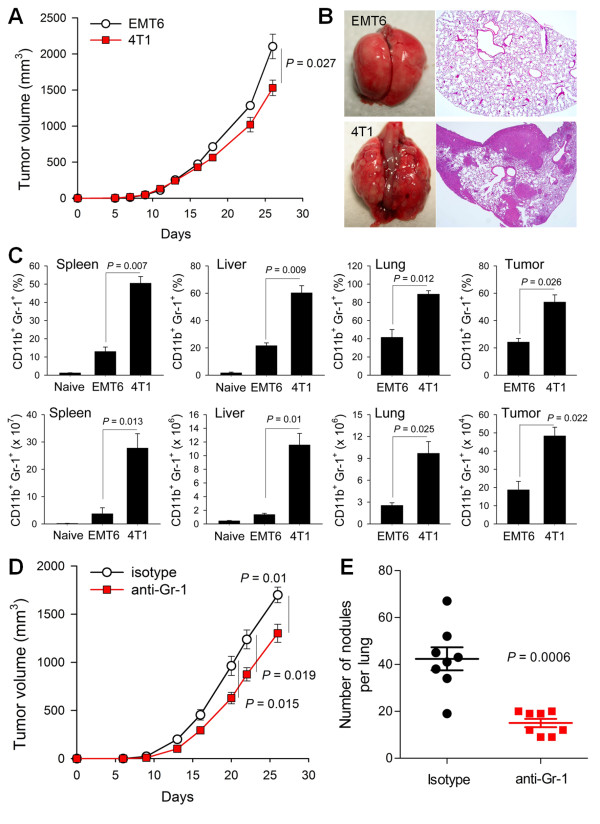
Murine breast cancer cells, 4T1 and EMT6, were orthotopically grafted into the mammary fat pads of syngeneic BALB/c mice. CD11b(+)Gr-1(+) MDSCs in the spleen, liver, lung and primary tumor mass were analyzed. To evaluate the role of MDSCs in the distant metastasis, MDSCs were depleted or reconstituted in tumor-bearing mice. To evaluate whether MDSCs in the metastasizing tumor microenvironment affect breast cancer cell behavior, MDSCs and cancer cells were co-cultivated. To investigate the role of MDSCs in in vivo metastasis, we blocked the interactions between MDSCs and cancer cells.
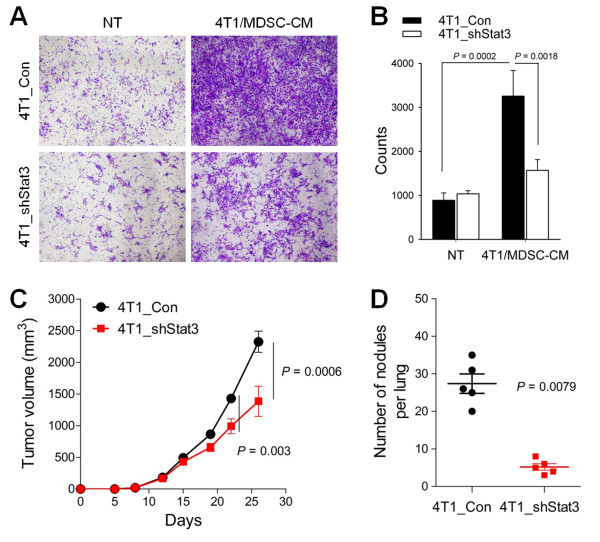
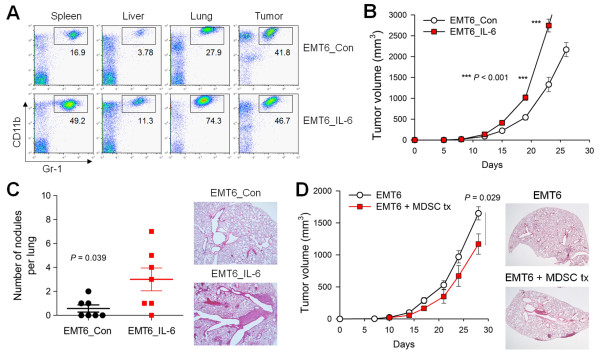
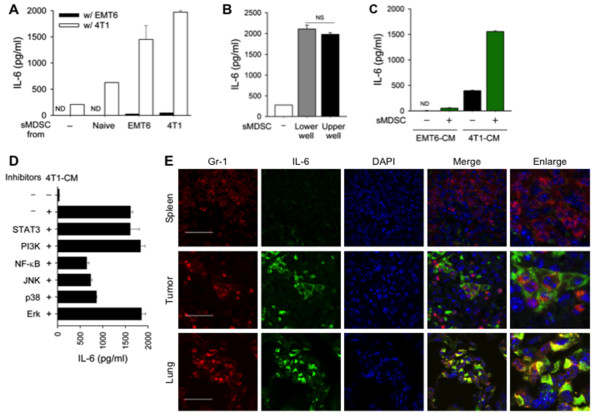
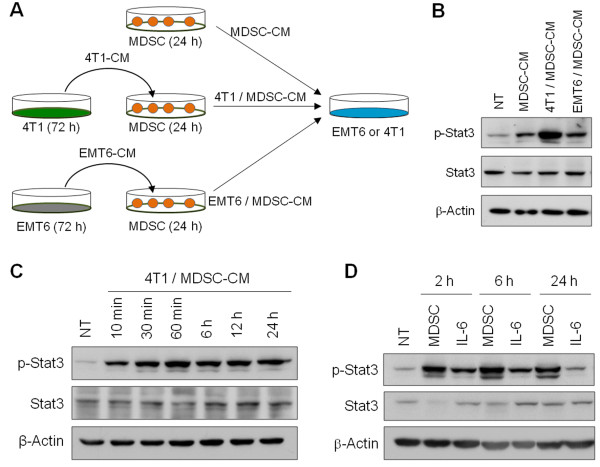
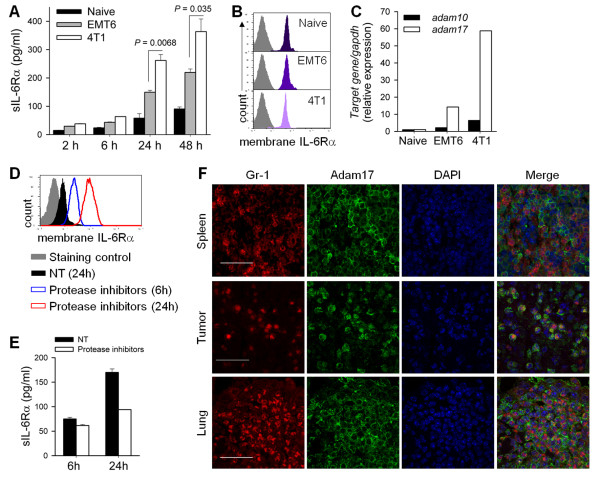
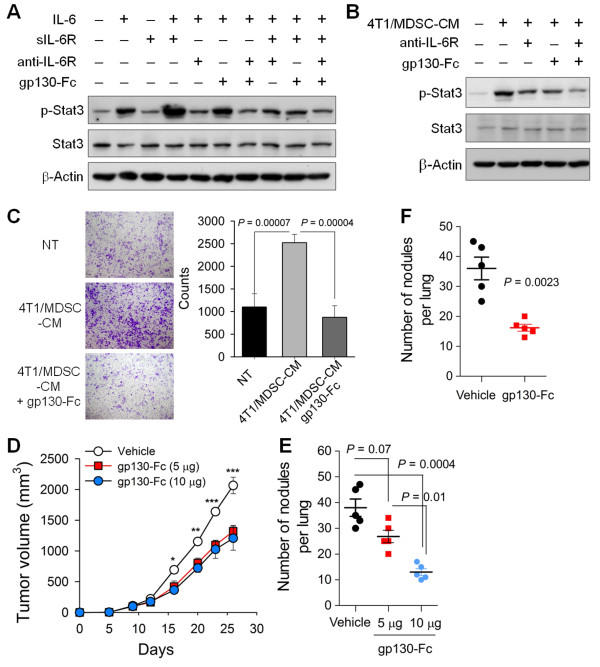
Using a murine breast cancer cell model, we showed that murine breast cancer cells with high IL-6 expression recruited more MDSCs and that the metastasizing capacity of cancer cells paralleled MDSC recruitment in tumor-bearing mice. Metastasizing, but not non-metastasizing, tumor-derived factors induced MDSCs to increase IL-6 production and full activation of recruited MDSCs occurred in the primary tumor site and metastatic organ in the vicinity of metastasizing cancer cells, but not in lymphoid organs. In addition, tumor-expanded MDSCs expressed Adam-family proteases, which facilitated shedding of IL-6 receptor, thereby contributing to breast cancer cell invasiveness and distant metastasis through IL-6 trans-signaling. The critical role of IL-6 trans-signaling was confirmed in both the afferent and efferent pathways of metastasis.
In this study, we showed that metastasizing cancer cells induced higher MDSCs infiltration and prompted them to secret exaggerated IL-6 as well as soluble IL-6Ra, which, in turn, triggered a persistent increase of pSTAT3 in tumor cells. This potential tumor-MDSC axis involving IL-6 trans-signaling directly affected breast cancer cell aggressiveness, leading to spontaneous metastasis.
肿瘤细胞与微环境的相互作用,尤其是与骨髓来源的髓样细胞的相互作用,在肿瘤转移的各个方面都很重要。髓样来源的抑制细胞(MDSCs)被认为构成了有利于肿瘤的微环境。在本研究中,我们阐明了一种MDSCs介导乳腺癌细胞自发远处转移的新机制。
将小鼠乳腺癌细胞4T1和EMT6原位移植到同基因BALB/c小鼠的乳腺脂肪垫中。分析脾脏、肝脏、肺和原发性肿瘤块中的CD11b(+)Gr-1(+) MDSCs。为了评估MDSCs在远处转移中的作用,在荷瘤小鼠中清除或重建MDSCs。为了评估转移肿瘤微环境中的MDSCs是否影响乳腺癌细胞行为,将MDSCs与癌细胞共培养。为了研究MDSCs在体内转移中的作用,我们阻断了MDSCs与癌细胞之间的相互作用。
使用小鼠乳腺癌细胞模型,我们发现高表达IL-6的小鼠乳腺癌细胞招募了更多的MDSCs,并且癌细胞的转移能力与荷瘤小鼠中MDSCs的招募情况平行。转移的而非不转移的肿瘤衍生因子诱导MDSCs增加IL-6的产生,并且招募的MDSCs的完全激活发生在原发性肿瘤部位和转移癌细胞附近的转移器官中,而不是在淋巴器官中。此外,肿瘤扩增的MDSCs表达Adam家族蛋白酶,其促进IL-6受体的脱落,从而通过IL-6转信号传导促进乳腺癌细胞的侵袭和远处转移。IL-6转信号传导在转移的传入和传出途径中的关键作用均得到证实。
在本研究中,我们表明转移的癌细胞诱导更高的MDSCs浸润,并促使它们分泌过量的IL-6以及可溶性IL-6Ra,这反过来又引发肿瘤细胞中pSTAT3的持续增加。这种涉及IL-6转信号传导的潜在肿瘤-MDSC轴直接影响乳腺癌细胞的侵袭性,导致自发转移。