German Center for Neurodegenerative Diseases (DZNE e.V.); Bonn, Germany.
German Center for Neurodegenerative Diseases (DZNE e.V.); Bonn, Germany; Rheinische Friedrich-Wilhelms-Universität; Bonn, Germany.
Prion. 2013 Sep-Oct;7(5):369-77. doi: 10.4161/pri.26414. Epub 2013 Sep 10.
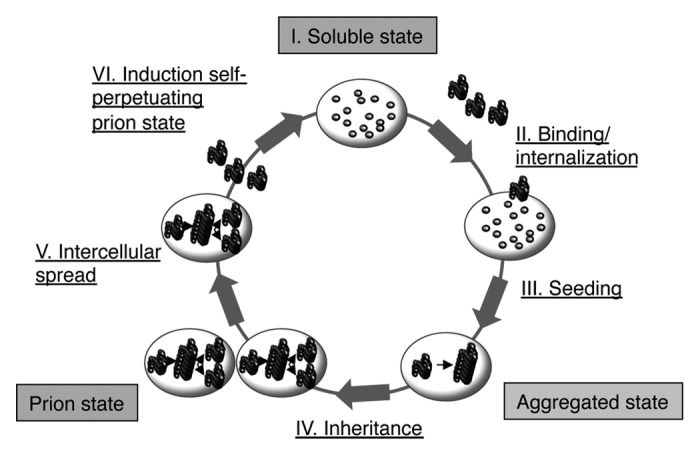
Prions are self-templating protein aggregates that were originally identified as the causative agent of prion diseases in mammals, but have since been discovered in other kingdoms. Mammalian prions represent a unique class of infectious agents that are composed of misfolded prion protein. Prion proteins usually exist as soluble proteins but can refold and assemble into highly ordered, self-propagating prion polymers. The prion concept is also applicable to a growing number of non-Mendelian elements of inheritance in lower eukaryotes. While prions identified in mammals are clearly pathogens, prions in lower eukaryotes can be either detrimental or beneficial to the host. Prion phenotypes in fungi are transmitted vertically from mother to daughter cells during cell division and horizontally during mating or abortive mating, but extracellular phases have not been reported. Recent findings now demonstrate that in a mammalian cell environment, protein aggregates derived from yeast prion domains exhibit a prion life cycle similar to mammalian prions propagated ex vivo. This life cycle includes a soluble state of the protein, an induction phase by exogenous prion fibrils, stable replication of prion entities, vertical transmission to progeny and natural horizontal transmission to neighboring cells. Our data reveal that mammalian cells contain all co-factors required for cytosolic prion propagation and dissemination. This has important implications for understanding prion-like properties of disease-related protein aggregates. In light of the growing number of identified functional amyloids, cell-to-cell propagation of cytosolic protein conformers might not only be relevant for the spreading of disease-associated proteins, but might also be of more general relevance under non-disease conditions.
朊病毒是自我模板化的蛋白质聚集体,最初被确定为哺乳动物朊病毒病的病原体,但后来在其他生物王国中也被发现。哺乳动物朊病毒代表了一类独特的传染性病原体,由错误折叠的朊病毒蛋白组成。朊病毒蛋白通常以可溶形式存在,但可以重新折叠并组装成高度有序、自我传播的朊病毒聚合物。朊病毒概念也适用于越来越多的低等真核生物中非孟德尔遗传元素。虽然哺乳动物中鉴定的朊病毒显然是病原体,但低等真核生物中的朊病毒对宿主可能有害也可能有益。真菌中的朊病毒表型在细胞分裂过程中从母细胞垂直传递到子细胞,在交配或失败交配过程中水平传递,但尚未报道细胞外阶段。最近的发现表明,在哺乳动物细胞环境中,源自酵母朊病毒结构域的蛋白质聚集体表现出类似于体外传播的哺乳动物朊病毒的朊病毒生命周期。这个生命周期包括蛋白质的可溶性状态、外源性朊病毒纤维诱导的诱导阶段、朊病毒实体的稳定复制、向后代的垂直传递以及向邻近细胞的自然水平传递。我们的数据表明,哺乳动物细胞中包含细胞质朊病毒传播和扩散所需的所有辅助因子。这对于理解与疾病相关的蛋白质聚集体的朊病毒样特性具有重要意义。鉴于越来越多的功能性淀粉样蛋白被鉴定出来,细胞质蛋白构象的细胞间传播不仅可能与疾病相关蛋白的传播有关,而且在非疾病条件下也可能具有更普遍的意义。