Weisleder Adriana, Fernald Anne
Department of Psychology, Stanford University.
Psychol Sci. 2013 Nov 1;24(11):2143-52. doi: 10.1177/0956797613488145. Epub 2013 Sep 10.
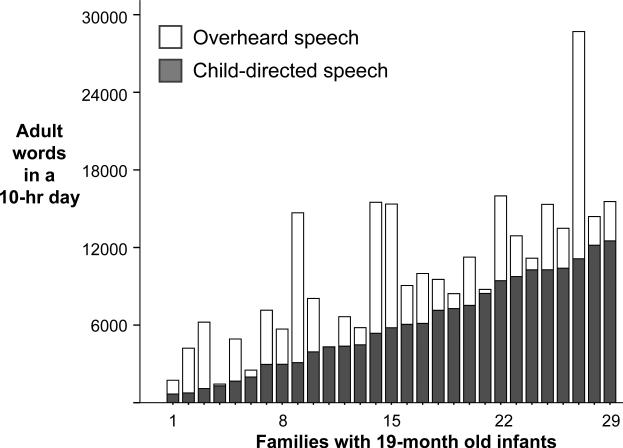
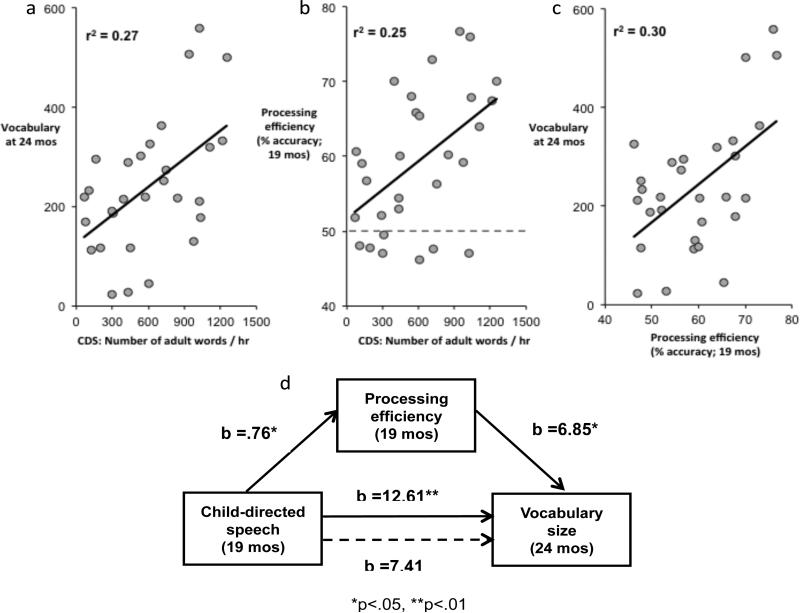
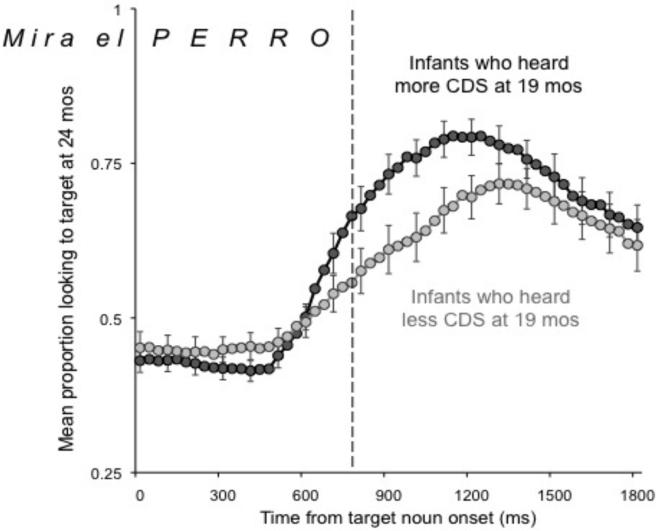
Infants differ substantially in their rates of language growth, and slow growth predicts later academic difficulties. In this study, we explored how the amount of speech directed to infants in Spanish-speaking families low in socioeconomic status influenced the development of children's skill in real-time language processing and vocabulary learning. All-day recordings of parent-infant interactions at home revealed striking variability among families in how much speech caregivers addressed to their child. Infants who experienced more child-directed speech became more efficient in processing familiar words in real time and had larger expressive vocabularies by the age of 24 months, although speech simply overheard by the child was unrelated to vocabulary outcomes. Mediation analyses showed that the effect of child-directed speech on expressive vocabulary was explained by infants' language-processing efficiency, which suggests that richer language experience strengthens processing skills that facilitate language growth.
婴儿在语言发展速度上存在显著差异,而发展缓慢预示着日后的学业困难。在本研究中,我们探讨了社会经济地位较低的讲西班牙语家庭中,针对婴儿的言语量如何影响儿童实时语言处理技能和词汇学习的发展。在家中对亲子互动进行全天记录发现,不同家庭中照顾者与孩子交谈的言语量存在显著差异。经历更多亲子对话的婴儿在实时处理熟悉词汇方面变得更高效,到24个月大时表达性词汇量也更大,不过孩子只是偶然听到的言语与词汇发展结果无关。中介分析表明,亲子对话对表达性词汇的影响是通过婴儿的语言处理效率来解释的,这表明更丰富的语言体验会强化有助于语言发展的处理技能。