Johann-Friedrich-Blumenbach Institute for Zoology and Anthropology, Georg-August-University Göttingen, Göttingen, Germany.
PLoS One. 2013 Aug 30;8(8):e74951. doi: 10.1371/journal.pone.0074951. eCollection 2013.
Fungi are key dietary resources for many animals. Fungi, in consequence, have evolved sophisticated physical and chemical defences for repelling and impairing fungivores. Expression of such defences may entail costs, requiring diversion of energy and nutrients away from fungal growth and reproduction. Inducible resistance that is mounted after attack by fungivores may allow fungi to circumvent the potential costs of defence when not needed. However, no information exists on whether fungi display inducible resistance. We combined organism and fungal gene expression approaches to investigate whether fungivory induces resistance in fungi.
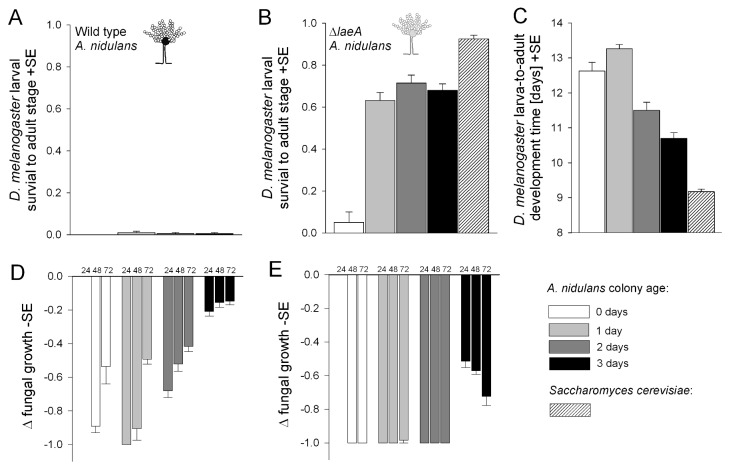
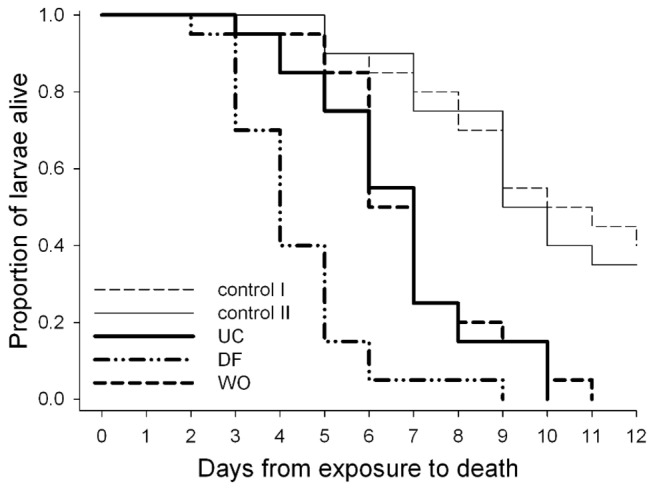
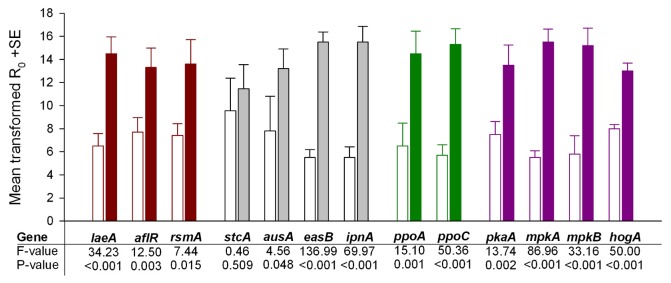
METHODOLOGY/PRINCIPAL FINDINGS: Here we show that grazing by larval fruit flies, Drosophila melanogaster, induces resistance in the filamentous mould, Aspergillus nidulans, to subsequent feeding by larvae of the same insect. Larval grazing triggered the expression of various putative fungal resistance genes, including the secondary metabolite master regulator gene laeA. Compared to the severe pathological effects of wild type A. nidulans, which led to 100% insect mortality, larval feeding on a laeA loss-of-function mutant resulted in normal insect development. Whereas the wild type fungus recovered from larval grazing, larvae eradicated the chemically deficient mutant. In contrast, mutualistic dietary yeast, Saccharomyces cerevisiae, reached higher population densities when exposed to Drosophila larval feeding.
CONCLUSIONS/SIGNIFICANCE: Our study presents novel evidence that insect grazing is capable of inducing resistance to further grazing in a filamentous fungus. This phenotypic shift in resistance to fungivory is accompanied by changes in the expression of genes involved in signal transduction, epigenetic regulation and secondary metabolite biosynthesis pathways. Depending on reciprocal insect-fungus fitness consequences, fungi may be selected for inducible resistance to maintain high fitness in fungivore-rich habitats. Induced fungal defence responses thus need to be included if we wish to have a complete conception of animal-fungus co-evolution, fungal gene regulation, and multitrophic interactions.
真菌是许多动物的主要食物资源。因此,真菌进化出了复杂的物理和化学防御机制,以击退和削弱真菌捕食者。表达这些防御机制可能会带来成本,需要将能量和营养物质从真菌的生长和繁殖中转移出来。在被真菌捕食者攻击后,诱导产生的抗性可能会使真菌在不需要防御时避免潜在的防御成本。然而,目前还没有关于真菌是否表现出诱导抗性的信息。我们结合生物和真菌基因表达方法,研究了真菌捕食是否会诱导真菌产生抗性。
方法/主要发现:在这里,我们表明,幼虫果蝇(Drosophila melanogaster)的摄食会诱导丝状霉菌(Aspergillus nidulans)产生抗性,从而抵抗同一昆虫幼虫的后续摄食。幼虫摄食触发了各种推测的真菌抗性基因的表达,包括次级代谢物主调控基因 laeA。与野生型 A. nidulans 的严重病理影响(导致 100%昆虫死亡)相比,幼虫摄食 laeA 缺失功能突变体导致昆虫正常发育。然而,从幼虫摄食中恢复的野生型真菌,幼虫会消灭化学缺陷的突变体。相比之下,互惠的饮食酵母(Saccharomyces cerevisiae)在暴露于果蝇幼虫摄食时会达到更高的种群密度。
结论/意义:我们的研究提供了新的证据,证明昆虫摄食能够诱导丝状真菌对进一步摄食产生抗性。这种对真菌捕食的抗性表型变化伴随着参与信号转导、表观遗传调控和次生代谢物生物合成途径的基因表达的变化。根据互惠的昆虫-真菌适应度结果,真菌可能会被选择产生诱导抗性,以保持在富含真菌捕食者的栖息地中的高适应度。因此,如果我们希望对动物-真菌共同进化、真菌基因调控和多营养级相互作用有一个完整的概念,就需要包括诱导性真菌防御反应。