Department of Molecular Medicine and Pathology, University of Auckland, Auckland, New Zealand.
PLoS One. 2013 Sep 2;8(9):e71142. doi: 10.1371/journal.pone.0071142. eCollection 2013.
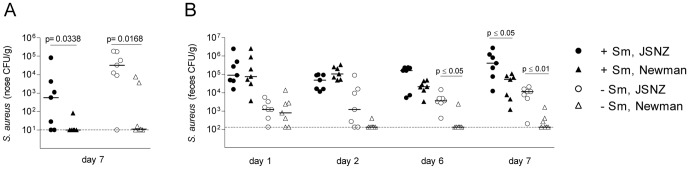
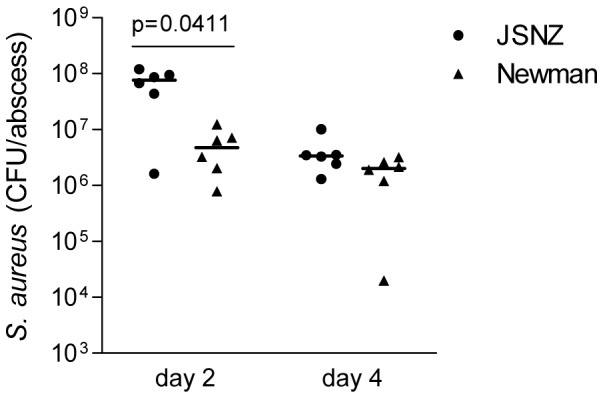
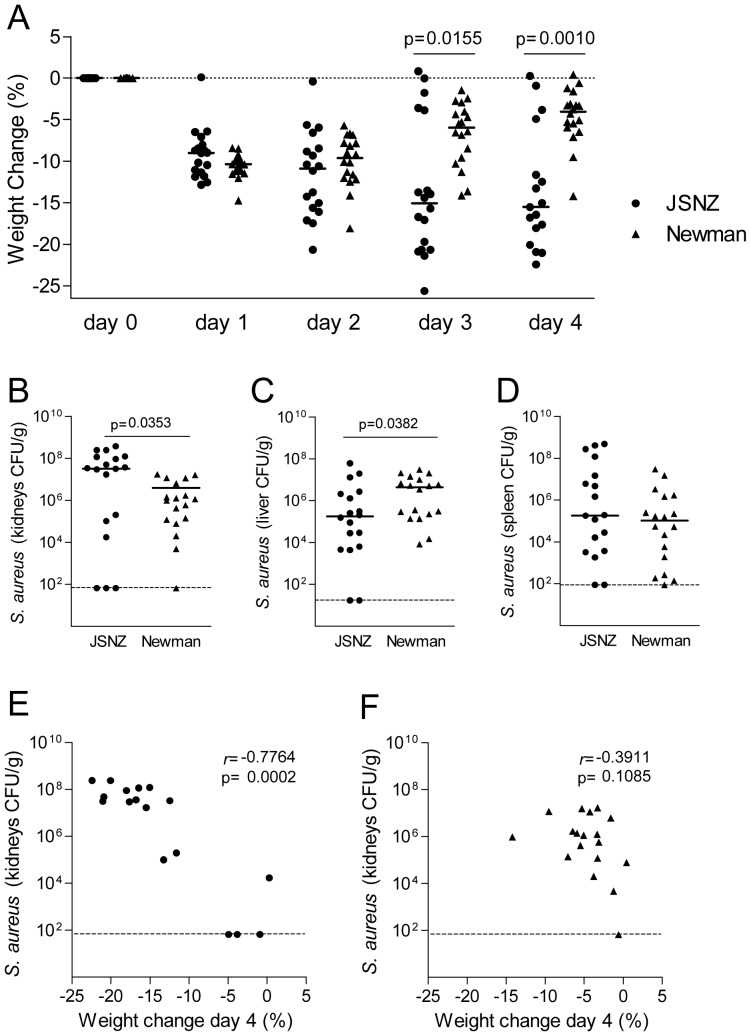
More effective antibiotics and a protective vaccine are desperately needed to combat the 'superbug' Staphylococcus aureus. While in vivo pathogenicity studies routinely involve infection of mice with human S. aureus isolates, recent genetic studies have demonstrated that S. aureus lineages are largely host-specific. The use of such animal-adapted S. aureus strains may therefore be a promising approach for developing more clinically relevant animal infection models. We have isolated a mouse-adapted S. aureus strain (JSNZ) which caused a severe outbreak of preputial gland abscesses among male C57BL/6J mice. We aimed to extensively characterize this strain on a genomic level and determine its virulence potential in murine colonization and infection models. JSNZ belongs to the MLST type ST88, rare among human isolates, and lacks an hlb-converting phage encoding human-specific immune evasion factors. Naive mice were found to be more susceptible to nasal and gastrointestinal colonization with JSNZ than with the human-derived Newman strain. Furthermore, naïve mice required antibiotic pre-treatment to become colonized with Newman. In contrast, JSNZ was able to colonize mice in the absence of antibiotic treatment suggesting that this strain can compete with the natural flora for space and nutrients. In a renal abscess model, JSNZ caused more severe disease than Newman with greater weight loss and bacterial burden. In contrast to most other clinical isolates, JSNZ can also be readily genetically modified by phage transduction and electroporation. In conclusion, the mouse-adapted strain JSNZ may represent a valuable tool for studying aspects of mucosal colonization and for screening novel vaccines and therapies directed at preventing colonization.
更有效的抗生素和保护性疫苗是迫切需要对抗“超级细菌”金黄色葡萄球菌。虽然体内致病性研究通常涉及用人类金黄色葡萄球菌分离株感染小鼠,但最近的遗传研究表明,金黄色葡萄球菌谱系在很大程度上是宿主特异性的。因此,使用这种适应动物的金黄色葡萄球菌菌株可能是开发更具临床相关性的动物感染模型的一种有前途的方法。我们已经分离出一种适应小鼠的金黄色葡萄球菌菌株(JSNZ),该菌株导致雄性 C57BL/6J 小鼠的包皮腺脓肿严重爆发。我们旨在在基因组水平上广泛表征该菌株,并确定其在小鼠定植和感染模型中的毒力潜力。JSNZ 属于 MLST 型 ST88,在人类分离株中很少见,并且缺乏编码人类特异性免疫逃避因子的 hlb 转化噬菌体。与来自人类的 Newman 菌株相比,未经过敏的小鼠更容易被鼻腔和胃肠道定植 JSNZ。此外,未经过敏的小鼠需要抗生素预处理才能用 Newman 定植。相比之下,JSNZ 能够在没有抗生素治疗的情况下定植小鼠,这表明该菌株可以与天然菌群争夺空间和营养。在肾脓肿模型中,JSNZ 比 Newman 引起更严重的疾病,体重减轻和细菌负荷更大。与大多数其他临床分离株不同,JSNZ 还可以通过噬菌体转导和电穿孔进行遗传修饰。总之,适应小鼠的菌株 JSNZ 可能代表研究黏膜定植和筛选针对预防定植的新型疫苗和疗法的有价值工具。