McCarthy Donald A, Ranganathan Aparna, Subbaram Sita, Flaherty Nicole L, Patel Nilay, Trebak Mohamed, Hempel Nadine, Melendez J Andrés
College of Nanoscale Sciences and Engineering, University at Albany, SUNY, Albany, NY 12203, USA.
Redox Biol. 2013 Apr 17;1(1):218-25. doi: 10.1016/j.redox.2013.03.001. eCollection 2013.
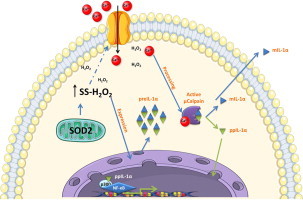
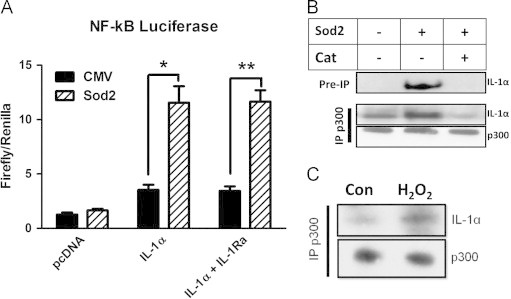
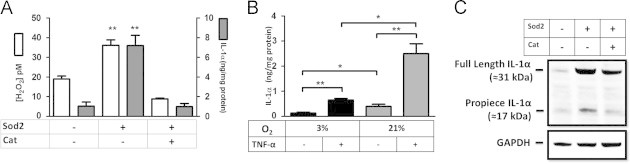
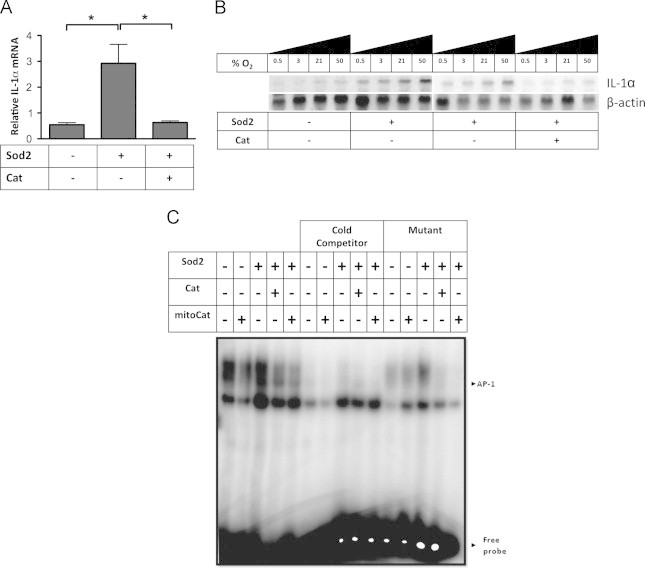
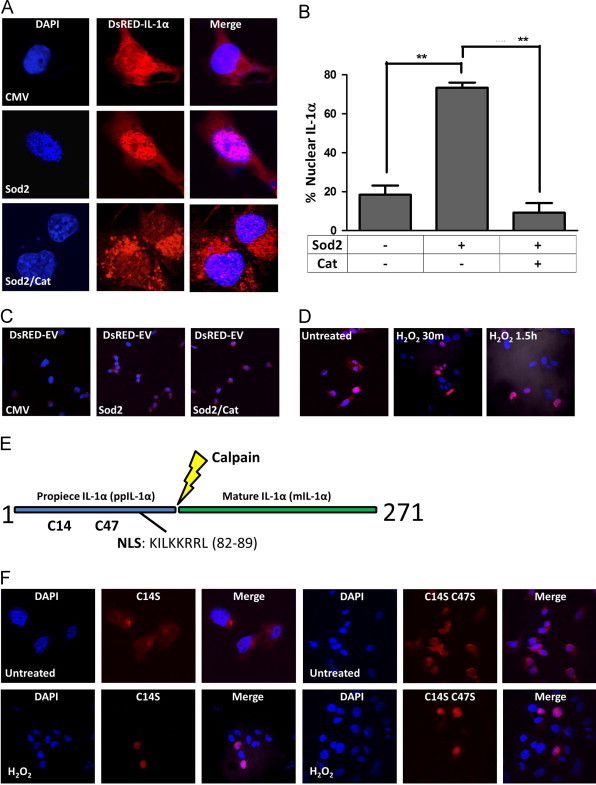
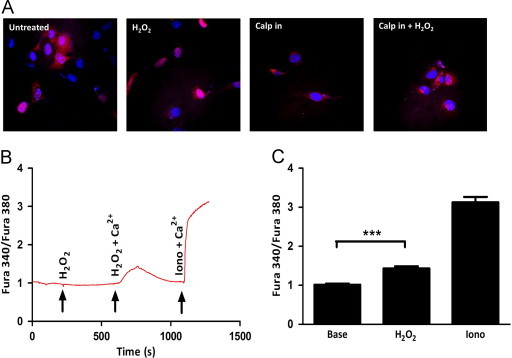
The pro-inflammatory cytokine Interleukin-1α (IL-1α) has recently emerged as a susceptibility marker for a wide array of inflammatory diseases associated with oxidative stress including Alzheimer's, arthritis, atherosclerosis, diabetes and cancer. In the present study, we establish that expression and nuclear localization of IL-1α are redox-dependent. Shifts in steady-state H2O2 concentrations (SS-[H2O2]) resulting from enforced expression of manganese superoxide dismutase (SOD2) drive IL-1α mRNA and protein expression. The redox-dependent expression of IL-1α is accompanied by its increased nuclear localization. Both IL-1α expression and its nuclear residency are abrogated by catalase co-expression. Sub-lethal doses of H2O2 also cause IL-1α nuclear localization. Mutagenesis revealed IL-1α nuclear localization does not involve oxidation of cysteines within its N terminal domain. Inhibition of the processing enzyme calpain prevents IL-1α nuclear localization even in the presence of H2O2. H2O2 treatment caused extracellular Ca(2+) influx suggesting oxidants may influence calpain activity indirectly through extracellular Ca(2+) mobilization. Functionally, as a result of its nuclear activity, IL-1α overexpression promotes NF-kB activity, but also interacts with the histone acetyl transferase (HAT) p300. Together, these findings demonstrate a mechanism by which oxidants impact inflammation through IL-1α and suggest that antioxidant-based therapies may prove useful in limiting inflammatory disease progression.
促炎细胞因子白细胞介素-1α(IL-1α)最近已成为与氧化应激相关的多种炎症性疾病的易感性标志物,这些疾病包括阿尔茨海默病、关节炎、动脉粥样硬化、糖尿病和癌症。在本研究中,我们证实IL-1α的表达和核定位是氧化还原依赖性的。由锰超氧化物歧化酶(SOD2)的强制表达导致的稳态过氧化氢浓度(SS-[H2O2])变化驱动IL-1α mRNA和蛋白质表达。IL-1α的氧化还原依赖性表达伴随着其核定位增加。过氧化氢酶共表达可消除IL-1α的表达及其核定位。亚致死剂量的H2O2也会导致IL-1α核定位。诱变显示IL-1α核定位不涉及其N末端结构域内半胱氨酸的氧化。即使在存在H2O2的情况下,抑制加工酶钙蛋白酶也可防止IL-1α核定位。H2O2处理导致细胞外Ca(2+)内流,表明氧化剂可能通过细胞外Ca(2+)动员间接影响钙蛋白酶活性。在功能上,由于其核活性,IL-1α过表达促进NF-κB活性,但也与组蛋白乙酰转移酶(HAT)p300相互作用。总之,这些发现证明了氧化剂通过IL-1α影响炎症的机制,并表明基于抗氧化剂的疗法可能对限制炎症性疾病进展有用。