Laboratorio de Neuroinmunología, Departamento de Medicina Experimental, Facultad de Medicina, Universidad Nacional Autónoma de México México City, México.
Front Integr Neurosci. 2013 Sep 2;7:64. doi: 10.3389/fnint.2013.00064.
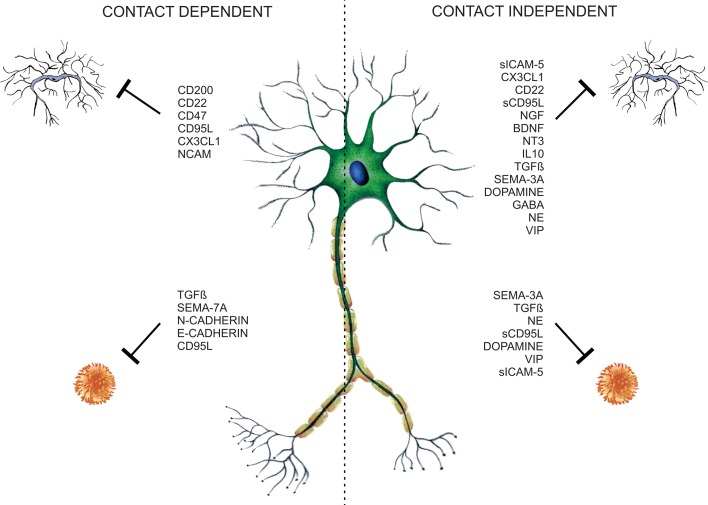
Central nervous system (CNS) has a highly specialized microenvironment, and despite being initially considered an immune privileged site, this immune status is far from absolute because it varies with age and brain topography. The brain monitors immune responses by several means that act in parallel; one pathway involves afferent nerves (vagal nerve) and the other resident cells (neurons and glia). These cell populations exert a strong role in the regulation of the immune system, favoring an immune-modulatory environment in the CNS. Neurons control glial cell and infiltrated T-cells by contact-dependent and -independent mechanisms. Contact-dependent mechanisms are provided by several membrane immune modulating molecules such as Sema-7A, CD95L, CD22, CD200, CD47, NCAM, ICAM-5, and cadherins; which can inhibit the expression of microglial inflammatory cytokines, induce apoptosis or inactivate infiltrated T-cells. On the other hand, soluble neuronal factors like Sema-3A, cytokines, neurotrophins, neuropeptides, and neurotransmitters attenuate microglial and/or T-cell activation. In this review, we focused on all known mechanism driven only by neurons in order to control the local immune cells.
中枢神经系统(CNS)具有高度专业化的微环境,尽管最初被认为是免疫特权部位,但这种免疫状态远非绝对,因为它随年龄和大脑拓扑结构而变化。大脑通过几种并行的方式来监测免疫反应;一种途径涉及传入神经(迷走神经)和其他固有细胞(神经元和神经胶质)。这些细胞群在免疫系统的调节中发挥着重要作用,有利于中枢神经系统中免疫调节环境。神经元通过依赖接触和不依赖接触的机制来控制神经胶质细胞和浸润的 T 细胞。接触依赖机制由几种膜免疫调节分子提供,如 Sema-7A、CD95L、CD22、CD200、CD47、NCAM、ICAM-5 和钙粘蛋白;它们可以抑制小胶质细胞炎症细胞因子的表达,诱导细胞凋亡或使浸润的 T 细胞失活。另一方面,可溶性神经元因子,如 Sema-3A、细胞因子、神经营养因子、神经肽和神经递质,可减轻小胶质细胞和/或 T 细胞的激活。在这篇综述中,我们重点介绍了仅由神经元驱动的所有已知机制,以控制局部免疫细胞。