Department of Psychology, Rutgers, The State University of New Jersey Newark, NJ, USA.
Front Hum Neurosci. 2013 Sep 2;7:518. doi: 10.3389/fnhum.2013.00518. eCollection 2013.
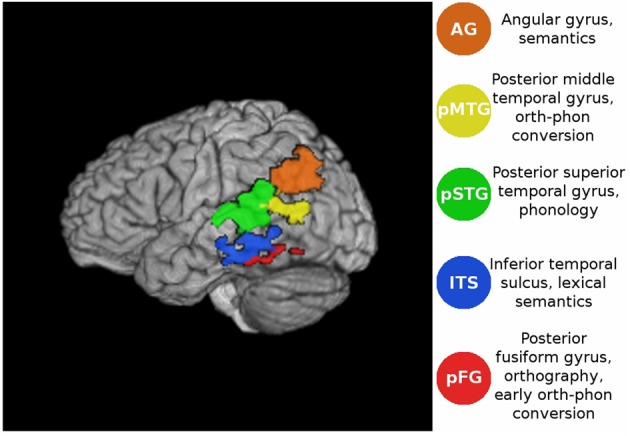
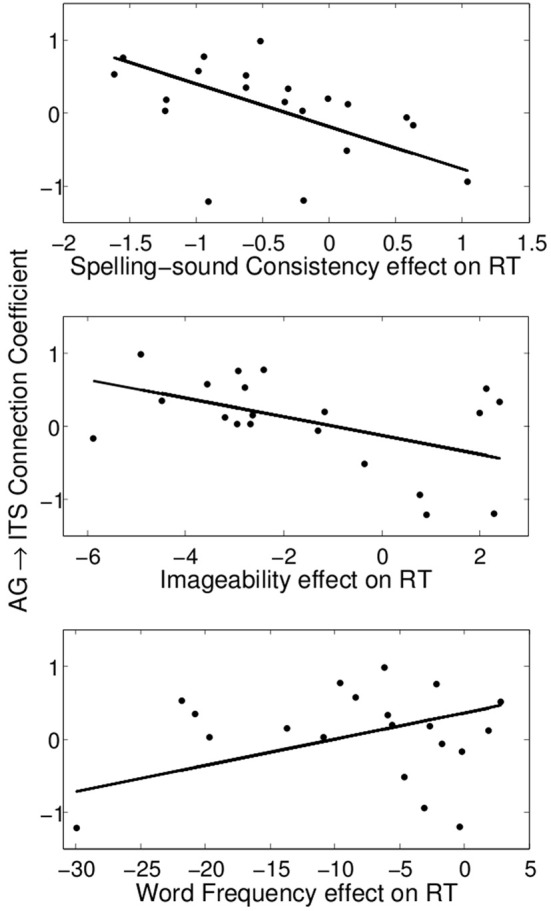
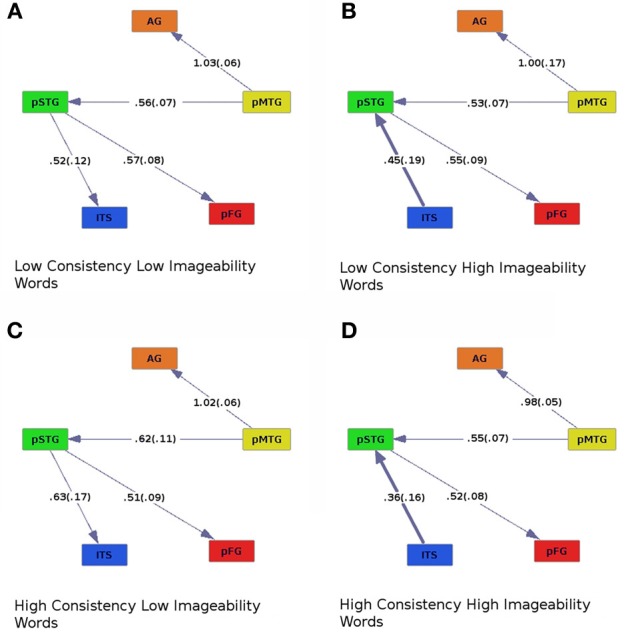
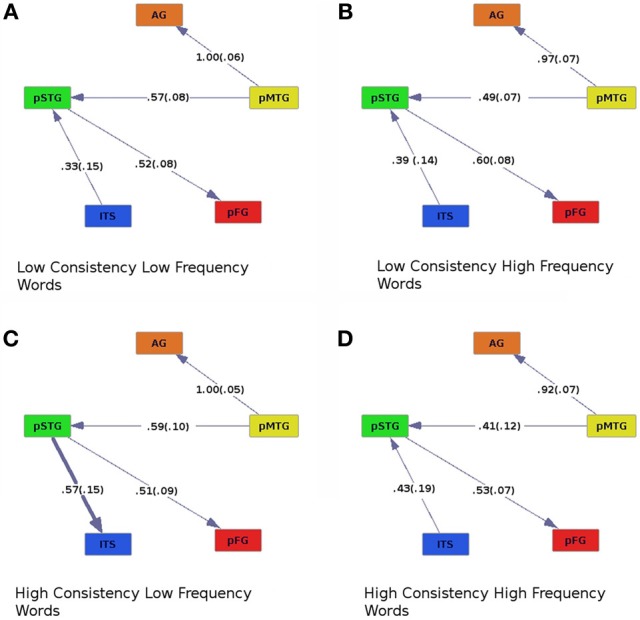
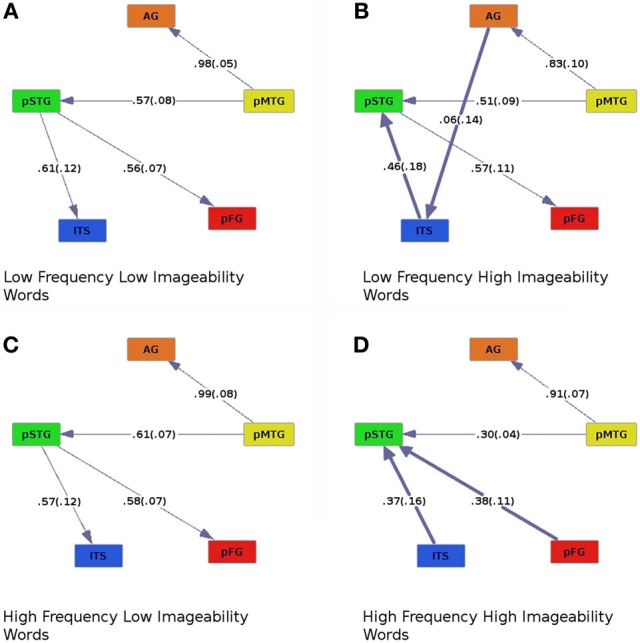
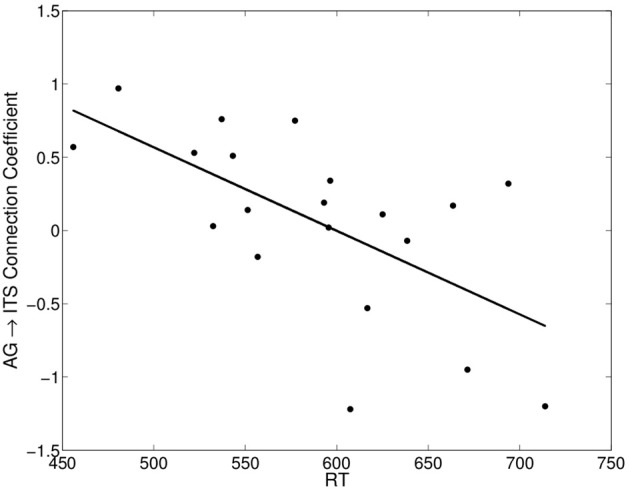
Reading is an essential part of contemporary society, yet much is still unknown about the physiological underpinnings of its information processing components. Two influential cognitive models of reading, the connectionist and dual-route cascaded models, offer very different accounts, yet evidence for one or the other remains equivocal. These models differ in several ways, including the role of semantics (word meaning) in mapping spelling to sound. We used a new effective connectivity algorithm, IMaGES, to provide a network-level perspective on these network-level models. Left hemisphere regions of interest were defined based on main effects in functional magnetic resonance imaging and included two regions linked with semantic processing-angular gyrus (AG) and inferior temporal sulcus (ITS)-and two regions linked with phonological processing-posterior superior temporal gyrus (pSTG) and posterior middle temporal gyrus (pMTG). Participants read aloud words of high or low spelling-sound consistency, word frequency, and imageability. Only the connectionist model predicted increased contributions from semantic areas with those computing phonology for low-consistency words. Effective connectivity analyses revealed that areas supporting semantic processing (e.g., the ITS) interacted with phonological areas (e.g., the pSTG), with the pattern changing as a function of word properties. Connectivity from semantic to phonological areas emerged for high- compared to low-imageability words, and a similar pattern emerged for low-consistency words, though only under certain conditions. Analyses of individual differences also showed that variation in the strength of modulation of ITS by AG was associated with reading aloud performance. Overall, these results suggest that connections with semantic processing areas are not only associated with reading aloud, but that these connections are also associated with optimal reading performance.
阅读是当代社会的重要组成部分,但对于阅读信息处理成分的生理基础,我们仍知之甚少。有两种有影响力的阅读认知模型,即连接主义和双重通路级联模型,它们提供了非常不同的解释,但对于其中一种或另一种模型的证据仍然存在争议。这些模型在几个方面有所不同,包括语义(词义)在将拼写映射到声音中的作用。我们使用了一种新的有效连接算法,即 IMaGES,从网络层面上对这些网络层面的模型进行了研究。左半球感兴趣区是根据功能磁共振成像中的主要效应来定义的,包括两个与语义处理相关的区域——角回(AG)和颞下回(ITS),以及两个与语音处理相关的区域——后上颞回(pSTG)和后中颞回(pMTG)。参与者大声朗读高或低拼写-发音一致性、词频和可成像性的单词。只有连接主义模型预测,对于低一致性单词,语义区域对语音的贡献会增加。有效的连接分析显示,支持语义处理的区域(如 ITS)与支持语音处理的区域(如 pSTG)相互作用,这种模式随着单词属性的变化而变化。与低可成像性的单词相比,高可成像性的单词与语义区域到语音区域的连接出现,对于低一致性的单词也出现了类似的模式,但仅在某些条件下出现。个体差异分析还表明,AG 对 ITS 的调制强度变化与朗读表现有关。总的来说,这些结果表明,与语义处理区域的连接不仅与朗读有关,而且与最佳阅读表现有关。