Juarez Deborah T, Tan Candace, Davis James W, Mau Marjorie M
College of Pharmacy, University of Hawaii, Hilo, HI, USA.
Am J Health Behav. 2014 Jan;38(1):53-62. doi: 10.5993/AJHB.38.1.6.
To examine racial/ethnic disparities in medication adherence between Asian and Pacific Islander Americans and Whites.
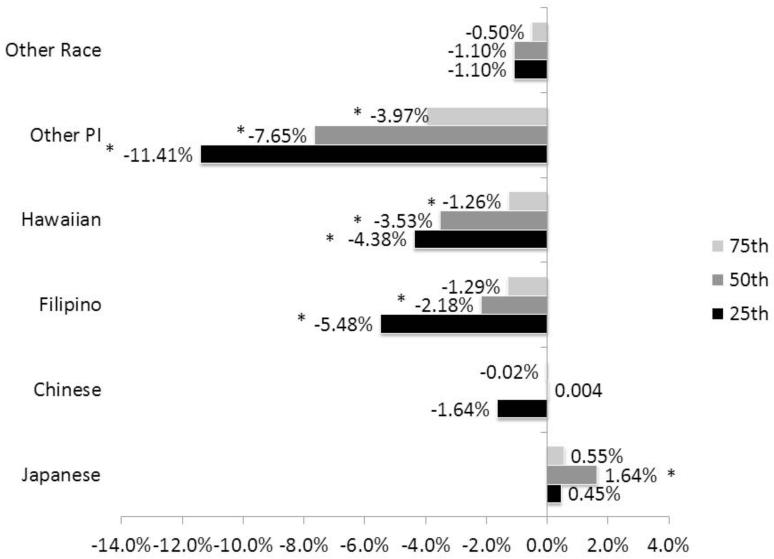
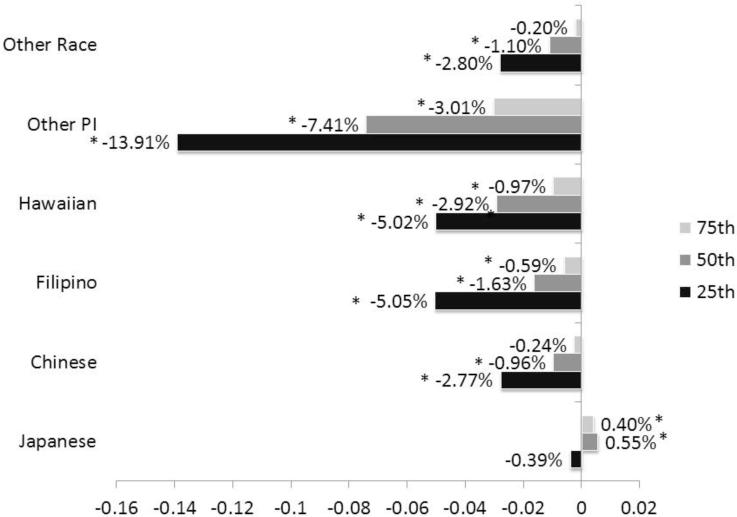
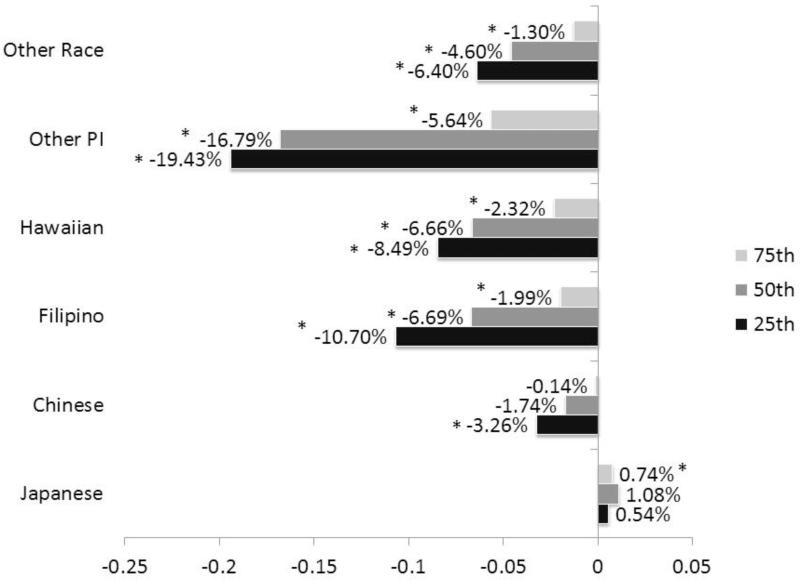
This retrospective data analysis included diabetes patients enrolled in a health plan in Hawaii (N = 43,445). For anti-diabetic, lipid-lowering, and anti-hypertensive medications, quantile regression was estimated at 25(th), 50(th), and 75(th) quantiles to examine the association with race and ethnicity, controlling for other patient characteristics.
Consistently, Filipinos, Native Hawaiians, and other Pacific Islanders were significantly less adherent than Whites. The greatest disparities were found for other Pacific Islanders using lipid-lowering medications, with adjusted differences in medication adherence, with reductions relative to Whites of as much as 19% for lipid-lowering medications for the 25(th) quantile of adherence.
Whereas the large sample size undoubtedly contributed to the statistical significance, the large magnitude of the disparities, particularly for Filipinos, Native Hawaiians, and other Pacific Islanders, which suggests that these are meaningful differences that need to be addressed. The largest disparities were found at the lowest quantile suggests that they may be occurring among the most vulnerable populations with potentially poor access to care.
研究亚裔和太平洋岛民美国人与白人在药物依从性方面的种族/族裔差异。
这项回顾性数据分析纳入了夏威夷一个健康计划中的糖尿病患者(N = 43445)。对于抗糖尿病、降脂和抗高血压药物,在第25、50和75百分位数处估计分位数回归,以研究与种族和族裔的关联,并控制其他患者特征。
菲律宾人、夏威夷原住民和其他太平洋岛民的依从性始终显著低于白人。在使用降脂药物的其他太平洋岛民中发现了最大的差异,在药物依从性方面存在调整后的差异,在依从性第25百分位数处,降脂药物相对于白人的减少幅度高达19%。
虽然样本量大无疑有助于统计学显著性,但差异幅度大,特别是对于菲律宾人、夏威夷原住民和其他太平洋岛民,这表明这些是需要解决的有意义的差异。在最低百分位数处发现的最大差异表明,这些差异可能发生在获得医疗服务机会可能较差的最脆弱人群中。