Centre for Regenerative Medicine, Institute of Inflammation and Repair, Faculty of Medical and Human Sciences, The University of Manchester, Manchester, United Kingdom.
PLoS One. 2013 Sep 5;8(9):e72994. doi: 10.1371/journal.pone.0072994. eCollection 2013.
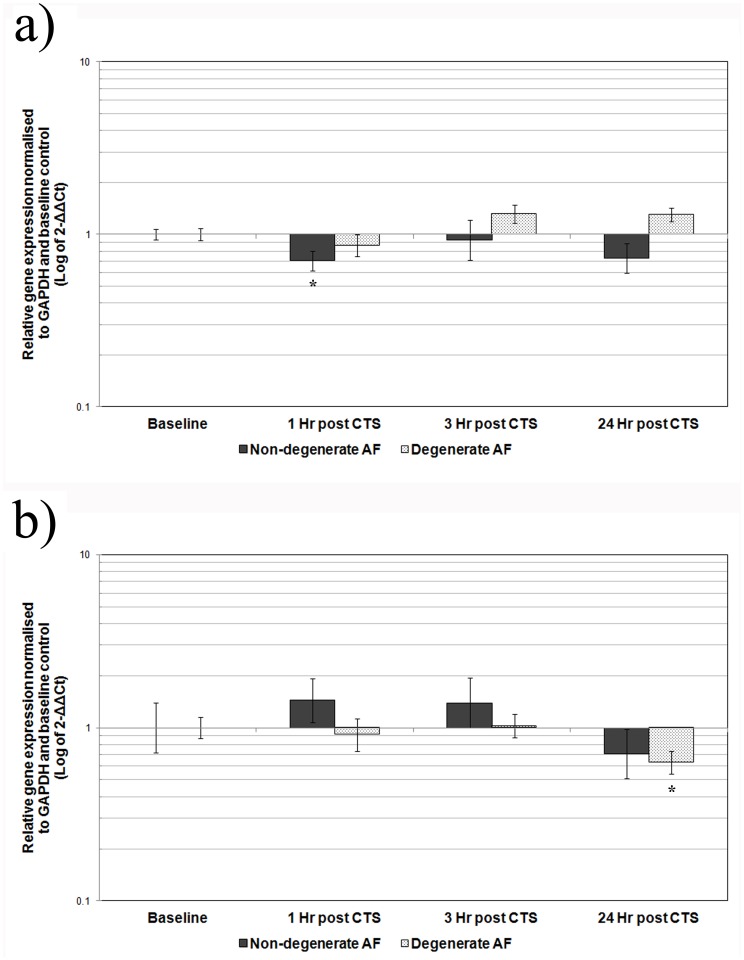
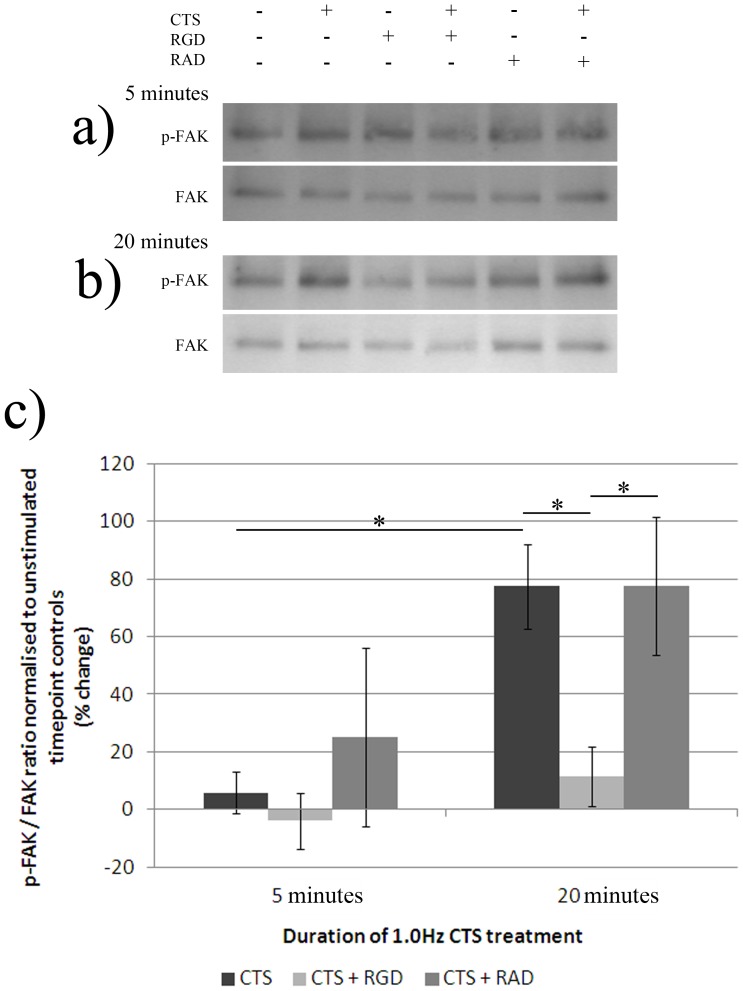
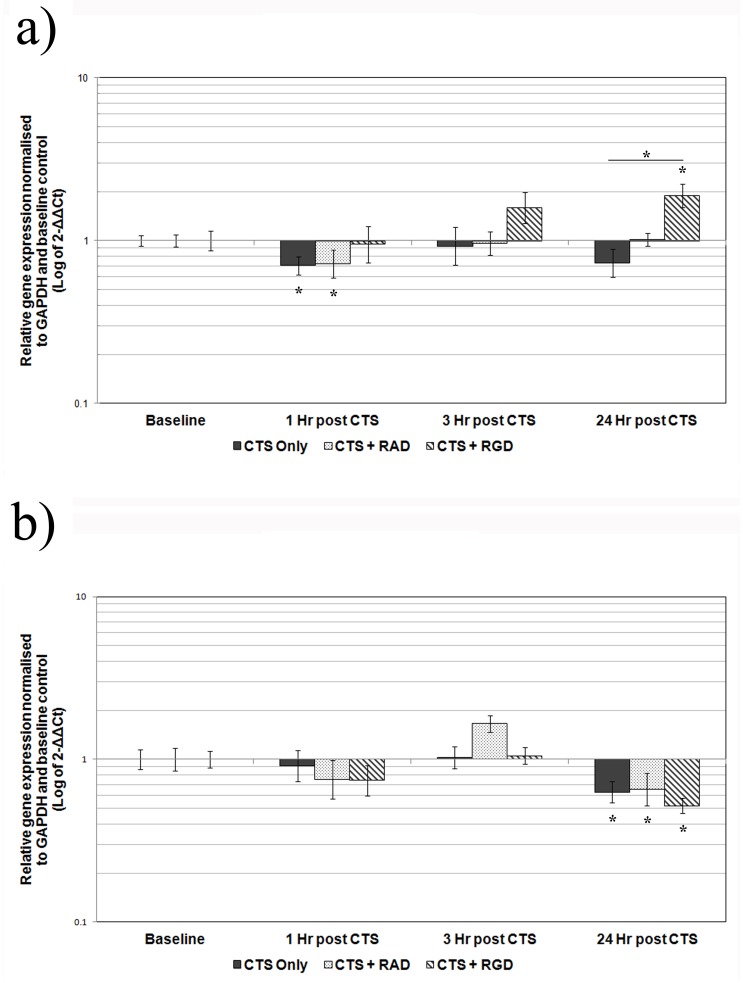
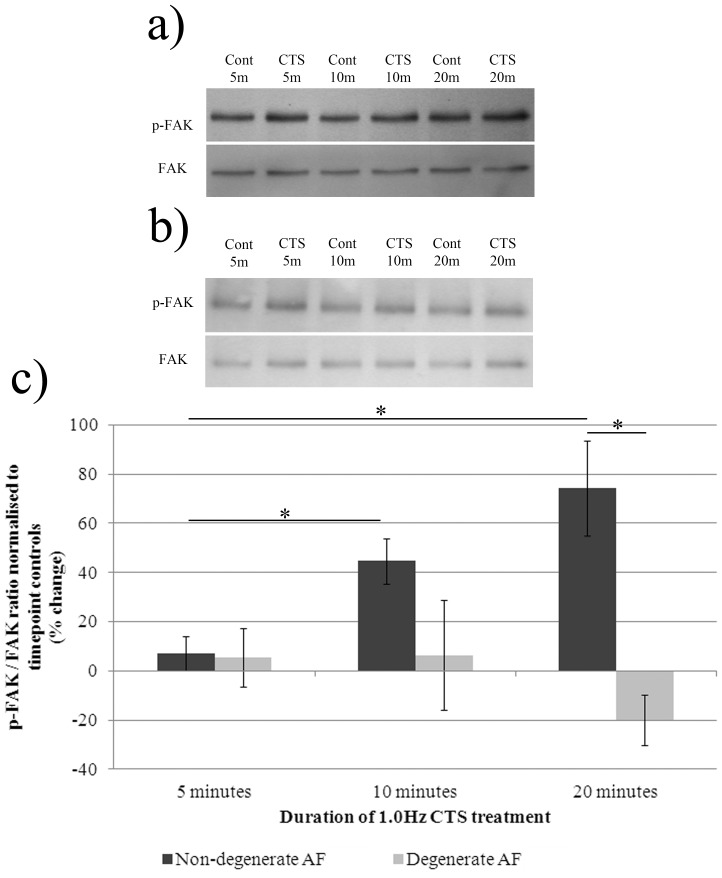
Intervertebral disc (IVD) cells derived from degenerate tissue respond aberrantly to mechanical stimuli, potentially due to altered mechanotransduction pathways. Elucidation of the altered, or alternative, mechanotransduction pathways operating with degeneration could yield novel targets for the treatment of IVD disease. Our aim here was to investigate the involvement of RGD-recognising integrins and associated signalling molecules in the response to cyclic tensile strain (CTS) of human annulus fibrosus (AF) cells derived from non-degenerate and degenerate IVDs. AF cells from non-degenerate and degenerate human IVDs were cyclically strained with and without function blocking RGD - peptides with 10% strain, 1.0 Hz for 20 minutes using a Flexercell® strain device. QRT-PCR and Western blotting were performed to analyse gene expression of type I collagen and ADAMTS -4, and phosphorylation of focal adhesion kinase (FAK), respectively. The response to 1.0 Hz CTS differed between the two groups of AF cells, with decreased ADAMTS -4 gene expression and decreased type I collagen gene expression post load in AF cells derived from non-degenerate and degenerate IVDs, respectively. Pre-treatment of non-degenerate AF cells with RGD peptides prevented the CTS-induced decrease in ADAMTS -4 gene expression, but caused an increase in expression at 24 hours, a response not observed in degenerate AF cells where RGD pre-treatment failed to inhibit the mechano-response. In addition, FAK phosphorylation increased in CTS stimulated AF cells derived from non-degenerate, but not degenerate IVDs, with RGD pre-treatment inhibiting the CTS - dependent increase in phosphorylated FAK. Our findings suggest that RGD -integrins are involved in the 1.0 Hz CTS - induced mechano-response observed in AF cells derived from non-degenerate, but not degenerate IVDs. This data supports our previous work, suggesting an alternative mechanotransduction pathway may be operating in degenerate AF cells.
椎间盘(IVD)细胞来源于退变组织,对机械刺激的反应异常,这可能是由于机械转导途径改变所致。阐明退变过程中发生改变或替代的机械转导途径,可为治疗 IVD 疾病提供新的靶点。本研究旨在探讨 RGDR 识别整合素及其相关信号分子在非退变和退变椎间盘来源的人纤维环(AF)细胞对循环拉伸应变(CTS)反应中的作用。使用 Flexercell®应变装置,以 10%应变、1.0 Hz 的频率对非退变和退变人椎间盘来源的 AF 细胞进行 20 分钟的周期性应变,同时施加或不施加功能阻断 RGDR 肽。采用 QRT-PCR 和 Western blot 分析 I 型胶原和 ADAMTS-4 的基因表达以及粘着斑激酶(FAK)的磷酸化情况。两种 AF 细胞对 1.0 Hz CTS 的反应不同,非退变和退变 IVD 来源的 AF 细胞在加载后 ADAMTS-4 基因表达降低,I 型胶原基因表达降低。非退变 AF 细胞用 RGDR 肽预处理可防止 CTS 诱导的 ADAMTS-4 基因表达降低,但在 24 小时时引起表达增加,而在退变 AF 细胞中未观察到这种反应,RGDR 预处理不能抑制机械反应。此外,在非退变来源的 CTS 刺激的 AF 细胞中,FAK 磷酸化增加,但在退变来源的 AF 细胞中未观察到这种增加,而 RGDR 预处理抑制了 CTS 依赖性的磷酸化 FAK 增加。我们的研究结果表明,RGDR-整合素参与了非退变来源的 AF 细胞中观察到的 1.0 Hz CTS 诱导的机械反应,但不参与退变来源的 AF 细胞中的机械反应。这一数据支持了我们之前的工作,表明替代的机械转导途径可能在退变的 AF 细胞中发挥作用。