Molecular Methods and Subtyping Branch, Division of Microbiology, Office of Regulatory Science, Center for Food Safety and Applied Nutrition, United States Food and Drug Administration, College Park, Maryland, United States of America.
PLoS One. 2013 Sep 9;8(9):e73079. doi: 10.1371/journal.pone.0073079. eCollection 2013.
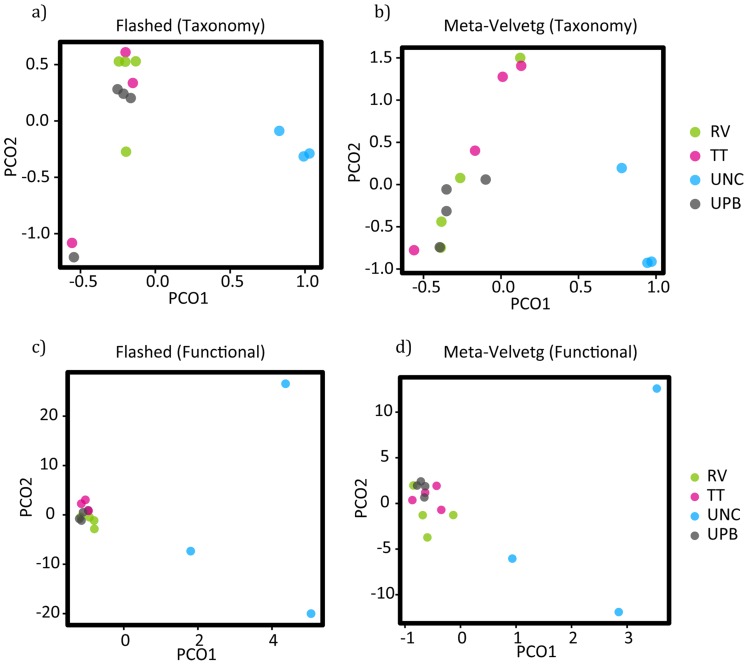
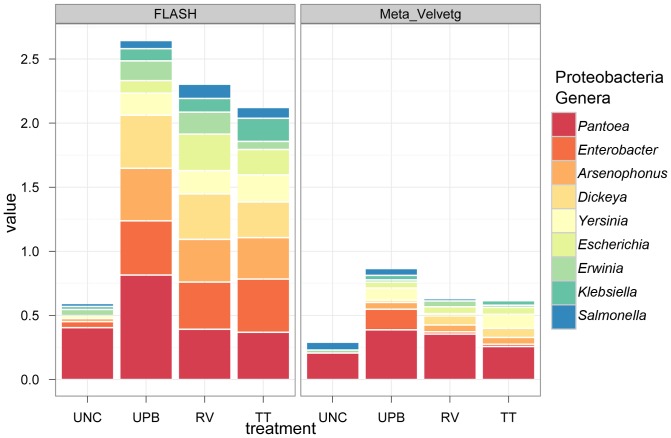
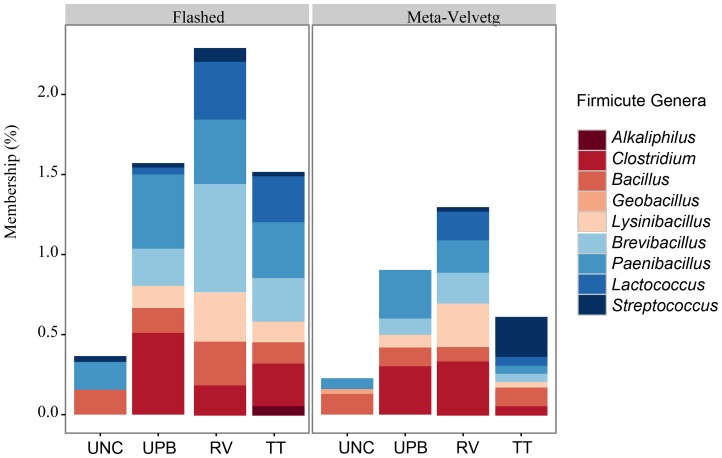
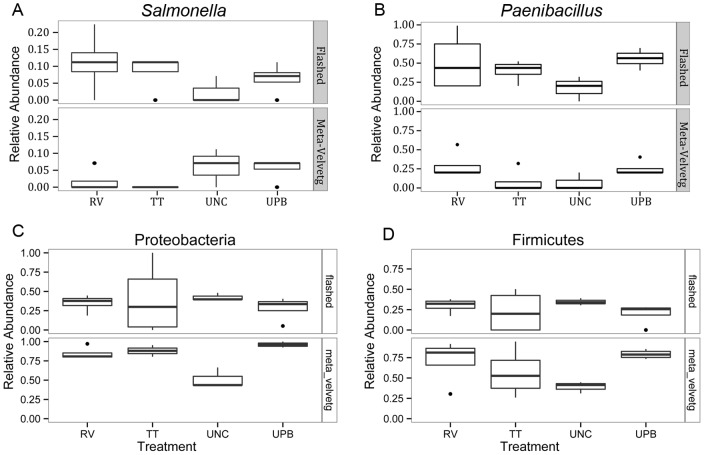
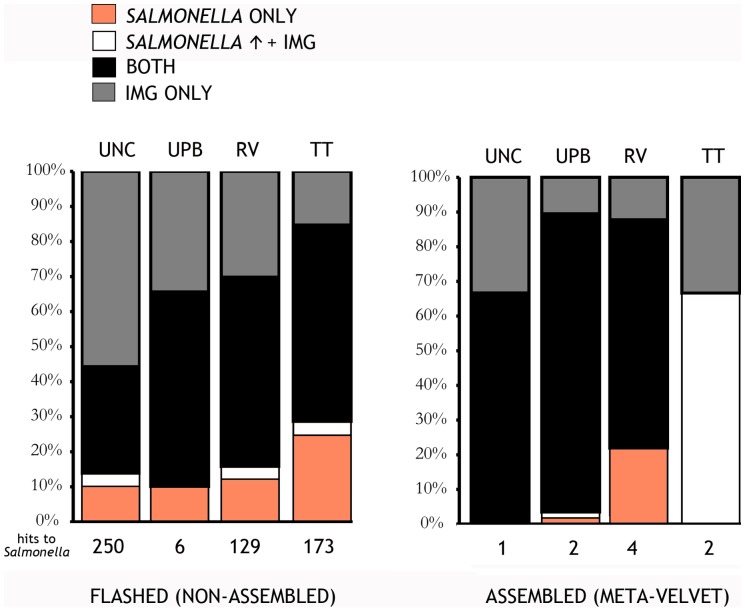
The ability to detect a specific organism from a complex environment is vitally important to many fields of public health, including food safety. For example, tomatoes have been implicated numerous times as vehicles of foodborne outbreaks due to strains of Salmonella but few studies have ever recovered Salmonella from a tomato phyllosphere environment. Precision of culturing techniques that target agents associated with outbreaks depend on numerous factors. One important factor to better understand is which species co-enrich during enrichment procedures and how microbial dynamics may impede or enhance detection of target pathogens. We used a shotgun sequence approach to describe taxa associated with samples pre-enrichment and throughout the enrichment steps of the Bacteriological Analytical Manual's (BAM) protocol for detection of Salmonella from environmental tomato samples. Recent work has shown that during efforts to enrich Salmonella (Proteobacteria) from tomato field samples, Firmicute genera are also co-enriched and at least one co-enriching Firmicute genus (Paenibacillus sp.) can inhibit and even kills strains of Salmonella. Here we provide a baseline description of microflora that co-culture during detection efforts and the utility of a bioinformatic approach to detect specific taxa from metagenomic sequence data. We observed that uncultured samples clustered together with distinct taxonomic profiles relative to the three cultured treatments (Universal Pre-enrichment broth (UPB), Tetrathionate (TT), and Rappaport-Vassiliadis (RV)). There was little consistency among samples exposed to the same culturing medias, suggesting significant microbial differences in starting matrices or stochasticity associated with enrichment processes. Interestingly, Paenibacillus sp. (Salmonella inhibitor) was significantly enriched from uncultured to cultured (UPB) samples. Also of interest was the sequence based identification of a number of sequences as Salmonella despite indication by all media, that samples were culture negative for Salmonella. Our results substantiate the nascent utility of metagenomic methods to improve both biological and bioinformatic pathogen detection methods.
从复杂环境中检测特定生物体对于公共卫生的许多领域都至关重要,包括食品安全。例如,由于沙门氏菌的存在,番茄多次被牵连为食源性疾病爆发的载体,但很少有研究从番茄叶际环境中回收过沙门氏菌。针对与爆发相关的病原体的培养技术的精确性取决于许多因素。一个重要的因素是,要更好地了解哪些物种在富集过程中共同富集,以及微生物动态如何阻碍或增强对目标病原体的检测。我们使用鸟枪法测序方法来描述与样品预富集以及整个富集步骤相关的分类群,这些步骤是根据《细菌分析手册》(BAM)的方案检测环境番茄样品中的沙门氏菌。最近的研究表明,在从番茄田间样本中富集沙门氏菌(变形菌门)的过程中,厚壁菌门的属也同时被富集,至少有一个共同富集的厚壁菌门属(芽孢杆菌属)可以抑制甚至杀死沙门氏菌的菌株。在这里,我们提供了在检测过程中共同培养的微生物区系的基线描述,以及从宏基因组序列数据中检测特定分类群的生物信息学方法的实用性。我们观察到,与三个培养处理(通用预富集肉汤(UPB)、四硫代硫酸盐(TT)和雷氏盐(RV))相比,未培养的样品聚类在一起,具有独特的分类特征。暴露于相同培养介质的样品之间几乎没有一致性,这表明起始基质中存在显著的微生物差异或与富集过程相关的随机性。有趣的是,芽孢杆菌属(沙门氏菌抑制剂)从未培养到培养(UPB)样品中显著富集。同样有趣的是,尽管所有培养基均指示样品对沙门氏菌培养呈阴性,但基于序列的鉴定方法鉴定出了许多序列为沙门氏菌。我们的结果证实了宏基因组方法在提高生物和生物信息学病原体检测方法方面的新兴实用性。