Daquigan Ninalynn, Grim Christopher J, White James R, Hanes Darcy E, Jarvis Karen G
Office of Applied Research and Safety Assessment, Center for Food Safety and Applied Nutrition, U.S. Food and Drug AdministrationLaurel, MD, USA; Oak Ridge Institute for Science and TechnologyOak Ridge, TN, USA.
Office of Applied Research and Safety Assessment, Center for Food Safety and Applied Nutrition, U.S. Food and Drug Administration Laurel, MD, USA.
Front Microbiol. 2016 Dec 27;7:2103. doi: 10.3389/fmicb.2016.02103. eCollection 2016.
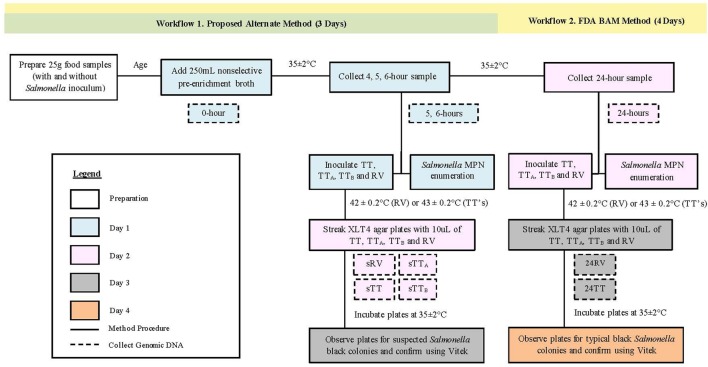
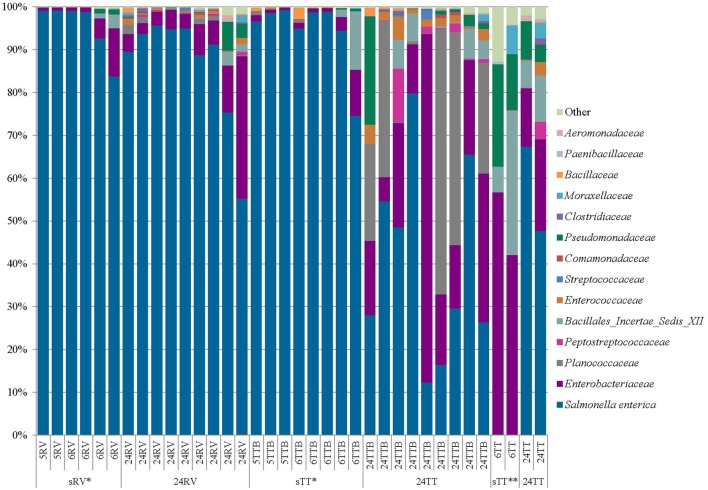
Culture based methods are commonly employed to detect pathogens in food and environmental samples. These methods are time consuming and complex, requiring multiple non-selective and selective enrichment broths, and usually take at least 1 week to recover and identify pathogens. Improving pathogen detection in foods is a primary goal for regulatory agencies and industry. detection in food relies on a series of culture steps in broth formulations optimized to resuscitate and reduce the abundance of competitive bacteria. Examples of non-selective pre-enrichment broths used to isolate from food include Lactose, Universal Pre-enrichment, BPW, and Trypticase Soy broths. Tetrathionate (TT) and Rappaport-Vassiliadis (RV) broths are employed after a 24-h non-selective enrichment to select for and hamper the growth of competitive bacteria. In this study, we tested a new formulation of TT broth that lacks brilliant green dye and has lower levels of TT . We employed this TT broth formulation in conjunction with a 6-h non-selective pre-enrichment period and determined that recovery was possible one day earlier than standard food culture methods. We tested the shortened culture method in different non-selective enrichment broths, enumerated in the non-selective enrichments, and used 16S rRNA gene sequencing to determine the proportional abundances of in the TT and RV selective enrichments. Together these data revealed that a 6-h non-selective pre-enrichment reduces the levels of competitive bacteria inoculated into the selective TT and RV broths, enabling the recovery of 1 day earlier than standard culture enrichment methods.
基于培养的方法通常用于检测食品和环境样本中的病原体。这些方法耗时且复杂,需要多种非选择性和选择性增菌肉汤,通常至少需要1周时间来复苏和鉴定病原体。改善食品中病原体的检测是监管机构和食品行业的首要目标。食品中的检测依赖于肉汤配方中的一系列培养步骤,这些步骤经过优化以复苏并降低竞争性细菌的数量。用于从食品中分离的非选择性预增菌肉汤的例子包括乳糖肉汤、通用预增菌肉汤、缓冲蛋白胨水和胰蛋白胨大豆肉汤。在24小时非选择性增菌后,使用四硫磺酸盐(TT)肉汤和Rappaport-Vassiliadis(RV)肉汤来选择并抑制竞争性细菌的生长。在本研究中,我们测试了一种新配方的TT肉汤,该肉汤不含亮绿染料且TT含量较低。我们将这种TT肉汤配方与6小时的非选择性预增菌期结合使用,并确定与标准食品培养方法相比,可以提前一天实现复苏。我们在不同的非选择性增菌肉汤中测试了这种缩短的培养方法,对非选择性增菌中的进行计数,并使用16S rRNA基因测序来确定在TT和RV选择性增菌中的相对丰度。这些数据共同表明,6小时的非选择性预增菌降低了接种到选择性TT和RV肉汤中的竞争性细菌的数量,使得比标准培养增菌方法提前一天实现复苏。