Unidad de Genética Molecular, Hospital Universitario Ramón y Cajal, Instituto Ramón y Cajal de Investigación Sanitaria (IRYCIS), Madrid, Spain ; Centro de Investigación Biomédica en Red de Enfermedades Raras (CIBERER), Madrid, Spain.
PLoS One. 2013 Sep 6;8(9):e73566. doi: 10.1371/journal.pone.0073566. eCollection 2013.
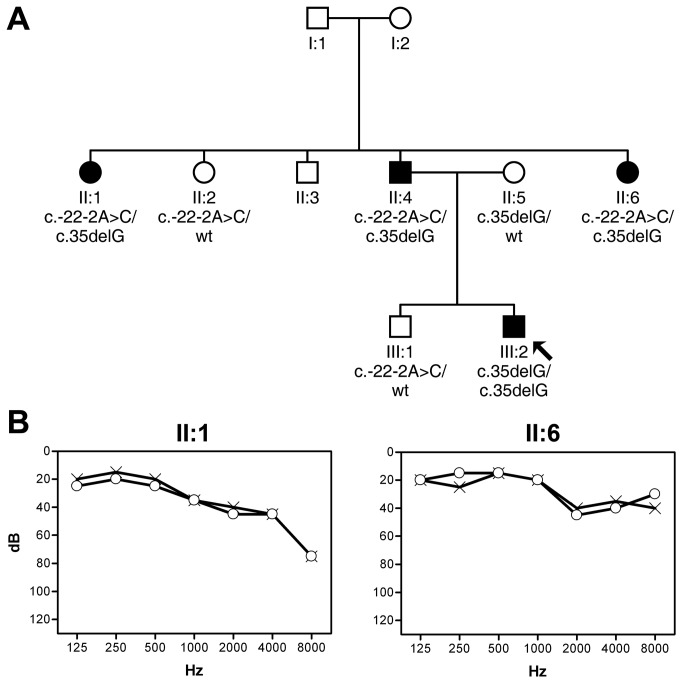
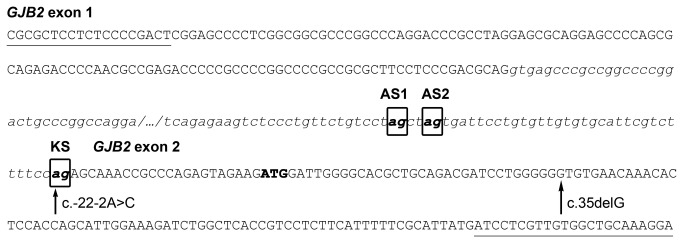
The DFNB1 subtype of autosomal recessive, nonsyndromic hearing impairment, caused by mutations affecting the GJB2 (connexin-26) [corrected] gene, is highly prevalent in most populations worldwide. DFNB1 hearing impairment is mostly severe or profound and usually appears before the acquisition of speech (prelingual onset), though a small number of hypomorphic missense mutations result in mild or moderate deafness of postlingual onset. We identified a novel GJB2 splice-site mutation, c. -22-2A>C, in three siblings with mild postlingual hearing impairment that were compound heterozygous for c. -22-2A>C and c.35delG. Reverse transcriptase-PCR experiments performed on total RNA extracted from saliva samples from one of these siblings confirmed that c. -22-2A>C abolished the acceptor splice site of the single GJB2 intron, resulting in the absence of normally processed transcripts from this allele. However, we did isolate transcripts from the c. -22-2A>C allele that keep an intact GJB2 coding region and that were generated by use of an alternative acceptor splice site previously unknown. The residual expression of wild-type connexin-26 [corrected] encoded by these transcripts probably underlies the mild severity and late onset of the hearing impairment of these subjects.
常染色体隐性遗传非综合征型听力损失的 DFNB1 亚型,由影响 GJB2(连接蛋白 26)[校正]基因的突变引起,在世界大多数人群中高度流行。DFNB1 听力损失大多为重度或极重度,通常在言语习得之前出现(语前发病),尽管少数低功能错义突变导致语后发病的轻度或中度耳聋。我们在 3 名具有轻度语后听力损失的兄弟姐妹中发现了一种新的 GJB2 剪接位点突变 c.-22-2A>C,他们是 c.-22-2A>C 和 c.35delG 的复合杂合子。对其中一位兄弟姐妹唾液样本总 RNA 进行的逆转录 PCR 实验证实,c.-22-2A>C 消除了单个 GJB2 内含子的受体剪接位点,导致该等位基因中正常加工的转录本缺失。然而,我们确实从 c.-22-2A>C 等位基因中分离出了保留完整 GJB2 编码区的转录本,这些转录本是通过使用以前未知的替代受体剪接位点产生的。这些转录本编码的野生型连接蛋白 26[校正]的残留表达可能是这些受试者听力损失程度较轻和发病较晚的原因。