Department of Radiology, Southwest Hospital, Third Military Medical University, Chongqing, China.
PLoS One. 2013 Sep 9;8(9):e73626. doi: 10.1371/journal.pone.0073626. eCollection 2013.
Susceptibility-weighted imaging (SWI) has been proven to be superior to T2*-weighted imaging and also other existing magnetic resonance imaging (MRI) techniques for the detection of iron content and hemorrhage in the brain. The purpose of this study was to compare SWI with T1WI, T2WI and T2*WI in detecting splenic siderotic lesions.
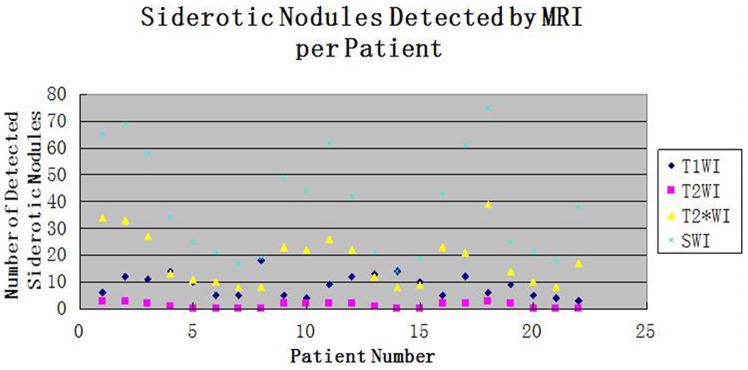
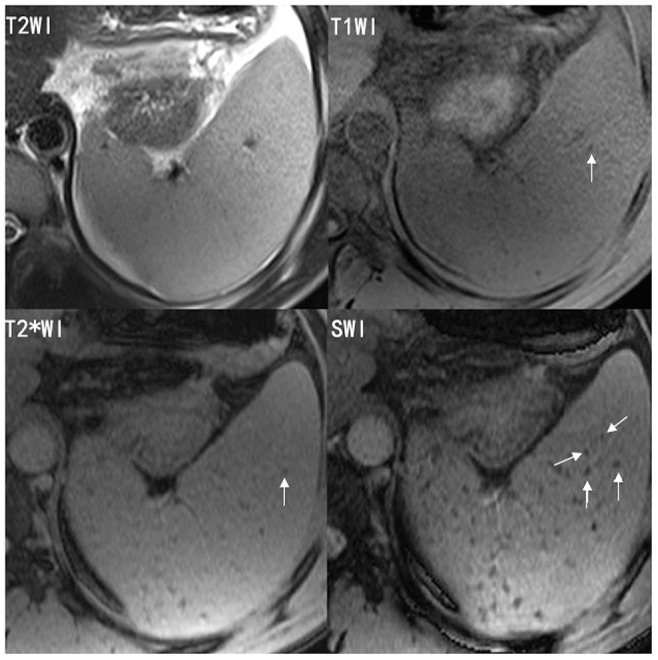
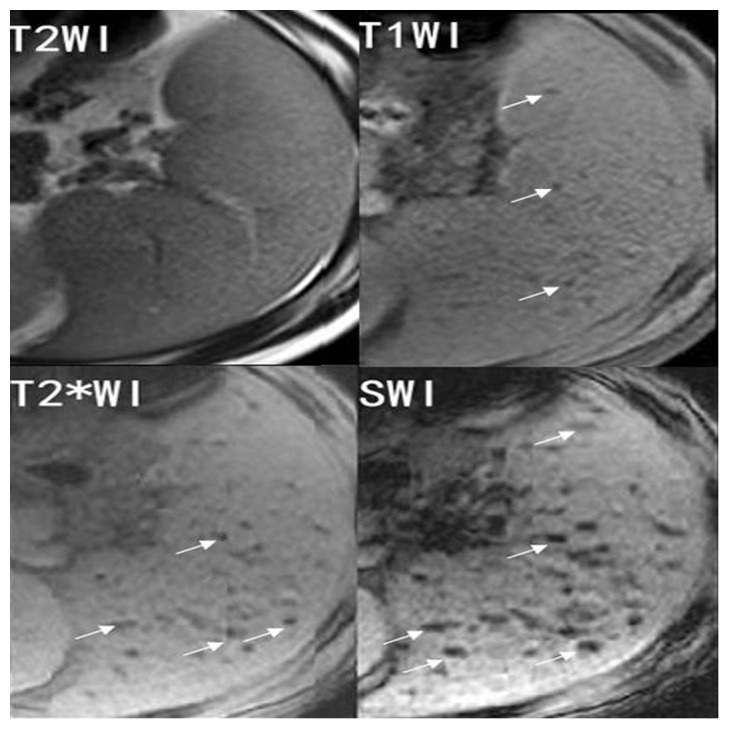
METHODOLOGY/PRINCIPAL FINDINGS: Twenty-two patients with splenic siderotic nodule were imaged with non-contrast MRI T1WI, T2WI, T2WI and SWI at 3.0 Tesla. Imaging data were independently analyzed by two experienced radiologists. The number of splenic siderotic nodules was counted, and the size (largest diameter) was measured. The conspicuity was calculated as the nodule to background parenchyma intensity ratio. We found that SWI detected a larger average number of splenic siderotic nodules than T1WI, T2WI, or T2WI (all P<0.05). The average size of the nodules detected by SWI was larger than that of those detected by T1WI, T2WI or T2*WI (all P<0.05). SWI provided superior contrast and visibility for splenic siderotic nodules compared to any other sequence (all P<0.001).
SWI may be a better detection scheme for splenic siderotic nodules than T1WI, T2WI and T2*WI.
顺磁加权成像(SWI)已被证明在检测脑内铁含量和出血方面优于 T2*-加权成像和其他现有的磁共振成像(MRI)技术。本研究的目的是比较 SWI 与 T1WI、T2WI 和 T2*WI 在检测脾脏铁质病变中的应用。
方法/主要发现:22 例脾脏铁质结节患者在 3.0T 场强下进行非对比 MRI T1WI、T2WI、T2WI 和 SWI 扫描。两名有经验的放射科医生独立分析影像学数据。计算脾脏铁质结节的数量,并测量其大小(最大直径)。将对比噪声比作为结节与背景实质的强度比进行计算。我们发现 SWI 比 T1WI、T2WI 或 T2WI 检测到更多的脾脏铁质结节(均 P<0.05)。SWI 检测到的结节平均大小大于 T1WI、T2WI 或 T2*WI 检测到的结节(均 P<0.05)。与任何其他序列相比,SWI 为脾脏铁质结节提供了更好的对比度和可视性(均 P<0.001)。
SWI 可能是一种比 T1WI、T2WI 和 T2*WI 更好的脾脏铁质结节检测方案。