• 文献检索
  • 文档翻译
  • 深度研究
  • 学术资讯
  • Suppr Zotero 插件Zotero 插件
  • 邀请有礼
  • 套餐&价格
  • 历史记录
应用&插件
Suppr Zotero 插件Zotero 插件浏览器插件Mac 客户端Windows 客户端微信小程序
定价
高级版会员购买积分包购买API积分包
服务
文献检索文档翻译深度研究API 文档MCP 服务
关于我们
关于 Suppr公司介绍联系我们用户协议隐私条款
关注我们

Suppr 超能文献

核心技术专利:CN118964589B侵权必究
粤ICP备2023148730 号-1Suppr @ 2026

文献检索

告别复杂PubMed语法,用中文像聊天一样搜索,搜遍4000万医学文献。AI智能推荐,让科研检索更轻松。

立即免费搜索

文件翻译

保留排版,准确专业,支持PDF/Word/PPT等文件格式,支持 12+语言互译。

免费翻译文档

深度研究

AI帮你快速写综述,25分钟生成高质量综述,智能提取关键信息,辅助科研写作。

立即免费体验

给予 E2 和 NS1 siRNA 可抑制体外的基孔肯雅病毒复制,并保护感染该病毒的小鼠。

Administration of E2 and NS1 siRNAs inhibit chikungunya virus replication in vitro and protects mice infected with the virus.

机构信息

National Institute of Virology, Microbial Containment Complex, Sus Road, Pashan, Pune, India.

出版信息

PLoS Negl Trop Dis. 2013 Sep 5;7(9):e2405. doi: 10.1371/journal.pntd.0002405. eCollection 2013.

DOI:10.1371/journal.pntd.0002405
PMID:24040429
原文链接:https://pmc.ncbi.nlm.nih.gov/articles/PMC3764232/
Abstract

BACKGROUND

Chikungunya virus (CHIKV) has reemerged as a life threatening pathogen and caused large epidemics in several countries. So far, no licensed vaccine or effective antivirals are available and the treatment remains symptomatic. In this context, development of effective and safe prophylactics and therapeutics assumes priority.

METHODS

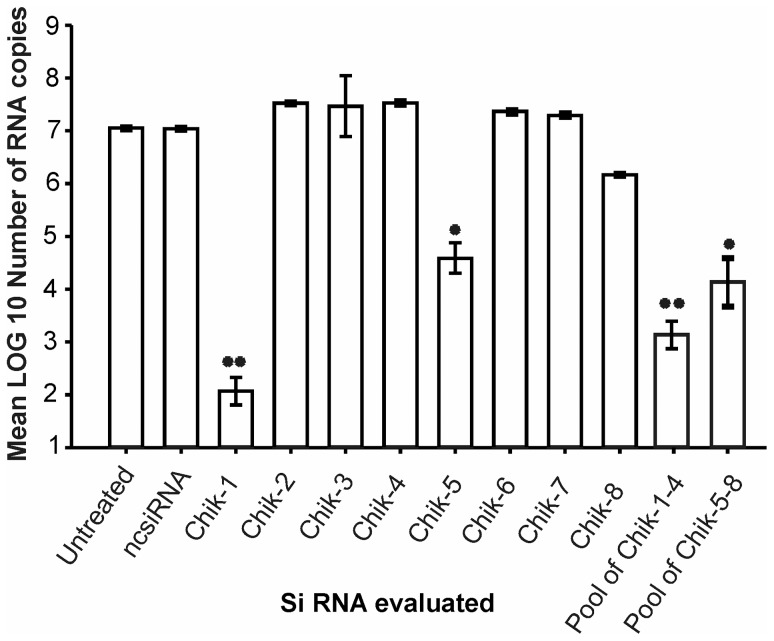
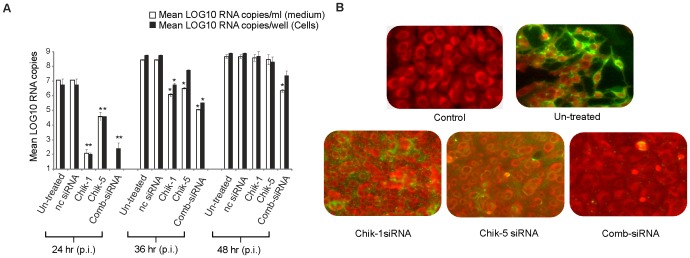
We evaluated the efficacy of the siRNAs against ns1 and E2 genes of CHIKV both in vitro and in vivo. Four siRNAs each, targeting the E2 (Chik-1 to Chik-4) and ns1 (Chik-5 to Chik-8) genes were designed and evaluated for efficiency in inhibiting CHIKV growth in vitro and in vivo. Chik-1 and Chik-5 siRNAs were effective in controlling CHIKV replication in vitro as assessed by real time PCR, IFA and plaque assay.

CONCLUSIONS

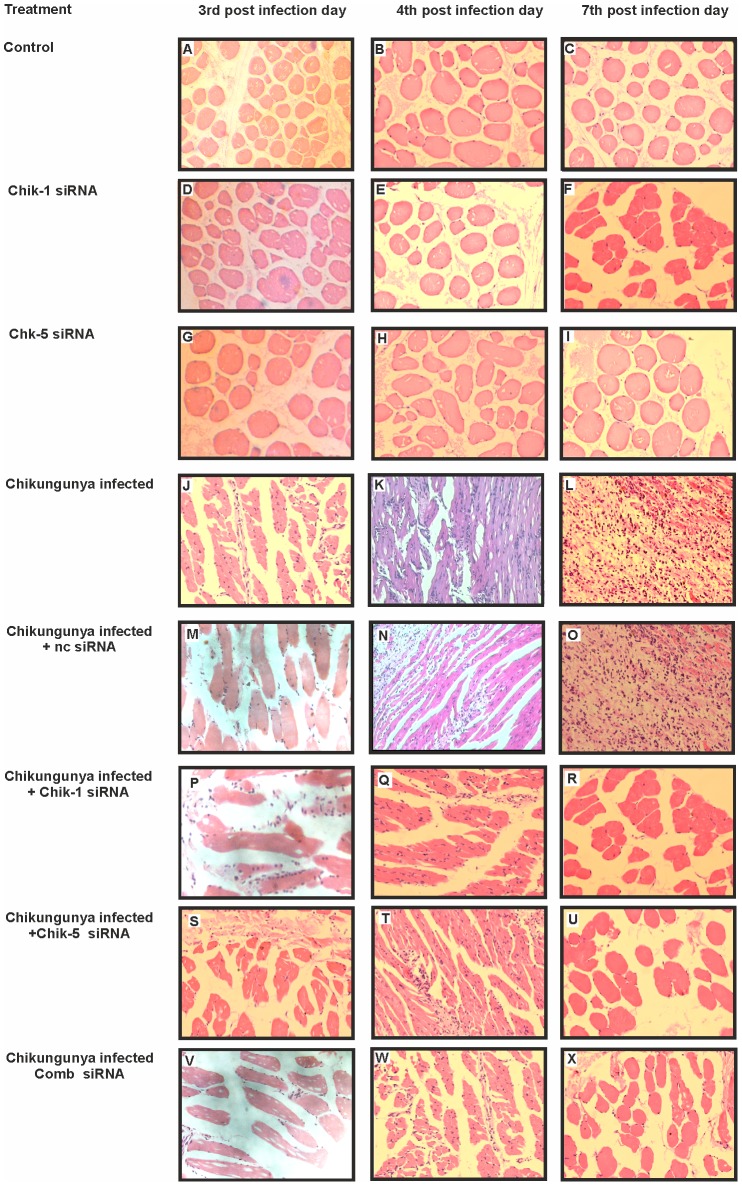
CHIKV replication was completely inhibited in the virus-infected mice when administered 72 hours post infection. The combination of Chik-1 and Chik-5 siRNAs exhibited additive effect leading to early and complete inhibition of virus replication. These findings suggest that RNAi capable of inhibiting CHIKV growth might constitute a new therapeutic strategy for controlling CHIKV infection and transmission.

摘要

背景

基孔肯雅病毒(CHIKV)再次出现,成为一种威胁生命的病原体,并在多个国家引发了大规模疫情。迄今为止,尚无许可疫苗或有效的抗病毒药物可用,治疗仍然是对症治疗。在这种情况下,开发有效和安全的预防和治疗方法成为当务之急。

方法

我们评估了针对 CHIKV 的 ns1 和 E2 基因的 siRNAs 的体外和体内疗效。设计了针对 E2(Chik-1 至 Chik-4)和 ns1(Chik-5 至 Chik-8)基因的每种 4 个 siRNAs,以评估其在体外和体内抑制 CHIKV 生长的效率。Chik-1 和 Chik-5 siRNAs 通过实时 PCR、IFA 和噬斑测定在体外有效控制 CHIKV 复制。

结论

当在感染后 72 小时给予时,感染病毒的小鼠中的 CHIKV 复制完全受到抑制。Chik-1 和 Chik-5 siRNAs 的组合表现出相加作用,导致病毒复制的早期和完全抑制。这些发现表明,能够抑制 CHIKV 生长的 RNAi 可能构成控制 CHIKV 感染和传播的新治疗策略。

https://cdn.ncbi.nlm.nih.gov/pmc/blobs/991c/3764232/09e35a2252bf/pntd.0002405.g010.jpg
https://cdn.ncbi.nlm.nih.gov/pmc/blobs/991c/3764232/8984d2841754/pntd.0002405.g001.jpg
https://cdn.ncbi.nlm.nih.gov/pmc/blobs/991c/3764232/3ebf6c83ae3f/pntd.0002405.g002.jpg
https://cdn.ncbi.nlm.nih.gov/pmc/blobs/991c/3764232/0edc963de865/pntd.0002405.g003.jpg
https://cdn.ncbi.nlm.nih.gov/pmc/blobs/991c/3764232/7d3e81d7ee2b/pntd.0002405.g004.jpg
https://cdn.ncbi.nlm.nih.gov/pmc/blobs/991c/3764232/c8550cd80a6e/pntd.0002405.g005.jpg
https://cdn.ncbi.nlm.nih.gov/pmc/blobs/991c/3764232/56001cffd747/pntd.0002405.g006.jpg
https://cdn.ncbi.nlm.nih.gov/pmc/blobs/991c/3764232/6b652effeb80/pntd.0002405.g007.jpg
https://cdn.ncbi.nlm.nih.gov/pmc/blobs/991c/3764232/5ed1c83dbfd9/pntd.0002405.g008.jpg
https://cdn.ncbi.nlm.nih.gov/pmc/blobs/991c/3764232/fb5d695ebc22/pntd.0002405.g009.jpg
https://cdn.ncbi.nlm.nih.gov/pmc/blobs/991c/3764232/09e35a2252bf/pntd.0002405.g010.jpg
https://cdn.ncbi.nlm.nih.gov/pmc/blobs/991c/3764232/8984d2841754/pntd.0002405.g001.jpg
https://cdn.ncbi.nlm.nih.gov/pmc/blobs/991c/3764232/3ebf6c83ae3f/pntd.0002405.g002.jpg
https://cdn.ncbi.nlm.nih.gov/pmc/blobs/991c/3764232/0edc963de865/pntd.0002405.g003.jpg
https://cdn.ncbi.nlm.nih.gov/pmc/blobs/991c/3764232/7d3e81d7ee2b/pntd.0002405.g004.jpg
https://cdn.ncbi.nlm.nih.gov/pmc/blobs/991c/3764232/c8550cd80a6e/pntd.0002405.g005.jpg
https://cdn.ncbi.nlm.nih.gov/pmc/blobs/991c/3764232/56001cffd747/pntd.0002405.g006.jpg
https://cdn.ncbi.nlm.nih.gov/pmc/blobs/991c/3764232/6b652effeb80/pntd.0002405.g007.jpg
https://cdn.ncbi.nlm.nih.gov/pmc/blobs/991c/3764232/5ed1c83dbfd9/pntd.0002405.g008.jpg
https://cdn.ncbi.nlm.nih.gov/pmc/blobs/991c/3764232/fb5d695ebc22/pntd.0002405.g009.jpg
https://cdn.ncbi.nlm.nih.gov/pmc/blobs/991c/3764232/09e35a2252bf/pntd.0002405.g010.jpg

相似文献

1
Administration of E2 and NS1 siRNAs inhibit chikungunya virus replication in vitro and protects mice infected with the virus.给予 E2 和 NS1 siRNA 可抑制体外的基孔肯雅病毒复制,并保护感染该病毒的小鼠。
PLoS Negl Trop Dis. 2013 Sep 5;7(9):e2405. doi: 10.1371/journal.pntd.0002405. eCollection 2013.
2
Vaccination with a chikungunya virus-like particle vaccine exacerbates disease in aged mice.接种基孔肯雅病毒样颗粒疫苗会使老年小鼠的病情恶化。
PLoS Negl Trop Dis. 2019 Apr 26;13(4):e0007316. doi: 10.1371/journal.pntd.0007316. eCollection 2019 Apr.
3
Expression and Characterization of Yeast Derived Chikungunya Virus Like Particles (CHIK-VLPs) and Its Evaluation as a Potential Vaccine Candidate.酵母衍生的基孔肯雅病毒样颗粒(CHIK-VLPs)的表达、表征及其作为潜在疫苗候选物的评估
PLoS Negl Trop Dis. 2016 Jul 11;10(7):e0004782. doi: 10.1371/journal.pntd.0004782. eCollection 2016 Jul.
4
Expression of plasmid-based shRNA against the E1 and nsP1 genes effectively silenced Chikungunya virus replication.基于质粒的 shRNA 对 E1 和 nsP1 基因的表达有效抑制了基孔肯雅病毒的复制。
PLoS One. 2012;7(10):e46396. doi: 10.1371/journal.pone.0046396. Epub 2012 Oct 8.
5
Effect of Cationic Lipid Nanoparticle Loaded siRNA with Stearylamine against Chikungunya Virus.阳离子脂质纳米颗粒负载带有硬脂胺的 siRNA 对基孔肯雅病毒的作用。
Molecules. 2022 Feb 9;27(4):1170. doi: 10.3390/molecules27041170.
6
In vitro and in vivo studies reveal α-Mangostin, a xanthonoid from Garcinia mangostana, as a promising natural antiviral compound against chikungunya virus.体外和体内研究表明,来自藤黄科藤黄属植物的一种紫檀芪,α-倒捻子素,是一种有前途的抗基孔肯雅病毒的天然抗病毒化合物。
Virol J. 2021 Feb 28;18(1):47. doi: 10.1186/s12985-021-01517-z.
7
Vector-delivered artificial miRNA effectively inhibited replication of Chikungunya virus.载体递送的人工微小RNA有效抑制基孔肯雅病毒的复制。
Antiviral Res. 2016 Oct;134:42-49. doi: 10.1016/j.antiviral.2016.08.019. Epub 2016 Aug 23.
8
A neutralizing monoclonal antibody targeting the acid-sensitive region in chikungunya virus E2 protects from disease.一种针对基孔肯雅病毒 E2 中酸敏感区域的中和单克隆抗体可预防疾病。
PLoS Negl Trop Dis. 2013 Sep 12;7(9):e2423. doi: 10.1371/journal.pntd.0002423. eCollection 2013.
9
Evaluation of recombinant E2 protein-based and whole-virus inactivated candidate vaccines against chikungunya virus.评估基于重组 E2 蛋白和全病毒灭活的候选登革热病毒疫苗。
Vaccine. 2012 Sep 21;30(43):6142-9. doi: 10.1016/j.vaccine.2012.07.072. Epub 2012 Aug 8.
10
Host oxidative folding pathways offer novel anti-chikungunya virus drug targets with broad spectrum potential.宿主氧化折叠途径提供了具有广谱潜力的新型抗基孔肯雅病毒药物靶点。
Antiviral Res. 2017 Jul;143:246-251. doi: 10.1016/j.antiviral.2017.04.014. Epub 2017 Apr 28.

引用本文的文献

1
Therapeutic Approaches of Viral Gene Silencing by Small Interfering RNA: Strategies to Prevent the Emergence of Antiviral Resistant Escape Mutants.小干扰RNA介导的病毒基因沉默治疗方法:预防抗病毒耐药逃逸突变体出现的策略
Pharmaceuticals (Basel). 2025 Jul 1;18(7):987. doi: 10.3390/ph18070987.
2
Small Interfering RNAs Targeting VP4, VP3, 2B, or 3A Coding Regions of Enterovirus A71 Inhibit Viral Replication In Vitro.靶向肠道病毒A71的VP4、VP3、2B或3A编码区的小干扰RNA在体外抑制病毒复制。
Biomedicines. 2025 Jul 18;13(7):1760. doi: 10.3390/biomedicines13071760.
3
Preclinical testing of antiviral siRNA therapeutics delivered in lipid nanoparticles in animal models - a comprehensive review.

本文引用的文献

1
Expression of plasmid-based shRNA against the E1 and nsP1 genes effectively silenced Chikungunya virus replication.基于质粒的 shRNA 对 E1 和 nsP1 基因的表达有效抑制了基孔肯雅病毒的复制。
PLoS One. 2012;7(10):e46396. doi: 10.1371/journal.pone.0046396. Epub 2012 Oct 8.
2
A mouse model of chikungunya virus-induced musculoskeletal inflammatory disease: evidence of arthritis, tenosynovitis, myositis, and persistence.基孔肯雅病毒诱导的肌肉骨骼炎症性疾病的小鼠模型:关节炎、腱鞘炎、肌炎和持续性的证据。
Am J Pathol. 2011 Jan;178(1):32-40. doi: 10.1016/j.ajpath.2010.11.018. Epub 2010 Dec 23.
3
Chikungunya virus nonstructural protein 2 inhibits type I/II interferon-stimulated JAK-STAT signaling.
脂质纳米颗粒递送的抗病毒小干扰RNA疗法在动物模型中的临床前测试——综述
Drug Deliv Transl Res. 2025 Feb 25. doi: 10.1007/s13346-025-01815-x.
4
Design of therapeutic siRNAs for potential application to infection with chikungunya virus.用于基孔肯雅病毒感染潜在治疗的小干扰RNA的设计
Heliyon. 2025 Jan 10;11(2):e41824. doi: 10.1016/j.heliyon.2025.e41824. eCollection 2025 Jan 30.
5
RNAi-Induced Gene Silencing against Chikungunya and COVID-19: What Have We Learned So Far, and What Is the Way Forward?RNAi 诱导的基对基因沉默对基孔肯雅热和 COVID-19:我们迄今为止学到了什么,以及未来的路是什么?
Viruses. 2024 Sep 20;16(9):1489. doi: 10.3390/v16091489.
6
Design and testing of Hepatitis Delta Ribozymes for suppression of Chikungunya virus infection in cell cultures.用于抑制细胞培养中基孔肯雅病毒感染的丁型肝炎核酶的设计与测试。
Med Res Arch. 2024 Aug;12(8). doi: 10.18103/mra.v12i8.5762. Epub 2024 Aug 31.
7
An Overview of Indian Biomedical Research on the Chikungunya Virus with Particular Reference to Its Vaccine, an Unmet Medical Need.印度关于基孔肯雅病毒的生物医学研究概述,特别提及针对该病毒的疫苗,这是一项未满足的医疗需求。
Vaccines (Basel). 2023 Jun 15;11(6):1102. doi: 10.3390/vaccines11061102.
8
Drug repurposing approach against chikungunya virus: an and study.药物重定位方法对抗基孔肯雅病毒:一项体内和体外研究。
Front Cell Infect Microbiol. 2023 Apr 27;13:1132538. doi: 10.3389/fcimb.2023.1132538. eCollection 2023.
9
Targeted gene silencing of E2 and nsP1 genes of chikungunya virus by biocompatible zeolitic imidazolate framework.通过生物相容性沸石咪唑酯骨架对基孔肯雅病毒的E2和nsP1基因进行靶向基因沉默。
Front Bioeng Biotechnol. 2022 Dec 14;10:1003448. doi: 10.3389/fbioe.2022.1003448. eCollection 2022.
10
antiviral activity of formulations against dengue virus type 2 and chikungunya viruses.制剂对登革热2型病毒和基孔肯雅病毒的抗病毒活性。
Heliyon. 2022 Nov 30;8(12):e11879. doi: 10.1016/j.heliyon.2022.e11879. eCollection 2022 Dec.
基孔肯雅病毒非结构蛋白 2 抑制 I/II 型干扰素刺激的 JAK-STAT 信号通路。
J Virol. 2010 Oct;84(20):10877-87. doi: 10.1128/JVI.00949-10. Epub 2010 Aug 4.
4
Biology and pathogenesis of chikungunya virus.基孔肯雅热病毒的生物学和发病机制。
Nat Rev Microbiol. 2010 Jul;8(7):491-500. doi: 10.1038/nrmicro2368.
5
Chikungunya virus arthritis in adult wild-type mice.成人野生型小鼠中的基孔肯雅病毒关节炎。
J Virol. 2010 Aug;84(16):8021-32. doi: 10.1128/JVI.02603-09. Epub 2010 Jun 2.
6
Chikungunya disease in nonhuman primates involves long-term viral persistence in macrophages.在非人类灵长类动物中,基孔肯雅热病涉及巨噬细胞中的长期病毒持续存在。
J Clin Invest. 2010 Mar;120(3):894-906. doi: 10.1172/JCI40104. Epub 2010 Feb 22.
7
Intracranial administration of P gene siRNA protects mice from lethal Chandipura virus encephalitis.颅内给予 P 基因 siRNA 可保护小鼠免于致死性钦迪普拉病毒脑炎。
PLoS One. 2010 Jan 7;5(1):e8615. doi: 10.1371/journal.pone.0008615.
8
Establishment and characterization of a new Aedes aegypti (L.) (Diptera: Culicidae) cell line with special emphasis on virus susceptibility.建立并鉴定一种新型埃及伊蚊(白纹伊蚊)(双翅目:蚊科)细胞系,特别关注其对病毒的易感性。
In Vitro Cell Dev Biol Anim. 2009 Oct;45(9):491-5. doi: 10.1007/s11626-009-9218-1. Epub 2009 Jun 16.
9
Deciphering the code of innate immunity recognition of siRNAs.解析小干扰RNA的天然免疫识别密码。
Methods Mol Biol. 2009;487:41-59. doi: 10.1007/978-1-60327-547-7_2.
10
RNA interference mediated inhibition of Chikungunya virus replication in mammalian cells.RNA干扰介导的对基孔肯雅病毒在哺乳动物细胞中复制的抑制作用。
Biochem Biophys Res Commun. 2008 Nov 28;376(4):718-22. doi: 10.1016/j.bbrc.2008.09.040. Epub 2008 Sep 19.