Department of Radiation Oncology (MAASTRO), GROW - School for Oncology and Developmental Biology, Maastricht University Medical Centre, Maastricht, The Netherlands.
Department of Radiology, GROW - School for Oncology and Developmental Biology, Maastricht University Medical Centre, Maastricht, The Netherlands.
Radiother Oncol. 2013 Oct;109(1):65-70. doi: 10.1016/j.radonc.2013.08.032. Epub 2013 Sep 14.
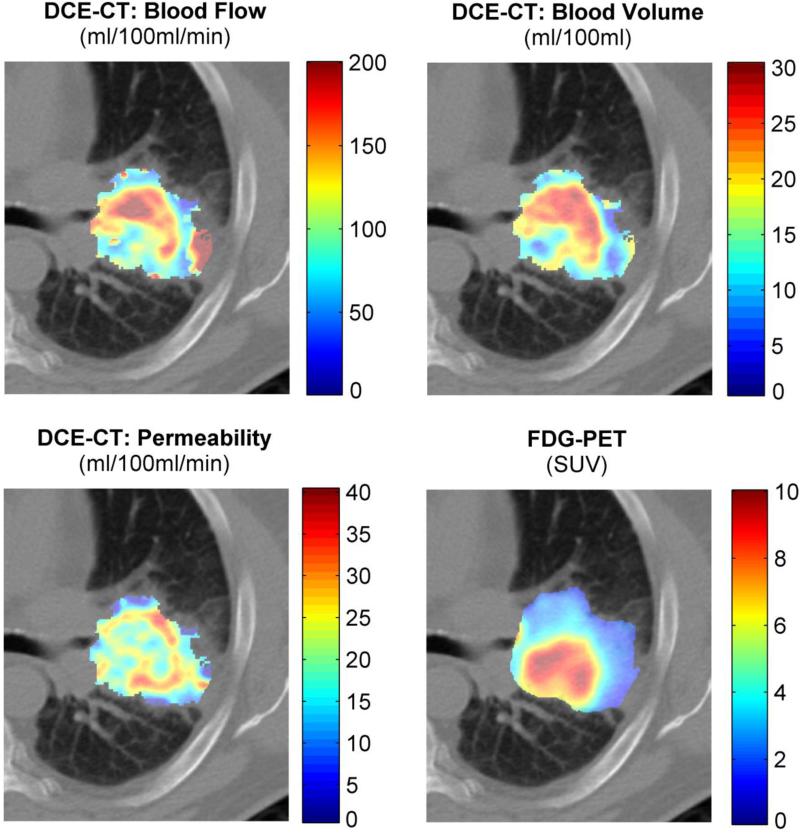
Dynamic contrast-enhanced CT (DCE-CT) quantifies vasculature properties of tumors, whereas static FDG-PET/CT defines metabolic activity. Both imaging modalities are capable of showing intra-tumor heterogeneity. We investigated differences in vasculature properties within primary non-small cell lung cancer (NSCLC) tumors measured by DCE-CT and metabolic activity from FDG-PET/CT.
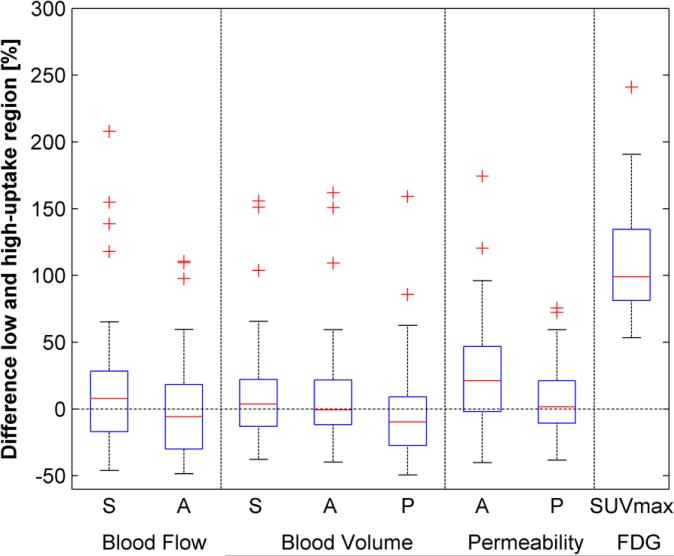
Thirty three NSCLC patients were analyzed prior to treatment. FDG-PET/CT and DCE-CT were co-registered. The tumor was delineated and metabolic activity was segmented on the FDG-PET/CT in two regions: low (<50% maximum SUV) and high (≥50% maximum SUV) metabolic uptake. Blood flow, blood volume and permeability were calculated using a maximum slope, deconvolution algorithm and a Patlak model. Correlations were assessed between perfusion parameters for the regions of interest.
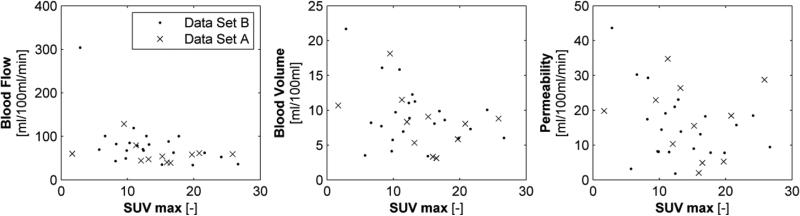
DCE-CT provided additional information on vasculature and tumor heterogeneity that was not correlated to metabolic tumor activity. There was no significant difference between low and high metabolic active regions for any of the DCE-CT parameters. Furthermore, only moderate correlations between maximum SUV and DCE-CT parameters were observed.
No direct correlation was observed between FDG-uptake and parameters extracted from DCE-CT. DCE-CT may provide complementary information to the characterization of primary NSCLC tumors over FDG-PET/CT imaging.
动态对比增强 CT(DCE-CT)定量评估肿瘤的血管特性,而静态 FDG-PET/CT 则定义代谢活性。这两种成像方式都能够显示肿瘤内的异质性。我们研究了 DCE-CT 测量的原发性非小细胞肺癌(NSCLC)肿瘤内血管特性与 FDG-PET/CT 代谢活性之间的差异。
对 33 名 NSCLC 患者进行治疗前分析。将 FDG-PET/CT 和 DCE-CT 进行配准。在 FDG-PET/CT 上,对肿瘤进行描绘并在两个区域(低代谢摄取区域(<50%最大 SUV)和高代谢摄取区域(≥50%最大 SUV))分割代谢活性。使用最大斜率、去卷积算法和 Patlak 模型计算血流、血容量和通透性。评估了感兴趣区域之间的灌注参数之间的相关性。
DCE-CT 提供了关于血管和肿瘤异质性的额外信息,与代谢肿瘤活性不相关。在任何 DCE-CT 参数方面,低代谢和高代谢活跃区域之间均无显著差异。此外,仅观察到最大 SUV 与 DCE-CT 参数之间存在中度相关性。
FDG 摄取与从 DCE-CT 提取的参数之间未观察到直接相关性。DCE-CT 可能为原发性 NSCLC 肿瘤的特征描述提供比 FDG-PET/CT 成像更具互补性的信息。