Department of Oral and Maxillofacial Pathobiology, Division of Frontier Medical Science, Graduate School of Biomedical and Health Sciences, Hiroshima University, 1-2-3 Kasumi, Minami-ku, Hiroshima 734-8553, Japan.
Br J Cancer. 2013 Oct 15;109(8):2248-58. doi: 10.1038/bjc.2013.550. Epub 2013 Sep 17.
Epithelial-mesenchymal transition (EMT) is a crucial process in cancer progression that provides cancer cells with the ability to escape from the primary focus, invade stromal tissues and migrate to distant regions. Cell lines that lack E-cadherin show increased tumorigenesis and metastasis, and the expression levels of E-cadherin and Snail correlate inversely with the prognosis of patients suffering from breast cancer or oral squamous cell carcinoma (OSCC). Moreover, recent studies have shown that most EMT cases are regulated by soluble growth factors or cytokines. Among these factors, fibroblast growth factors (FGFs) execute diverse functions by binding to and activating members of the FGF receptor (FGFR) family, including FGFR1-4. Fibroblast growth factor receptor 1 is an oncoprotein that is involved in tumorigenesis, and PD173074 is known to be a selective inhibitor of FGFR1. However, the roles of FGFR1 and FGFR1 inhibitors have not yet been examined in detail.
Here, we investigated the expression of FGFR1 in head and neck squamous cell carcinoma (HNSCC) and the role of the FGFR1 inhibitor PD173074 in carcinogenesis and the EMT process.
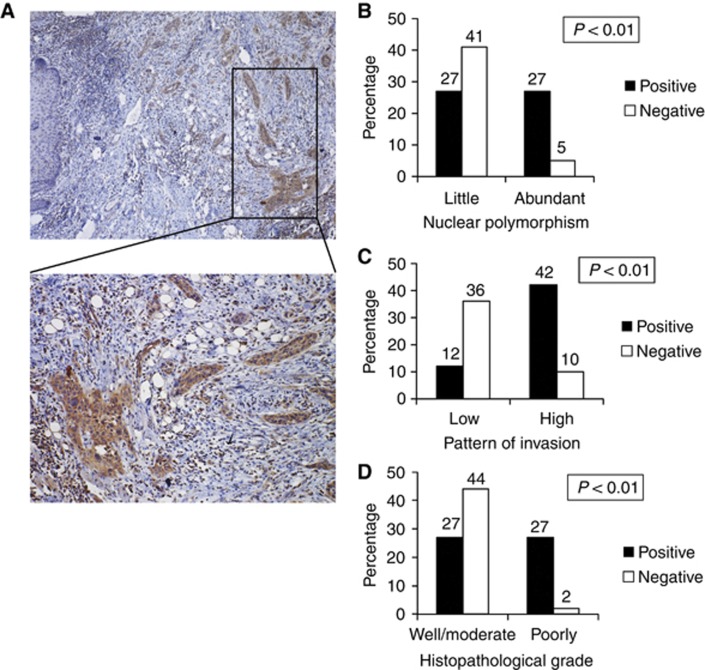
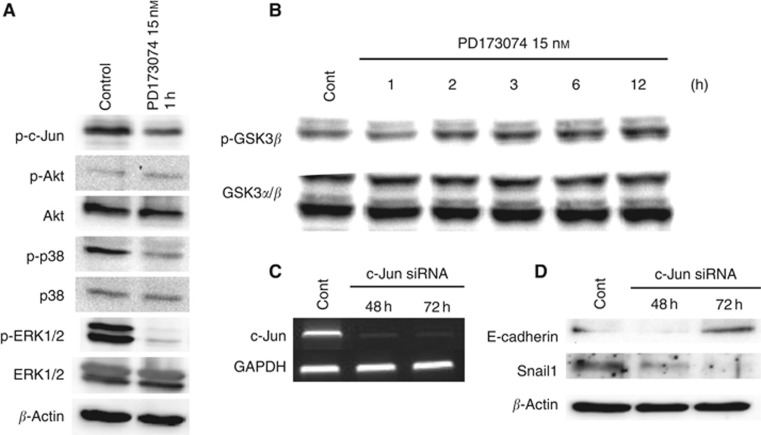
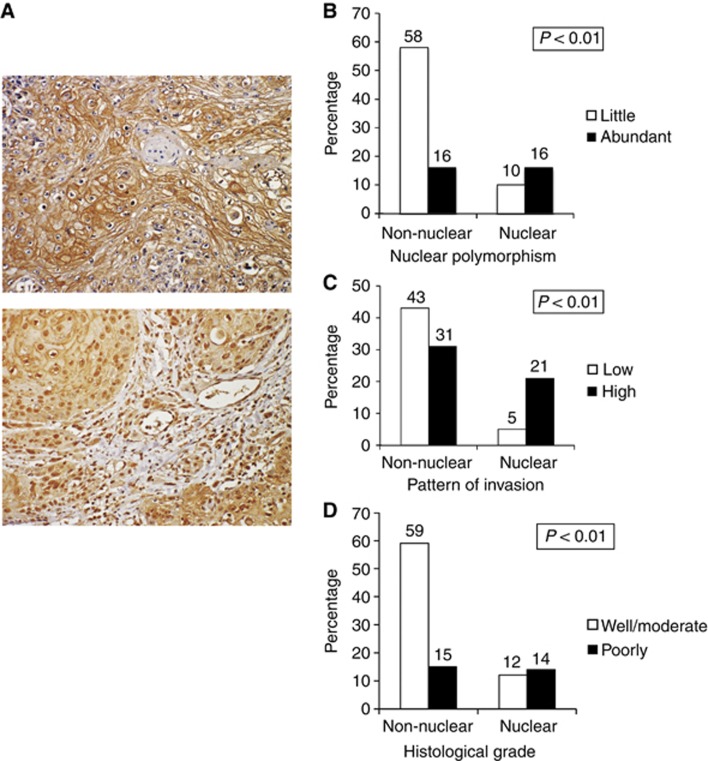
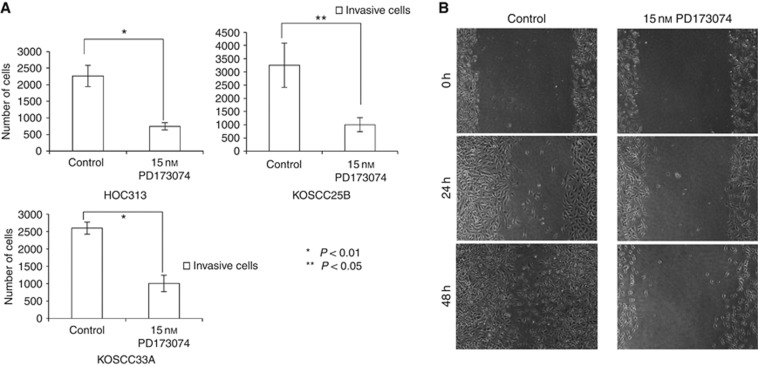
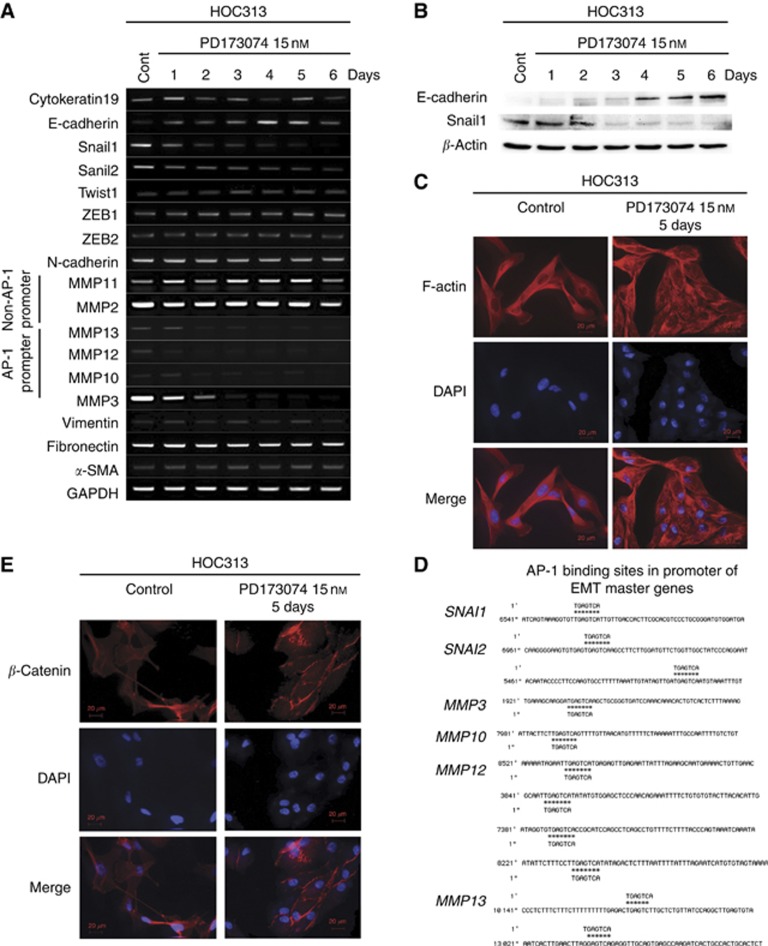
Fibroblast growth factor receptor 1 was highly expressed in 54% of HNSCC cases and was significantly correlated with malignant behaviours. Nuclear FGFR1 expression was also observed and correlated well with histological differentiation, the pattern of invasion and abundant nuclear polymorphism. Fibroblast growth factor receptor 1 was also overexpressed in EMT cell lines compared with non-EMT cell lines. Furthermore, treatment of HOC313 cells with PD173074 suppressed cellular proliferation and invasion and reduced ERK1/2 and p38 activation. These cells also demonstrated morphological changes, transforming from spindle- to cobble stone-like in shape. In addition, the expression levels of certain matrix metalloproteinases (MMPs), whose genes contain activator protein-1 (AP-1) promoter sites, as well as Snail1 and Snail2 were reduced following PD173074 treatment.
Taken together, these data suggest that PD173074 inhibits the MAPK pathway, which regulates the activity of AP-1 and induces MET. Furthermore, this induction of MET likely suppresses cancer cell growth and invasion.
上皮-间充质转化(EMT)是癌症进展过程中的一个关键过程,它赋予癌细胞逃离原发灶、侵袭间质组织并迁移到远处的能力。缺乏 E-钙黏蛋白的细胞系显示出更高的肿瘤发生和转移能力,E-钙黏蛋白和 Snail 的表达水平与乳腺癌或口腔鳞状细胞癌(OSCC)患者的预后呈负相关。此外,最近的研究表明,大多数 EMT 情况是由可溶性生长因子或细胞因子调节的。在这些因子中,成纤维细胞生长因子(FGFs)通过与成纤维细胞生长因子受体(FGFR)家族成员结合并激活来执行多种功能,包括 FGFR1-4。成纤维细胞生长因子受体 1 是一种癌蛋白,参与肿瘤发生,PD173074 是 FGFR1 的选择性抑制剂。然而,FGFR1 和 FGFR1 抑制剂的作用尚未详细研究。
在这里,我们研究了 FGFR1 在头颈部鳞状细胞癌(HNSCC)中的表达以及 FGFR1 抑制剂 PD173074 在致癌作用和 EMT 过程中的作用。
成纤维细胞生长因子受体 1 在 54%的 HNSCC 病例中高表达,与恶性行为显著相关。还观察到核 FGFR1 表达,并且与组织学分化、浸润模式和丰富的核多态性密切相关。成纤维细胞生长因子受体 1 在 EMT 细胞系中也过度表达,而非 EMT 细胞系。此外,用 PD173074 处理 HOC313 细胞可抑制细胞增殖和侵袭,并减少 ERK1/2 和 p38 的激活。这些细胞还表现出形态变化,从梭形变为鹅卵石形。此外,PD173074 处理后,某些基质金属蛋白酶(MMPs)的表达水平降低,其基因包含激活蛋白-1(AP-1)启动子位点,以及 Snail1 和 Snail2。
综上所述,这些数据表明 PD173074 抑制 MAPK 通路,该通路调节 AP-1 的活性并诱导 MET。此外,这种 MET 的诱导可能抑制癌细胞的生长和侵袭。