Department of Medicine, Section of Rheumatology, and Department of Biochemistry, Rush University Medical Center, 1611 W. Harrison Street, Chicago, IL 60612, USA.
Nat Rev Rheumatol. 2013 Nov;9(11):654-64. doi: 10.1038/nrrheum.2013.138. Epub 2013 Sep 17.
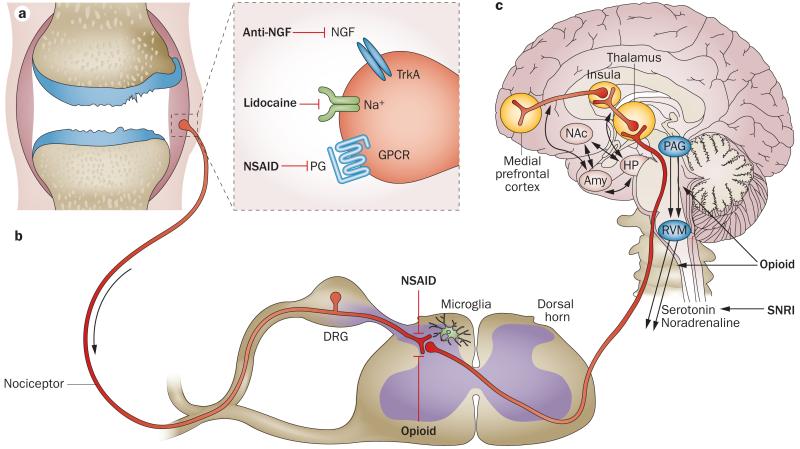
Pain is the defining symptom of osteoarthritis (OA), yet available treatment options, of which NSAIDs are the most common, provide inadequate pain relief and are associated with serious health risks when used long term. Chronic pain pathways are subject to complex levels of control and modulation, both in the periphery and in the central nervous system. Ongoing clinical and basic research is uncovering how these pathways operate in OA. Indeed, clinical investigation into the types of pain associated with progressive OA, the presence of central sensitization, the correlation with structural changes in the joint, and the efficacy of novel analgesics affords new insights into the pathophysiology of OA pain. Moreover, studies in disease-specific animal models enable the unravelling of the cellular and molecular pathways involved. We expect that increased understanding of the mechanisms by which chronic OA-associated pain is generated and maintained will offer opportunities for targeting and improving the safety of analgesia. In addition, using clinical and genetic approaches, it might become possible to identify subsets of patients with pain of different pathophysiology, thus enabling a tailored approach to pain management.
疼痛是骨关节炎(OA)的主要症状,但现有的治疗方法(其中 NSAIDs 最为常见)并不能充分缓解疼痛,并且长期使用时会带来严重的健康风险。慢性疼痛通路受到复杂的外周和中枢神经系统控制和调节。正在进行的临床和基础研究正在揭示这些通路在 OA 中的作用方式。实际上,对与进行性 OA 相关的疼痛类型、中枢敏化的存在、与关节结构变化的相关性以及新型镇痛药的疗效的临床研究为 OA 疼痛的病理生理学提供了新的见解。此外,在特定疾病的动物模型中的研究使涉及的细胞和分子途径得以阐明。我们期望,对慢性 OA 相关疼痛产生和维持的机制的理解的增加将为靶向治疗和提高镇痛安全性提供机会。此外,通过临床和遗传方法,有可能识别出具有不同病理生理学的疼痛患者亚组,从而能够针对疼痛管理进行个性化治疗。