Department of Infectious Diseases, Virology, Heidelberg University Hospital, Im Neuenheimer Feld 324, D-69120 Heidelberg, Germany, Cluster of Excellence CellNetworks, Heidelberg University, Im Neuenheimer Feld 267, D-69120 Heidelberg, Germany, Department of Medicine III, University Hospital Aachen, Pauwelstrasse 30, D-52074 Aachen, Germany, Department of Infectious Diseases, Molecular Virology, Heidelberg University, Im Neuenheimer Feld 345, D-69120 Heidelberg, Germany, Division Signaling and Functional Genomics, German Cancer Research Center, Im Neuenheimer Feld 580, D-69120 Heidelberg, Germany, BioQuant, Heidelberg University, Im Neuenheimer Feld 267, D-69120 Heidelberg, Germany and Department of Pediatric Oncology, Hematology, Immunology and Pulmonology, Heidelberg University Hospital, Im Neuenheimer Feld 350, D-69120 Heidelberg, Germany.
Nucleic Acids Res. 2013 Nov;41(21):e199. doi: 10.1093/nar/gkt836. Epub 2013 Sep 17.
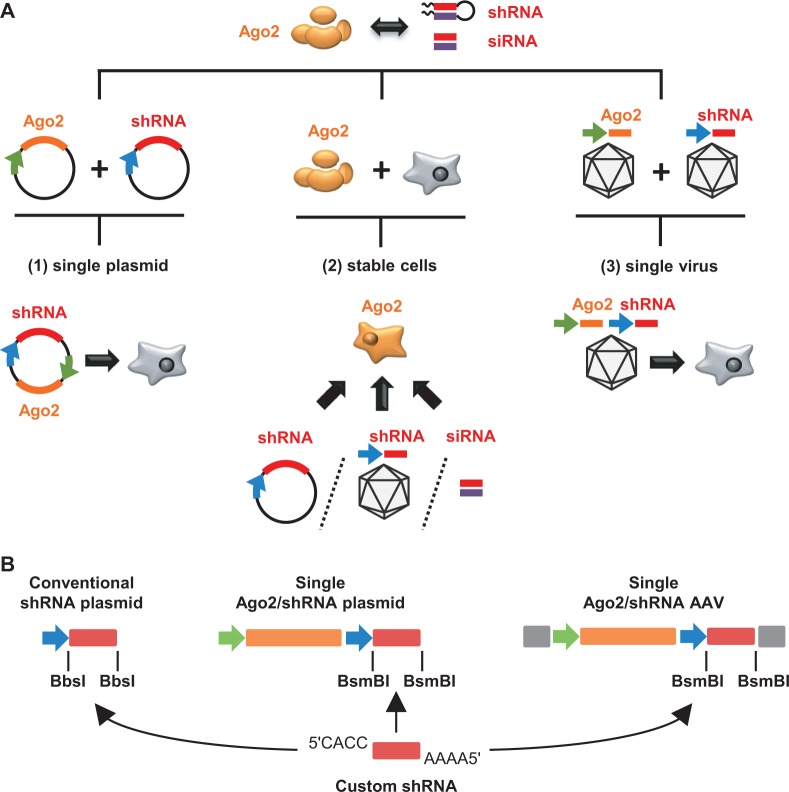
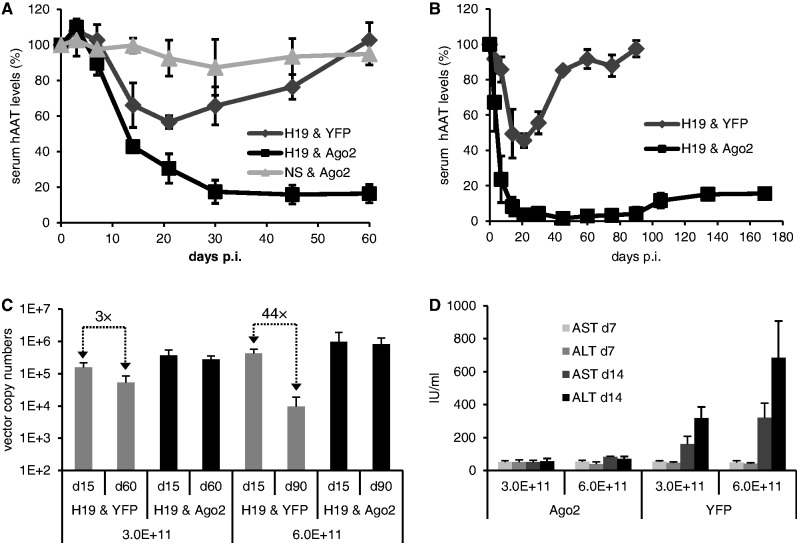
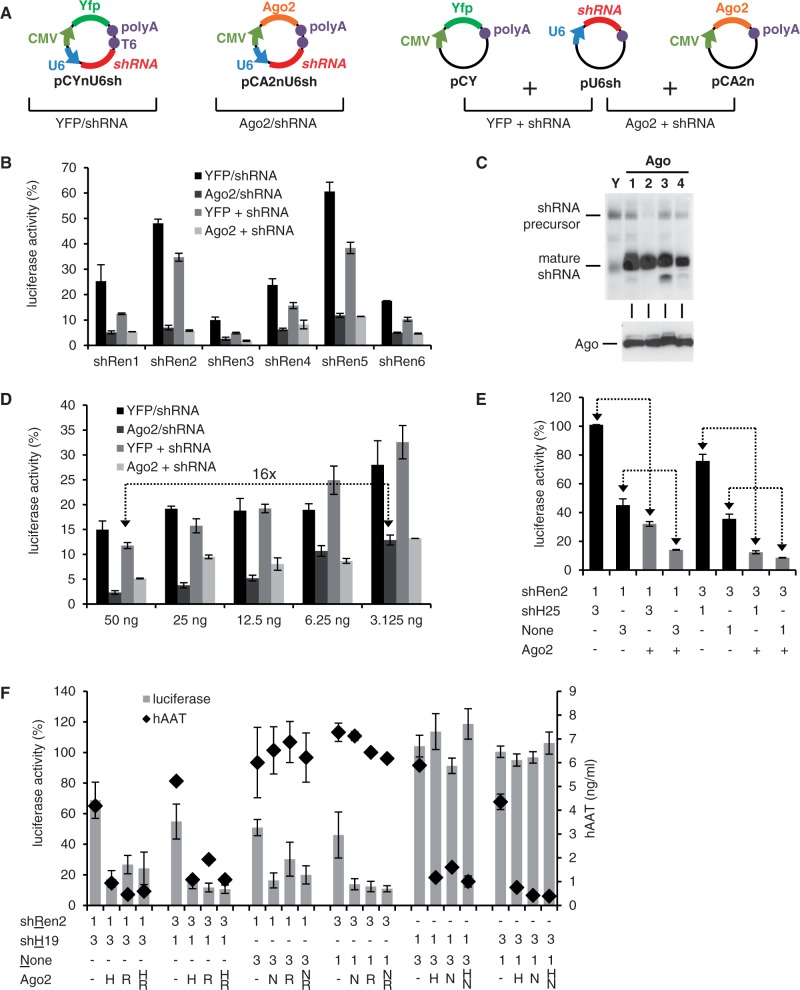
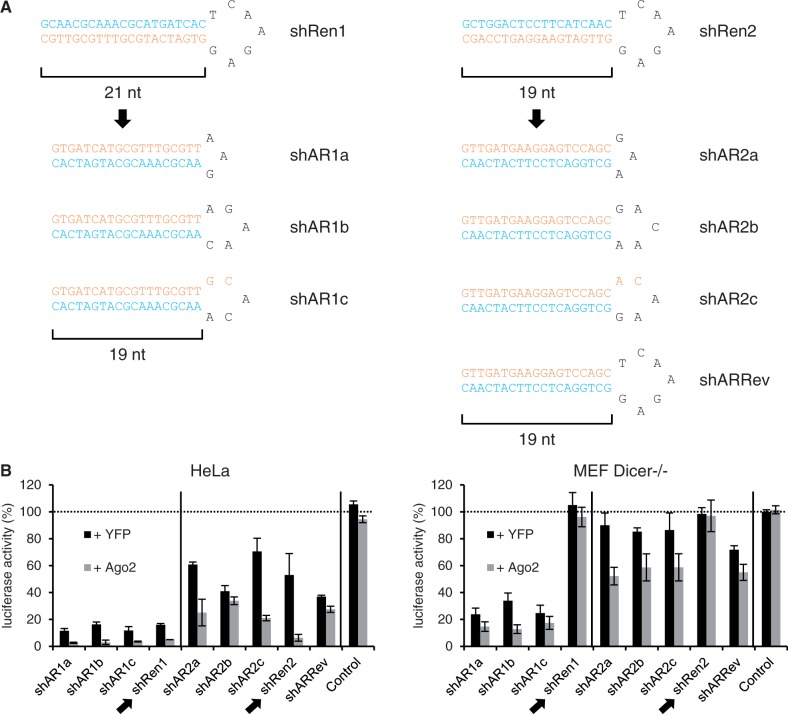
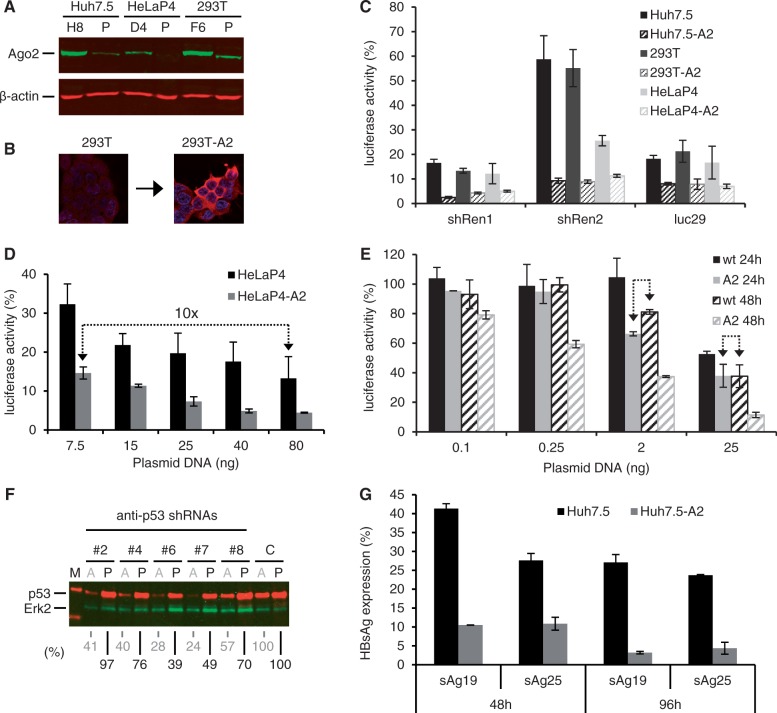
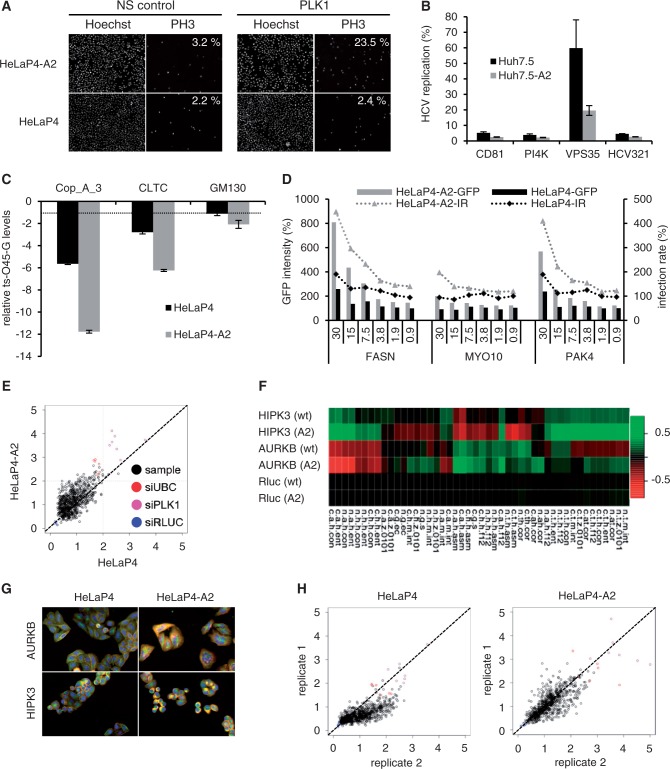
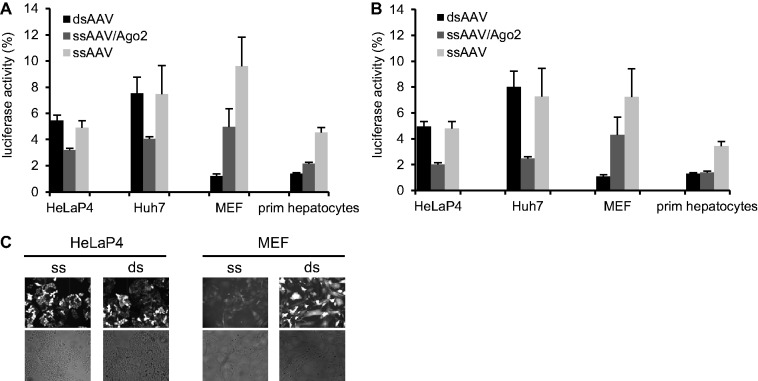
As the only mammalian Argonaute protein capable of directly cleaving mRNAs in a small RNA-guided manner, Argonaute-2 (Ago2) is a keyplayer in RNA interference (RNAi) silencing via small interfering (si) or short hairpin (sh) RNAs. It is also a rate-limiting factor whose saturation by si/shRNAs limits RNAi efficiency and causes numerous adverse side effects. Here, we report a set of versatile tools and widely applicable strategies for transient or stable Ago2 co-expression, which overcome these concerns. Specifically, we engineered plasmids and viral vectors to co-encode a codon-optimized human Ago2 cDNA along with custom shRNAs. Furthermore, we stably integrated this Ago2 cDNA into a panel of standard human cell lines via plasmid transfection or lentiviral transduction. Using various endo- or exogenous targets, we demonstrate the potential of all three strategies to boost mRNA silencing efficiencies in cell culture by up to 10-fold, and to facilitate combinatorial knockdowns. Importantly, these robust improvements were reflected by augmented RNAi phenotypes and accompanied by reduced off-targeting effects. We moreover show that Ago2/shRNA-co-encoding vectors can enhance and prolong transgene silencing in livers of adult mice, while concurrently alleviating hepatotoxicity. Our customizable reagents and avenues should broadly improve future in vitro and in vivo RNAi experiments in mammalian systems.
作为唯一能够以小 RNA 引导的方式直接切割 mRNAs 的哺乳动物 Argonaute 蛋白,Argonaute-2(Ago2)是通过小干扰 (si) 或短发夹 (sh) RNA 进行 RNA 干扰 (RNAi) 沉默的关键因子。它也是一种限速因子,其通过 si/shRNA 的饱和限制了 RNAi 的效率并导致许多不良反应。在这里,我们报告了一系列通用的工具和广泛适用的策略,用于瞬时或稳定表达 Ago2,这些策略克服了这些问题。具体来说,我们设计了质粒和病毒载体,共同编码一个密码子优化的人 Ago2 cDNA 以及定制的 shRNA。此外,我们通过质粒转染或慢病毒转导将该 Ago2 cDNA 稳定整合到一系列标准的人类细胞系中。使用各种内源性或外源性靶标,我们证明了这三种策略在细胞培养中提高 mRNA 沉默效率的潜力高达 10 倍,并促进了组合敲低。重要的是,这些强大的改进反映在增强的 RNAi 表型中,并伴随着降低的脱靶效应。此外,我们还表明,Ago2/shRNA 共编码载体可以增强和延长成年小鼠肝脏中转基因的沉默,同时减轻肝毒性。我们的定制试剂和方法应该广泛改善未来哺乳动物系统中的体外和体内 RNAi 实验。