Zahedi Maryam, Ghiasvand Reza, Feizi Awat, Asgari Gholamreza, Darvish Leila
Department of Nutrition, School of Food Science and Nutrition, Isfahan University of Medical Sciences, Isfahan, Iran.
Int J Prev Med. 2013 Jul;4(7):777-85.
Quercetin has been distributed in a wide range of foods, but some of its known effects in vitro, are not proven in human studies. Therefore, the aim of this study was evaluation of the effects of quercetin intake on cardiovascular risk factors and inflammatory biomarkers in women with type 2 diabetes.
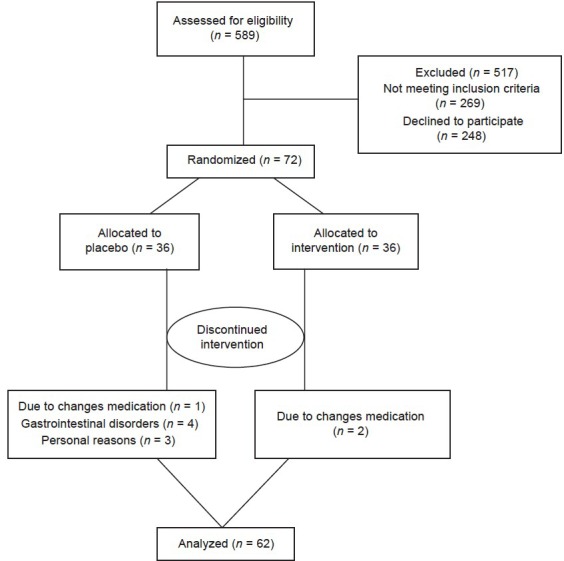
This double-blind randomized clinical trial was carried out on 72 women for 10 weeks. Subjects were assigned to quercetin and placebo groups using a permutated block randomization of size two. Quercetin was given to participants as a 500 mg capsule daily. Biochemical variables were measured at baseline and at the end of the study, and changes were compared using appropriate statistical methods.
Compared with placebo, quercetin intake decreased systolic blood pressure significantly (-8.8 ± 9.3 vs. -3.5 ± 11.7, P = 0.04). Although changes in diastolic blood pressure between the groups was not significant (P = 0.19), high-density lipoprotein cholesterol (HDL-C) was significantly decreased in both groups while changes in total cholesterol, low-density lipoprotein cholesterol (LDL-C), triglycerides (TG) and ratio of TG/HDL-C and LDL-C/HDL-C were not significant between and within groups. Quercetin supplementation significantly reduced the serum concentration of tumor necrosis factor-α (TNF-α) and interleukin-6 (IL-6) (P = 0.01 and P < 0.0001, respectively); however, the mean changes in serum levels of IL-6, TNF-α, and high-sensitivity C-reactive protein were not significant between the groups.
Quercetin supplementation reduced systolic blood pressure significantly but had no effect on other cardiovascular risk factors and inflammatory biomarkers. Considering the biological effects of quercetin in vitro, we need more studies with a stronger design and sample size with different doses of quercetin.
槲皮素广泛存在于多种食物中,但其一些已知的体外作用在人体研究中尚未得到证实。因此,本研究旨在评估摄入槲皮素对2型糖尿病女性心血管危险因素和炎症生物标志物的影响。
本双盲随机临床试验对72名女性进行了为期10周的研究。采用大小为2的置换区组随机化方法将受试者分为槲皮素组和安慰剂组。给参与者每天服用一粒500毫克的槲皮素胶囊。在基线和研究结束时测量生化变量,并使用适当的统计方法比较变化情况。
与安慰剂相比,摄入槲皮素可显著降低收缩压(-8.8±9.3对-3.5±11.7,P=0.04)。尽管两组之间舒张压的变化不显著(P=0.19),但两组的高密度脂蛋白胆固醇(HDL-C)均显著降低,而总胆固醇、低密度脂蛋白胆固醇(LDL-C)、甘油三酯(TG)以及TG/HDL-C和LDL-C/HDL-C的比值在组间和组内变化均不显著。补充槲皮素可显著降低血清肿瘤坏死因子-α(TNF-α)和白细胞介素-6(IL-6)的浓度(分别为P=0.01和P<0.0001);然而,两组之间IL-6、TNF-α和高敏C反应蛋白血清水平的平均变化不显著。
补充槲皮素可显著降低收缩压,但对其他心血管危险因素和炎症生物标志物无影响。考虑到槲皮素在体外的生物学作用,我们需要更多设计更严谨、样本量更大且使用不同剂量槲皮素的研究。