Department of Surgery, University of Washington, Harborview Medical Center, Seattle, WA.
J Am Coll Surg. 2013 Dec;217(6):1108-17. doi: 10.1016/j.jamcollsurg.2013.08.006. Epub 2013 Sep 17.
Assuring adequate enteral nutritional support in critically ill patients is challenging. By describing our experience, we sought to characterize the challenges, benefits, and complications of an approach that stresses enteral nutrition.
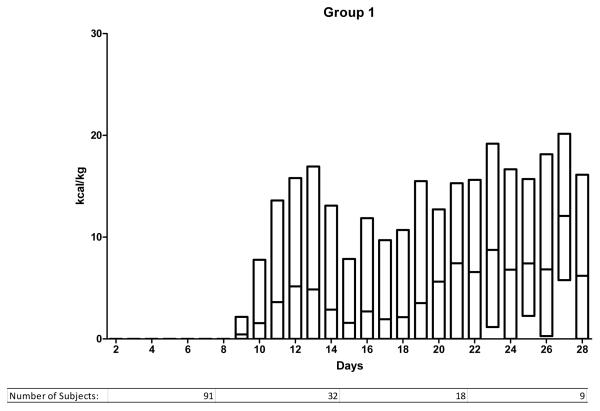
We examined nutritional support received by victims of blunt trauma from 8 trauma centers. We grouped patients according to mean daily enteral caloric intake during the first 7 days. Group 1 received the fewest (0 kcal/kg/d) and group 5 the greatest (16 to 30 kcal/kg/d) number of calories in the first week. We focused our analyses on the patients remaining in the ICU for 8 days or longer and compared clinical outcomes among the groups.
There were 1,100 patients in the ICU for 8 days or longer. Patients receiving the greatest number of enteral calories during the first week (group 5) had the highest incidence of ventilator-associated pneumonia (49%) and the lowest incidence of bacteremia (14%). Use of parenteral nutrition was associated with bacteremia (adjusted odds ratio = 2.5; 95% CI, 1.8-3.5), ventilator-associated pneumonia (adjusted odds ratio = 2.4; 95% CI, 1.7-3.3), and death (adjusted odds ratio = 1.9; 95% CI, 1.1-3.1).
Enteral caloric intake during the first week was related to the pattern and severity of injury and was associated with important infectious outcomes. Our observations support moderating enteral intake during the first week after injury and avoiding parenteral nutrition.
确保危重症患者获得充足的肠内营养支持具有挑战性。通过描述我们的经验,我们试图描述强调肠内营养的方法所面临的挑战、益处和并发症。
我们检查了 8 个创伤中心钝器伤患者的营养支持情况。我们根据患者在第 1 天的平均每日肠内热量摄入量将患者分组。第 1 组摄入的热量最少(0 千卡/公斤/天),第 5 组摄入的热量最多(16 至 30 千卡/公斤/天)。我们的分析重点是在 ICU 中停留 8 天或更长时间的患者,并比较各组之间的临床结局。
有 1100 名患者在 ICU 中停留 8 天或更长时间。在第 1 周内摄入最多肠内热量的患者(第 5 组)呼吸机相关性肺炎(49%)发生率最高,菌血症(14%)发生率最低。肠外营养的使用与菌血症(调整后的优势比=2.5;95%置信区间,1.8-3.5)、呼吸机相关性肺炎(调整后的优势比=2.4;95%置信区间,1.7-3.3)和死亡(调整后的优势比=1.9;95%置信区间,1.1-3.1)相关。
第 1 周的肠内热量摄入与损伤的模式和严重程度有关,并与重要的感染结果相关。我们的观察结果支持在损伤后第 1 周内适度摄入肠内营养并避免使用肠外营养。