Rajan Prabhakar, Sudbery Ian M, Villasevil M Eugenia M, Mui Ernest, Fleming Janis, Davis Mark, Ahmad Imran, Edwards Joanne, Sansom Owen J, Sims David, Ponting Chris P, Heger Andreas, McMenemin Rhona M, Pedley Ian D, Leung Hing Y
Institute of Cancer Sciences, College of Medical, Veterinary and Life Sciences, University of Glasgow, Cancer Research UK Beatson Institute, Glasgow, UK; Cancer Research UK Beatson Institute, The Beatson Institute for Cancer Research, Glasgow, UK.
Computational Genomics Analysis and Training Programme, Medical Research Council Functional Genomics Unit, Department of Physiology Anatomy and Genetics, University of Oxford, Oxford, UK.
Eur Urol. 2014 Jul;66(1):32-9. doi: 10.1016/j.eururo.2013.08.011. Epub 2013 Aug 14.
Androgen-deprivation therapy (ADT) is standard treatment for locally advanced or metastatic prostate cancer (PCa). Many patients develop castration resistance (castration-resistant PCa [CRPC]) after approximately 2-3 yr, with a poor prognosis. The molecular mechanisms underlying CRPC progression are unclear.
To undertake quantitative tumour transcriptome profiling prior to and following ADT to identify functionally important androgen-regulated pathways or genes that may be reactivated in CRPC.
DESIGN, SETTING, AND PARTICIPANTS: RNA sequencing (RNA-seq) was performed on tumour-rich, targeted prostatic biopsies from seven patients with locally advanced or metastatic PCa before and approximately 22 wk after ADT initiation. Differentially regulated genes were identified in treatment pairs and further investigated by quantitative reverse transcription-polymerase chain reaction (qRT-PCR) on cell lines and immunohistochemistry on a separate CRPC patient cohort. Functional assays were used to determine the effect of pathway modulation on cell phenotypes.
We searched for gene expression changes affecting key cell signalling pathways that may be targeted as proof of principle in a CRPC in vitro cell line model.
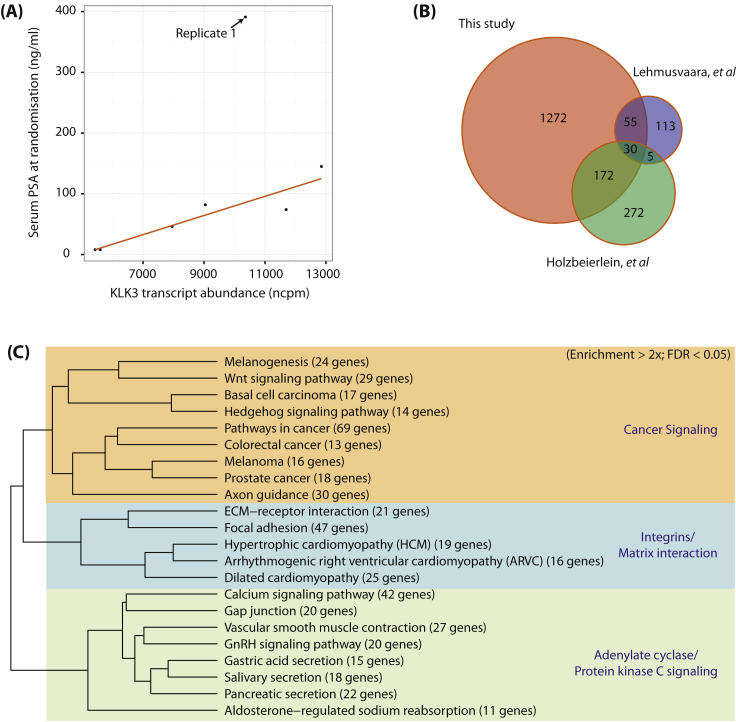
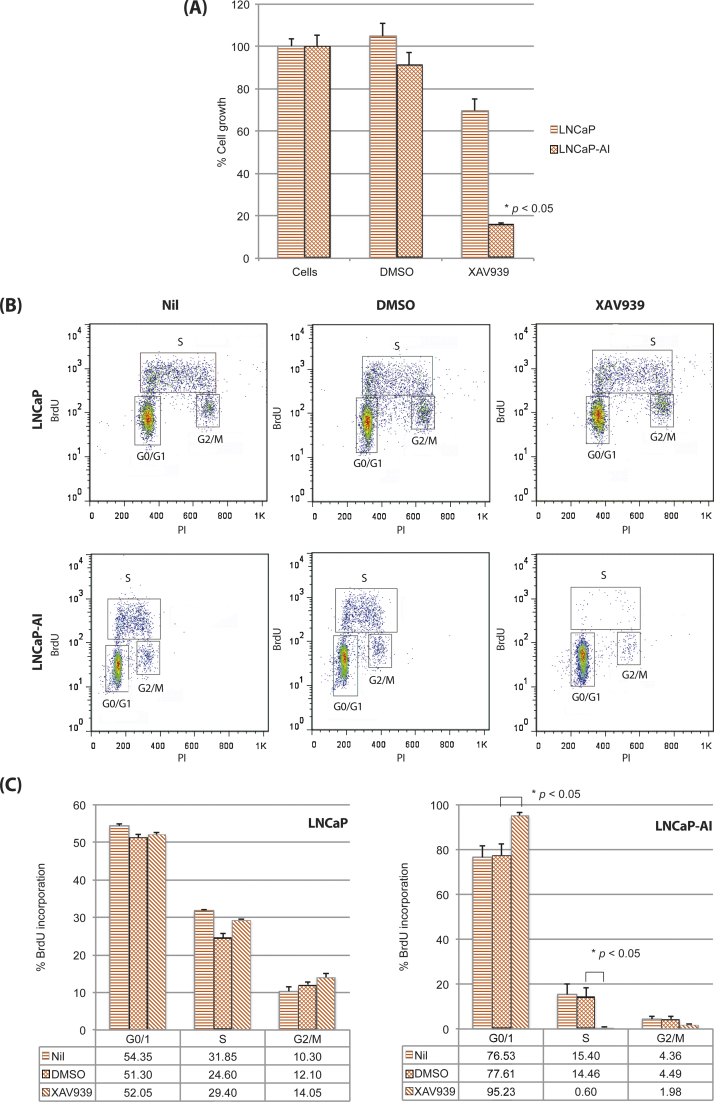
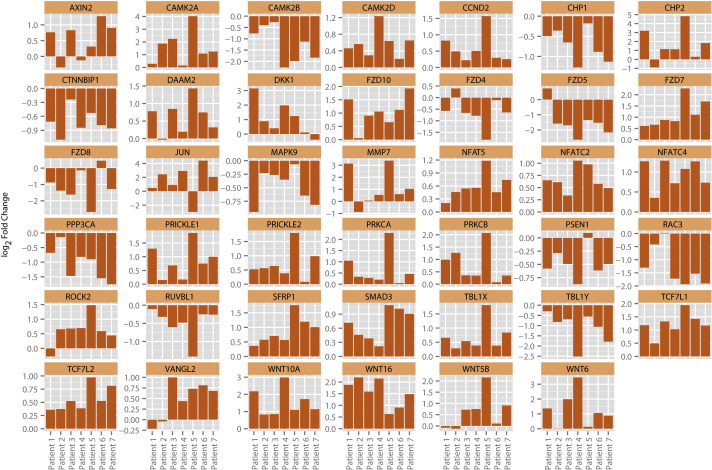
We identified ADT-regulated signalling pathways, including the Wnt/β-catenin signalling pathway, and observed overexpression of β-catenin in a subset of CRPC by immunohistochemistry. We validated 6 of 12 (50%) pathway members by qRT-PCR on LNCaP/LNCaP-AI cell RNAs, of which 4 (67%) demonstrated expression changes consistent with RNA-seq data. We show that the tankyrase inhibitor XAV939 (which promotes β-catenin degradation) reduced androgen-independent LNCaP-AI cell line growth compared with androgen-responsive LNCaP cells via an accumulation of cell proportions in the G0/G1 phase and reduction in the S and G2/M phases. Our biopsy protocol did not account for tumour heterogeneity, and pathway inhibition was limited to pharmacologic approaches.
RNA-seq of paired PCa samples revealed ADT-regulated signalling pathways. Proof-of-principle inhibition of the Wnt/β-catenin signalling pathway specifically delays androgen-independent PCa cell cycle progression and proliferation and warrants further investigation as a potential target for therapy for CRPC.
雄激素剥夺疗法(ADT)是局部晚期或转移性前列腺癌(PCa)的标准治疗方法。许多患者在大约2 - 3年后会出现去势抵抗(去势抵抗性前列腺癌[CRPC]),预后较差。CRPC进展的分子机制尚不清楚。
在ADT前后进行定量肿瘤转录组分析,以确定在CRPC中可能重新激活的功能上重要的雄激素调节途径或基因。
设计、设置和参与者:对7例局部晚期或转移性PCa患者在ADT开始前及开始后约22周进行富含肿瘤的靶向前列腺活检,并进行RNA测序(RNA-seq)。在治疗组中鉴定差异调节基因,并通过对细胞系进行定量逆转录聚合酶链反应(qRT-PCR)以及对另一组CRPC患者队列进行免疫组织化学进一步研究。使用功能测定来确定途径调节对细胞表型的影响。
我们在CRPC体外细胞系模型中寻找影响关键细胞信号通路的基因表达变化,这些变化可作为原理验证的靶点。
我们鉴定了ADT调节的信号通路,包括Wnt/β-连环蛋白信号通路,并通过免疫组织化学观察到在一部分CRPC中β-连环蛋白的过表达。我们通过对LNCaP/LNCaP-AI细胞RNA进行qRT-PCR验证了12个(50%)通路成员中的6个,其中4个(67%)显示出与RNA-seq数据一致的表达变化。我们表明,端锚聚合酶抑制剂XAV939(促进β-连环蛋白降解)与雄激素反应性LNCaP细胞相比,通过G0/G1期细胞比例的积累以及S期和G2/M期的减少,降低了雄激素非依赖性LNCaP-AI细胞系的生长。我们的活检方案没有考虑肿瘤异质性,并且途径抑制仅限于药理学方法。
配对PCa样本的RNA-seq揭示了ADT调节的信号通路。Wnt/β-连环蛋白信号通路的原理验证性抑制特异性地延迟了雄激素非依赖性PCa细胞周期进程和增殖,作为CRPC治疗的潜在靶点值得进一步研究。