Balabram Débora, Turra Cassio M, Gobbi Helenice
Breast Pathology Laboratory, School of Medicine, Federal University of Minas Gerais (UFMG), Belo Horizonte, Brazil.
BMC Cancer. 2013 Sep 24;13:434. doi: 10.1186/1471-2407-13-434.
Breast cancer incidence is increasing. The survival rate varies and is longer in high-income countries. In Brazil, lower-income populations rely on the Unified Public Health System (Sistema Único de Saude, SUS) for breast cancer care. The goal of our study is to evaluate the survival of patients with operable breast cancer stages I-III at a Brazilian public hospital that treats mostly patients from the SUS.
A cohort study of patients who underwent surgery for breast cancer treatment at the Clinical Hospital of the Federal University of Minas Gerais from 2001 to 2008 was performed, with a population of 897 cases. Information on tumor pathology and staging, as well as patients' age and type of health coverage (SUS or private system) was collected. A probabilistic record linkage was performed with the database of the Mortality Information System to identify patients who died by December 31th, 2011. The basic cause of death was retrieved, and breast cancer-specific survival rates were estimated with the Kaplan-Meier method. The Cox proportional hazards model was used for univariate and multivariate analysis of factors related to survival.
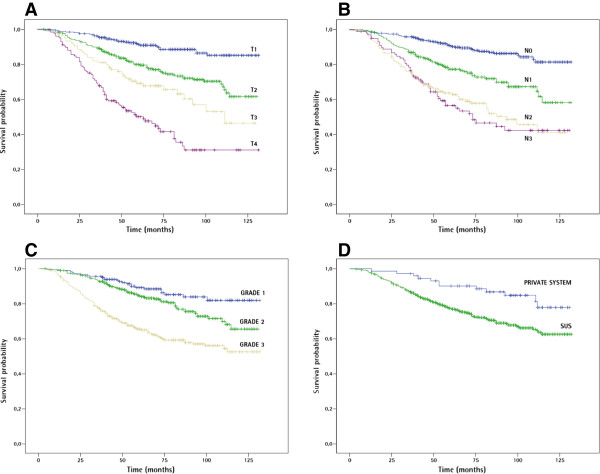
A total of 282 deaths occurred during the study's period, 228 of them due to breast cancer. Five-year breast cancer-specific survival rates were 95.5% for stage I, 85.1% for stage II and 62.1% for stage III disease. Patients from the SUS had higher stages at diagnosis (42% was in stage III, and from the private system only 17.6% was in this stage), and in the univariate but not multivariate analysis, being treated by the SUS was associated with shorter survival (hazard ratio, HR = 2.22, 95% CI 1.24-3.98). In the multivariate analysis, larger tumor size, higher histologic grade, higher number of positive nodes and age older than 70 years were associated with a shorter breast cancer-specific survival.
Five-year breast cancer survival was comparable to other Brazilian cohorts. Patients treated by the SUS, rather than by the private system, had shorter survival times, mostly due to higher initial stage of the disease.
乳腺癌发病率呈上升趋势。生存率各不相同,在高收入国家更长。在巴西,低收入人群依靠统一公共卫生系统(Sistema Único de Saude,SUS)接受乳腺癌治疗。我们研究的目的是评估一家主要治疗SUS患者的巴西公立医院中I - III期可手术乳腺癌患者的生存率。
对2001年至2008年在米纳斯吉拉斯联邦大学临床医院接受乳腺癌手术治疗的患者进行队列研究,共897例。收集了肿瘤病理和分期信息,以及患者年龄和医保类型(SUS或私立系统)。与死亡率信息系统数据库进行概率性记录链接,以确定截至2011年12月31日死亡的患者。检索死亡的根本原因,并用Kaplan - Meier方法估计乳腺癌特异性生存率。使用Cox比例风险模型对与生存相关的因素进行单变量和多变量分析。
在研究期间共发生282例死亡,其中228例死于乳腺癌。I期乳腺癌患者的五年特异性生存率为95.5%,II期为85.1%,III期为62.1%。来自SUS的患者诊断时分期更高(42%为III期,而私立系统中只有17.6%处于该分期),在单变量分析而非多变量分析中,接受SUS治疗与较短的生存期相关(风险比,HR = 2.22,95% CI 1.24 - 3.98)。在多变量分析中,肿瘤体积较大、组织学分级较高、阳性淋巴结数量较多以及年龄大于70岁与较短的乳腺癌特异性生存期相关。
五年乳腺癌生存率与其他巴西队列相当。接受SUS治疗而非私立系统治疗的患者生存期较短,主要是由于疾病的初始分期较高。