Department of Anatomy, PTE-MTA Lendulet PACAP Research Team, University of Pecs, Pécs 7624, Hungary.
Int J Mol Sci. 2013 Sep 16;14(9):19054-66. doi: 10.3390/ijms140919054.
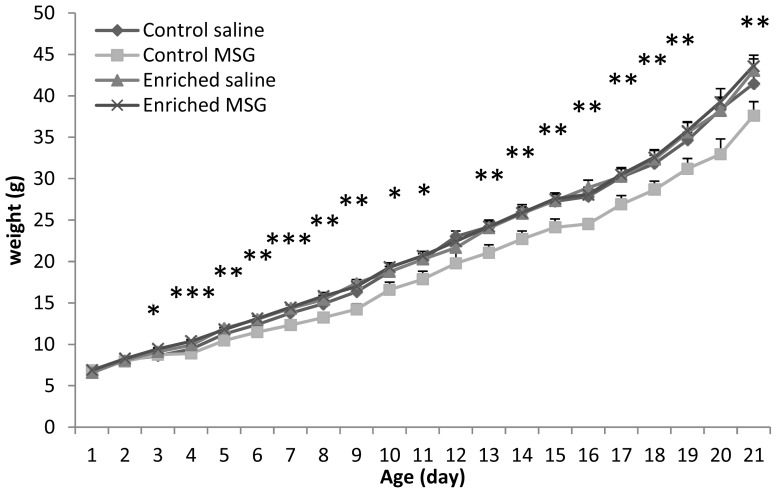
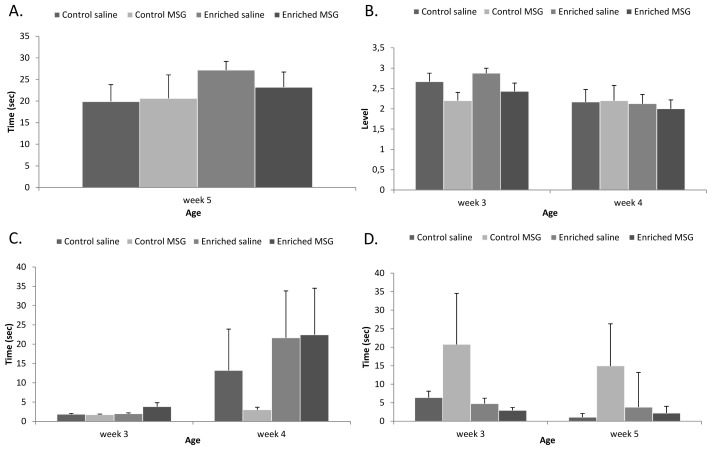
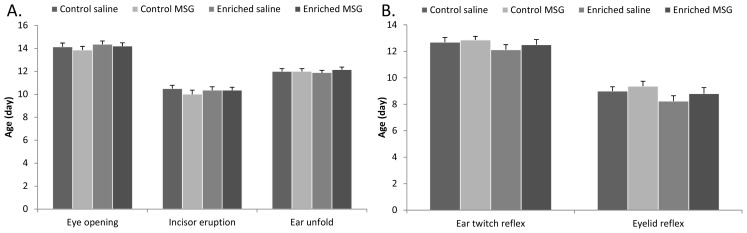
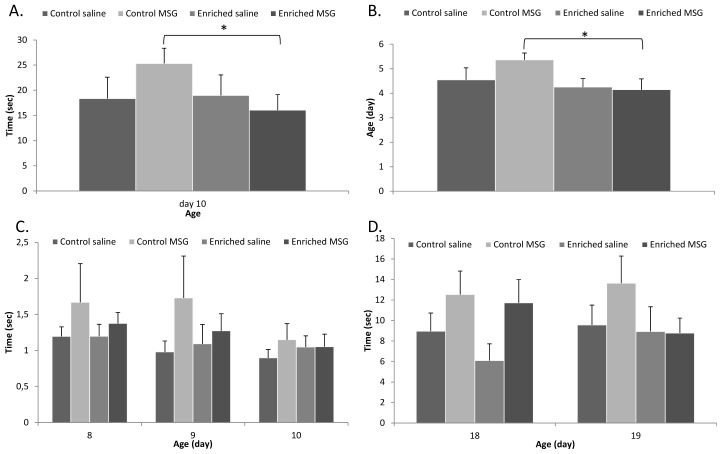
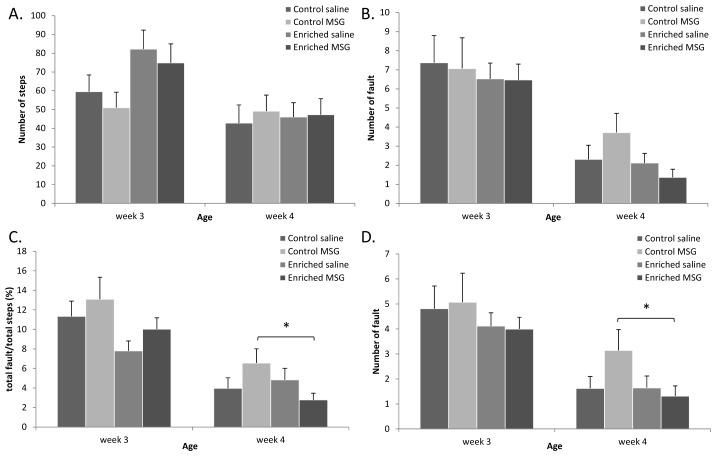
Environmental enrichment is a popular strategy to enhance motor and cognitive performance and to counteract the effects of various harmful stimuli. The protective effects of enriched environment have been shown in traumatic, ischemic and toxic nervous system lesions. Monosodium glutamate (MSG) is a commonly used taste enhancer causing excitotoxic effects when given in newborn animals. We have previously demonstrated that MSG leads to a delay in neurobehavioral development, as shown by the delayed appearance of neurological reflexes and maturation of motor coordination. In the present study we aimed at investigating whether environmental enrichment is able to decrease the neurobehavioral delay caused by neonatal MSG treatment. Newborn pups were treated with MSG subcutaneously on postnatal days 1, 5 and 9. For environmental enrichment, we placed rats in larger cages, supplemented with different toys that were altered daily. Normal control and enriched control rats received saline treatment only. Physical parameters such as weight, day of eye opening, incisor eruption and ear unfolding were recorded. Animals were observed for appearance of reflexes such as negative geotaxis, righting reflexes, fore- and hindlimb grasp, fore- and hindlimb placing, sensory reflexes and gait. In cases of negative geotaxis, surface righting and gait, the time to perform the reflex was also recorded daily. For examining motor coordination, we performed grid walking, footfault, rope suspension, rota-rod, inclined board and walk initiation tests. We found that enriched environment alone did not lead to marked alterations in the course of development. On the other hand, MSG treatment caused a slight delay in reflex development and a pronounced delay in weight gain and motor coordination maturation. This delay in most signs and tests could be reversed by enriched environment: MSG-treated pups kept under enriched conditions showed no weight retardation, no reflex delay in some signs and performed better in most coordination tests. These results show that environmental enrichment is able to decrease the neurobehavioral delay caused by neonatal excitotoxicity.
环境丰富是一种增强运动和认知表现、对抗各种有害刺激影响的流行策略。丰富环境的保护作用已在创伤性、缺血性和毒性神经系统损伤中得到证实。谷氨酸单钠(MSG)是一种常用的味觉增强剂,在新生动物中给予时会产生兴奋毒性作用。我们之前的研究表明,MSG 会导致神经行为发育延迟,表现为神经反射出现延迟和运动协调成熟。在本研究中,我们旨在研究环境丰富是否能减少新生期 MSG 处理引起的神经行为延迟。新生幼鼠在出生后第 1、5 和 9 天接受皮下 MSG 处理。为了进行环境丰富,我们将大鼠放置在更大的笼子中,并补充了不同的玩具,这些玩具每天都在变化。正常对照组和丰富对照组仅接受生理盐水处理。记录体重、睁眼日、切牙萌出和耳展开等生理参数。观察动物出现负趋地性、翻正反射、前肢和后肢抓握、前肢和后肢放置、感觉反射和步态等反射。在负趋地性、表面翻正和步态的情况下,每天还记录完成反射的时间。为了检查运动协调,我们进行了网格行走、足误、绳悬挂、转棒、斜板和行走启动测试。我们发现,环境丰富本身并不会导致发育过程中出现明显变化。另一方面,MSG 处理导致反射发育轻微延迟、体重增加和运动协调成熟明显延迟。这种在大多数迹象和测试中的延迟可以通过环境丰富来逆转:在丰富环境下饲养的 MSG 处理幼鼠没有体重滞后,一些迹象的反射延迟没有,在大多数协调测试中表现更好。这些结果表明,环境丰富能够减少新生期兴奋毒性引起的神经行为延迟。