Schreck R, Baeuerle P A
Laboratorium für molekulare Biologie Ludwig-Maximilians-Universität München, Federal Republic of Germany.
Mol Cell Biol. 1990 Mar;10(3):1281-6. doi: 10.1128/mcb.10.3.1281-1286.1990.
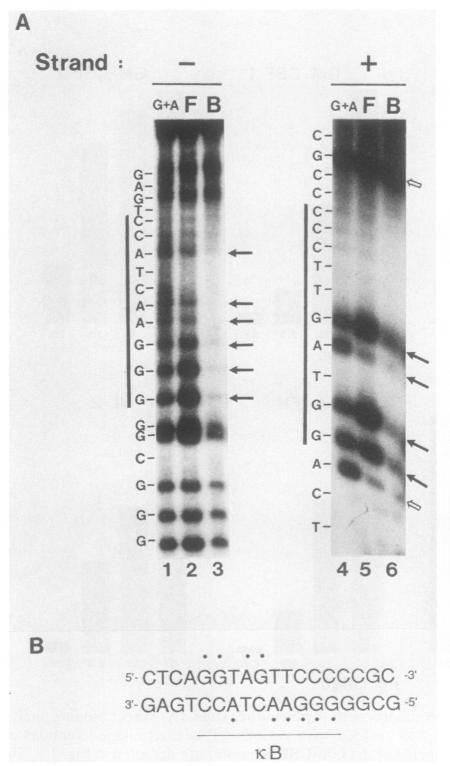
The expression of the gene encoding the granulocyte-macrophage colony-stimulating factor (GM-CSF) is induced upon activation of T cells with phytohemagglutinin and active phorbolester and upon expression of tax1, a transactivating protein of the human T-cell leukemia virus type I. The same agents induce transcription from the interleukin-2 receptor alpha-chain and interleukin-2 genes, depending on promoter elements that bind the inducible transcription factor NF-kappa B (or an NF-kappa B-like factor). We therefore tested the possibility that the GM-CSF gene is also regulated by a cognate motif for the NF-kappa B transcription factor. A recent functional analysis by Miyatake et al. (S. Miyatake, M. Seiki, M. Yoshida, and K. Arai, Mol. Cell. Biol. 8:5581-5587, 1988) described a short promoter region in the GM-CSF gene that conferred strong inducibility by T-cell-activating signals and tax1, but no NF-kappa B-binding motifs were identified. Using electrophoretic mobility shift assays, we showed binding of purified human NF-kappa B and of the NF-kappa B activated in Jurkat T cells to an oligonucleotide comprising the GM-CSF promoter element responsible for mediating responsiveness to T-cell-activating signals and tax1. As shown by a methylation interference analysis and oligonucleotide competition experiments, purified NF-kappa B binds at positions -82 to -91 (GGGAACTACC) of the GM-CSF promoter sequence with an affinity similar to that with which it binds to the biologically functional kappa B motif in the beta interferon promoter (GGGAAATTCC). Two kappa B-like motifs at positions -98 to -108 of the GM-CSF promoter were also recognized but with much lower affinities. Our data provide strong evidence that the expression of the GM-CSF gene following T-cell activation is controlled by binding of the NF-kappa B transcription factor to a high-affinity binding site in the GM-CSF promoter.
用植物血凝素和活性佛波酯激活T细胞以及表达人T细胞白血病病毒I型的反式激活蛋白tax1时,可诱导编码粒细胞巨噬细胞集落刺激因子(GM-CSF)的基因表达。同样的因子可诱导白细胞介素-2受体α链基因和白细胞介素-2基因转录,这取决于与诱导型转录因子NF-κB(或类NF-κB因子)结合的启动子元件。因此,我们测试了GM-CSF基因是否也受NF-κB转录因子的同源基序调控的可能性。Miyatake等人最近的功能分析(S. Miyatake、M. Seiki、M. Yoshida和K. Arai,《分子细胞生物学》8:5581 - 5587,1988年)描述了GM-CSF基因中的一个短启动子区域,该区域赋予T细胞激活信号和tax1很强的诱导性,但未鉴定出NF-κB结合基序。通过电泳迁移率变动分析,我们发现纯化的人NF-κB以及在Jurkat T细胞中被激活的NF-κB与包含GM-CSF启动子元件的寡核苷酸结合,该元件负责介导对T细胞激活信号和tax1的反应性。正如甲基化干扰分析和寡核苷酸竞争实验所示,纯化的NF-κB以与它结合β干扰素启动子中生物学功能κB基序(GGGAAATTCC)相似的亲和力,结合在GM-CSF启动子序列的 - 82至 - 91位(GGGAACTACC)。GM-CSF启动子 - 98至 - 108位的两个类κB基序也能被识别,但亲和力低得多。我们的数据提供了强有力的证据,表明T细胞激活后GM-CSF基因通过NF-κB转录因子与GM-CSF启动子中高亲和力结合位点的结合来控制其表达。