Allied Health Research Unit, University of Central Lancashire, Preston, UK.
BMJ Open. 2013 Sep 23;3(9):e003795. doi: 10.1136/bmjopen-2013-003795.
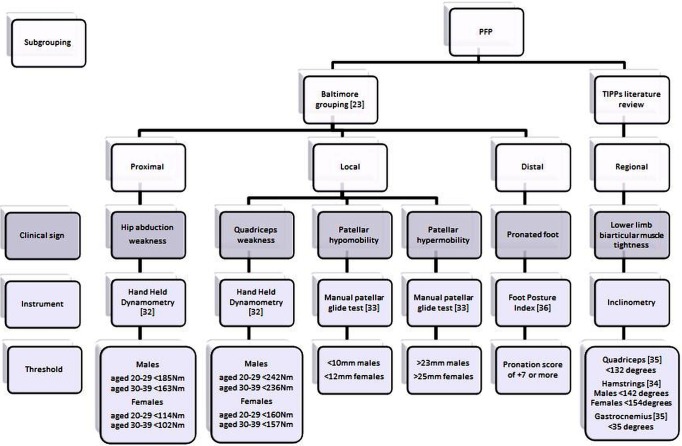
Patellofemoral pain (PFP) can cause significant pain leading to limitations in societal participation and physical activity. An international expert group has highlighted the need for a classification system to allow targeted intervention for patients with PFP; we have developed a work programme systematically investigating this. We have proposed six potential subgroups: hip abductor weakness, quadriceps weakness, patellar hypermobility, patellar hypomobility, pronated foot posture and lower limb biarticular muscle tightness. We could not uncover any evidence of the relative frequency with which patients with PFP fell into these subgroups or whether these subgroups were mutually exclusive. The aim of this study is to provide information on the clinical utility of our classification system.
150 participants will be recruited over 18 months in four National Health Services (NHS) physiotherapy departments in England.
adults 18-40 years with PFP for longer than 3 months, PFP in at least two predesignated functional activities and PFP elicited by clinical examination.
prior or forthcoming lower limb surgery; comorbid illness or health condition; and lower limb training or pregnancy. We will record medical history, demographic details, pain, quality of life, psychomotor movement awareness and knee temperature. We will assess hip abductor and quadriceps weakness, patellar hypermobility and hypomobility, foot posture and lower limb biarticular muscle tightness. The primary analytic approach will be descriptive. We shall present numbers and percentages of participants who meet the criteria for membership of (1) each of the subgroups, (2) none of the subgroups and (3) multiple subgroups. Exact (binomial) 95% CIs for these percentages will also be presented.
This study has been approved by National Research Ethics Service (NRES) Committee North West-Greater Manchester North (11/NW/0814) and University of Central Lancashire (UCLan) Built, Sport, Health (BuSH) Ethics Committee (BuSH 025). An abstract has been accepted for the third International Patellofemoral Pain Research Retreat, Vancouver, September 2013.
髌股疼痛(PFP)可导致显著疼痛,从而限制患者参与社会活动和进行体育锻炼。一个国际专家小组强调需要建立一种分类系统,以便针对 PFP 患者进行有针对性的干预;我们已经制定了一个系统的工作计划来对此进行研究。我们提出了六个可能的亚组:髋外展肌无力、股四头肌无力、髌骨过度活动、髌骨活动不足、足内翻和下肢双关节肌肉紧张。我们未能发现任何证据表明 PFP 患者属于这些亚组的相对频率,或者这些亚组是否相互排斥。本研究的目的是提供有关我们分类系统临床实用性的信息。
将在英格兰四个国民保健服务(NHS)物理治疗部门招募 150 名参与者,招募时间为 18 个月。
年龄 18-40 岁,PFP 病史超过 3 个月,至少有两种预先指定的功能活动出现 PFP,且临床检查可引出 PFP。
下肢手术史或即将进行下肢手术;并存疾病或健康状况;下肢训练或妊娠。我们将记录病史、人口统计学细节、疼痛、生活质量、运动知觉和膝关节温度。我们将评估髋外展肌和股四头肌无力、髌骨过度活动和活动不足、足内翻和下肢双关节肌肉紧张。主要分析方法是描述性的。我们将呈现符合以下标准的参与者人数和百分比:(1)每个亚组,(2)无亚组,(3)多个亚组。这些百分比的精确(二项式)95%置信区间也将呈现。
本研究已获得国家研究伦理服务(NRES)委员会西北-大曼彻斯特北(11/NW/0814)和中央兰开夏大学(UCLan)建筑、运动、健康(BuSH)伦理委员会(BuSH 025)的批准。一篇摘要已被接受在 2013 年 9 月温哥华举行的第三届国际髌股疼痛研究 retreat 上发表。