Department of Pharmacology and Neuroscience, Center FOR HER, Institute for Aging and Alzheimer's Disease Research, University of North Texas Health Science Center at Fort Worth Fort Worth, TX, USA.
Front Neurosci. 2013 Sep 19;7:159. doi: 10.3389/fnins.2013.00159.
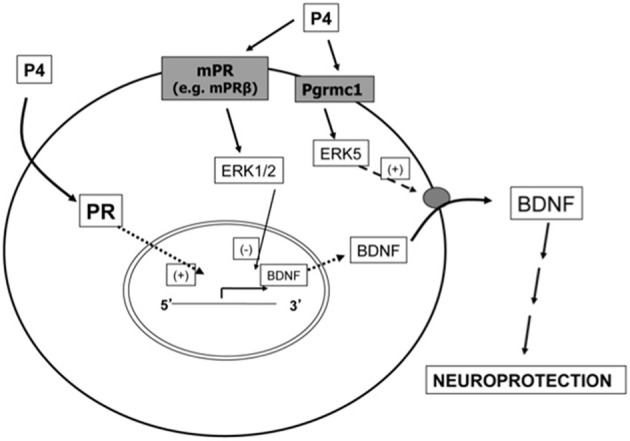
Progesterone is a gonadal steroid hormone whose physiological effects extend well beyond the strict confines of reproductive function. In fact, progesterone can have important effects on a variety of tissues, including the bone, the heart and the brain. Mechanistically, progesterone has been thought to exert its effects through the progesterone receptor (PR), a member of the nuclear steroid hormone superfamily, and as such, acts through specific progesterone response elements (PRE) within the promoter region of target genes to regulate transcription of such genes. This has been often described as the "genomic" mechanism of progesterone action. However, just as progesterone has a diverse range of tissue targets, the mechanisms through which progesterone elicits its effects are equally diverse. For example, progesterone can activate alternative receptors, such as membrane-associated PRs (distinct from the classical PR), to elicit the activation of several signaling pathways that in turn, can influence cell function. Here, we review various non-nuclear (i.e., non-genomic) signaling mechanisms that progesterone can recruit to elicit its effects, focusing our discussion primarily on those signaling mechanisms by which progesterone influences cell viability in the brain.
孕激素是一种性腺类固醇激素,其生理作用远远超出了生殖功能的严格范围。事实上,孕激素对各种组织都有重要影响,包括骨骼、心脏和大脑。从机制上讲,孕激素被认为通过核甾体激素超家族的孕激素受体 (PR) 发挥作用,因此,通过靶基因启动子区域内的特定孕激素反应元件 (PRE) 调节这些基因的转录。这通常被描述为孕激素作用的“基因组”机制。然而,正如孕激素有广泛的组织靶标一样,孕激素发挥作用的机制同样多种多样。例如,孕激素可以激活替代受体,如膜相关 PR(与经典 PR 不同),从而激活几种信号通路,进而影响细胞功能。在这里,我们综述了孕激素可以招募的各种非核(即非基因组)信号机制,主要集中讨论孕激素影响大脑中细胞活力的那些信号机制。