Center on Addiction, Learning and Memory, Department of Neuroscience, Baylor College of Medicine Houston, TX, USA.
Front Endocrinol (Lausanne). 2012 Jan 30;3:7. doi: 10.3389/fendo.2012.00007. eCollection 2012.
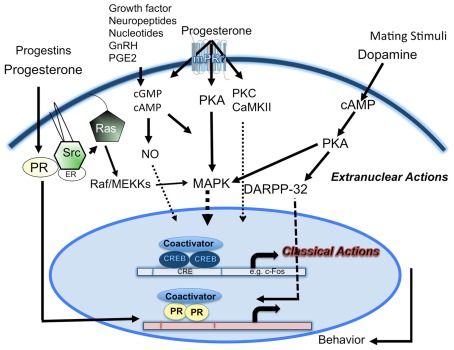
Steroid hormone, progesterone, modulates neuroendocrine functions in the central nervous system resulting in alterations in physiology and behavior. These neuronal effects are mediated primarily by intracellular progestin receptors (PRs) in the steroid-sensitive neurons, resulting in transcription-dependent genomic actions (classical mechanism). In addition to progesterone, intracellular PRs can also be activated in a "ligand-independent" manner by neurotransmitters, peptide growth factors, cyclic nucleotides, and neurosteroids. Recent studies indicate that rapid, non-classical progesterone actions involving cytoplasmic kinase signaling and/or extranuclear PRs can result in both transcription-independent and transcription-dependent actions. Cross-talk between extranuclear and classical intracellular signaling pathways promotes progesterone-dependent behavior in mammals. This review focuses on the mechanisms by which progesterone-initiated signaling mechanisms converge with PRs in the brain to modulate reproductive behavior in female rodents.
甾体激素孕酮通过调节中枢神经系统的神经内分泌功能,导致生理和行为的改变。这些神经元效应主要是通过类固醇敏感神经元中的细胞内孕激素受体(PR)介导的,导致转录依赖性基因组作用(经典机制)。除孕酮外,细胞内 PR 还可以通过神经递质、肽生长因子、环核苷酸和神经甾体以“配体非依赖性”方式激活。最近的研究表明,涉及细胞质激酶信号和/或核外 PR 的快速非经典孕酮作用可导致转录独立和转录依赖的作用。核外和经典细胞内信号通路之间的串扰促进了哺乳动物中依赖孕酮的行为。本综述重点讨论了孕酮起始信号机制与大脑中的 PR 相互作用,从而调节雌性啮齿动物的生殖行为的机制。