Department of Psychiatry, Tenth People's Hospital, Tongji University Shanghai, People's Republic of China ; Department of Psychiatry, Tongji Hospital, Tongji University Shanghai, People's Republic of China.
Front Cell Neurosci. 2013 Sep 19;7:142. doi: 10.3389/fncel.2013.00142. eCollection 2013.
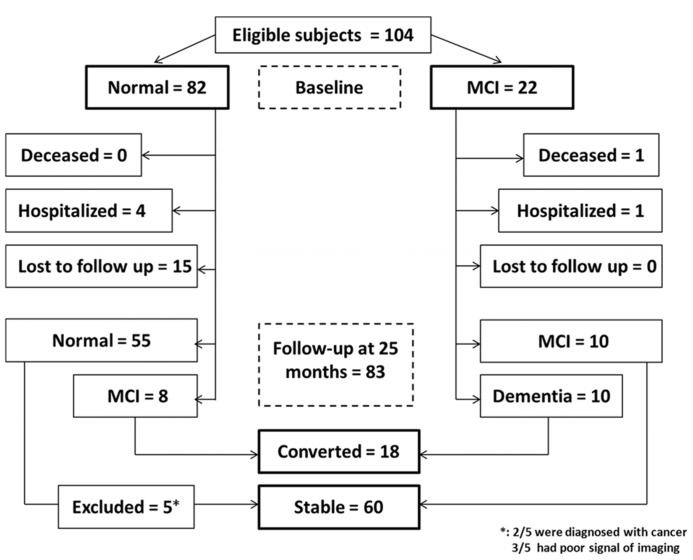
Thinner retinal nerve fiber layer (RNFL) has been reported in Alzheimer's disease (AD) patient. However, whether changes in RNFL thickness can predict the cognitive deterioration remains unknown. We therefore set out a prospective clinical investigation to determine the potential association between the attenuation of RNFL thickness and the deterioration of cognitive function over a period of 25 months. We assessed cognitive function using the Repeatable Battery for the Assessment of Neuropsychological Status and measured RNFL thickness employing optical coherence tomography in 78 participants (mean age 72.31 ± 3.98 years, 52% men). The participants were categorized as stable participants whose cognitive status remained no change (N = 60) and converted participants whose cognitive status deteriorated (N = 18). We found that there was an association between the attenuation of superior quadrant RNFL thickness and the deterioration of cognitive function in the stable participants. In the converted participants, however, there was an inverse association between the reduction of inferior quadrant RNFL thickness and decline of cognitive functions [scores of list recall (R = -0.670, P = 0.002), adjusted (R = -0.493, P = 0.031)]. These data showed that less reduction in the inferior quadrant of RNFL thickness might indicate a higher risk for the patients to develop cognitive deterioration. These findings have established a system to embark a larger scale study to further test whether changes in RNFL thickness can serve as a biomarker of AD, and would lead to mechanistic studies to determine the cellular mechanisms of cognitive deterioration.
较薄的视网膜神经纤维层 (RNFL) 在阿尔茨海默病 (AD) 患者中已有报道。然而,RNFL 厚度的变化是否可以预测认知能力下降仍不清楚。因此,我们进行了一项前瞻性临床研究,以确定 RNFL 厚度衰减与认知功能恶化之间在 25 个月期间的潜在关联。我们使用重复神经心理状态评估电池来评估认知功能,并使用光学相干断层扫描测量 78 名参与者(平均年龄 72.31 ± 3.98 岁,52%为男性)的 RNFL 厚度。参与者被分为认知状态无变化的稳定参与者(N = 60)和认知状态恶化的转换参与者(N = 18)。我们发现,在稳定参与者中,上象限 RNFL 厚度的衰减与认知功能的恶化之间存在关联。然而,在转换参与者中,下象限 RNFL 厚度的减少与认知功能的下降呈负相关[列表回忆得分(R = -0.670,P = 0.002),调整后(R = -0.493,P = 0.031)]。这些数据表明,RNFL 厚度下象限的减少较少可能表明患者发生认知恶化的风险较高。这些发现为开展更大规模的研究建立了一个系统,以进一步测试 RNFL 厚度的变化是否可以作为 AD 的生物标志物,并将导致确定认知恶化的细胞机制的机制研究。