Computational Biology Group, Department of Clinical Laboratory Sciences, Institute of Infectious Disease and Molecular Medicine, University of Cape Town, Medical School, Cape Town, South Africa.
PLoS One. 2013 Sep 16;8(9):e73971. doi: 10.1371/journal.pone.0073971. eCollection 2013.
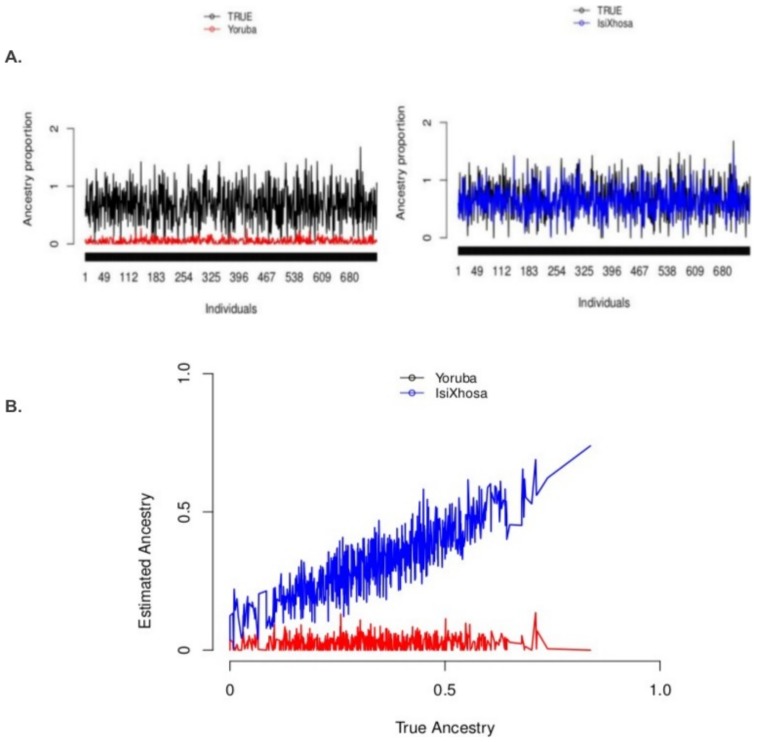
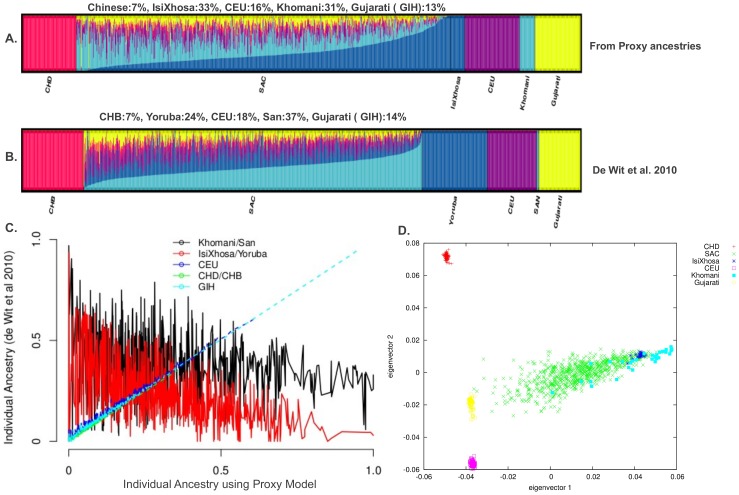
Admixed populations can make an important contribution to the discovery of disease susceptibility genes if the parental populations exhibit substantial variation in susceptibility. Admixture mapping has been used successfully, but is not designed to cope with populations that have more than two or three ancestral populations. The inference of admixture proportions and local ancestry and the imputation of missing genotypes in admixed populations are crucial in both understanding variation in disease and identifying novel disease loci. These inferences make use of reference populations, and accuracy depends on the choice of ancestral populations. Using an insufficient or inaccurate ancestral panel can result in erroneously inferred ancestry and affect the detection power of GWAS and meta-analysis when using imputation. Current algorithms are inadequate for multi-way admixed populations. To address these challenges we developed PROXYANC, an approach to select the best proxy ancestral populations. From the simulation of a multi-way admixed population we demonstrate the capability and accuracy of PROXYANC and illustrate the importance of the choice of ancestry in both estimating admixture proportions and imputing missing genotypes. We applied this approach to a complex, uniquely admixed South African population. Using genome-wide SNP data from over 764 individuals, we accurately estimate the genetic contributions from the best ancestral populations: isiXhosa [Formula: see text], ‡Khomani SAN [Formula: see text], European [Formula: see text], Indian [Formula: see text], and Chinese [Formula: see text]. We also demonstrate that the ancestral allele frequency differences correlate with increased linkage disequilibrium in the South African population, which originates from admixture events rather than population bottlenecks.
The collective term for people of mixed ancestry in southern Africa is "Coloured," and this is officially recognized in South Africa as a census term, and for self-classification. Whilst we acknowledge that some cultures may use this term in a derogatory manner, these connotations are not present in South Africa, and are certainly not intended here.
如果双亲群体在易感性方面表现出显著差异,混合人群可以为发现疾病易感基因做出重要贡献。混合映射已被成功应用,但它并不是为处理具有两个或三个以上祖先群体的人群而设计的。在理解疾病变异和识别新的疾病基因座方面,推断混合群体中的混合比例和局部祖先以及对缺失基因型的推断都至关重要。这些推断利用了参考群体,准确性取决于祖先群体的选择。使用不足或不准确的祖先面板会导致错误推断的祖先,并在使用推断时影响 GWAS 和荟萃分析的检测能力。当前的算法对于多向混合人群是不够的。为了解决这些挑战,我们开发了 PROXYANC,这是一种选择最佳代理祖先群体的方法。通过对一个多向混合人群的模拟,我们展示了 PROXYANC 的能力和准确性,并说明了在估计混合比例和推断缺失基因型时,祖先选择的重要性。我们将这种方法应用于一个复杂的、独特的混合南非人群。使用来自 764 多人的全基因组 SNP 数据,我们准确地估计了来自最佳祖先群体的遗传贡献:isiXhosa [Formula: see text],‡Khomani SAN [Formula: see text],欧洲 [Formula: see text],印度 [Formula: see text],和中国 [Formula: see text]。我们还表明,祖先等位基因频率的差异与南非人群中增加的连锁不平衡相关,这是由混合事件而不是种群瓶颈引起的。
南非混合血统人群的统称是“有色人种”,这在南非是官方认可的普查术语,也是自我分类的术语。虽然我们承认一些文化可能会以贬损的方式使用这个词,但在南非并没有这样的内涵,这里也绝对不是这个意思。