Wellcome Trust Centre for Human Genetics, University of Oxford, Oxford, United Kingdom ; MRC Functional Genomics Unit, Department of Physiology, Anatomy & Genetics, University of Oxford, Oxford, United Kingdom.
PLoS Genet. 2013;9(9):e1003751. doi: 10.1371/journal.pgen.1003751. Epub 2013 Sep 12.
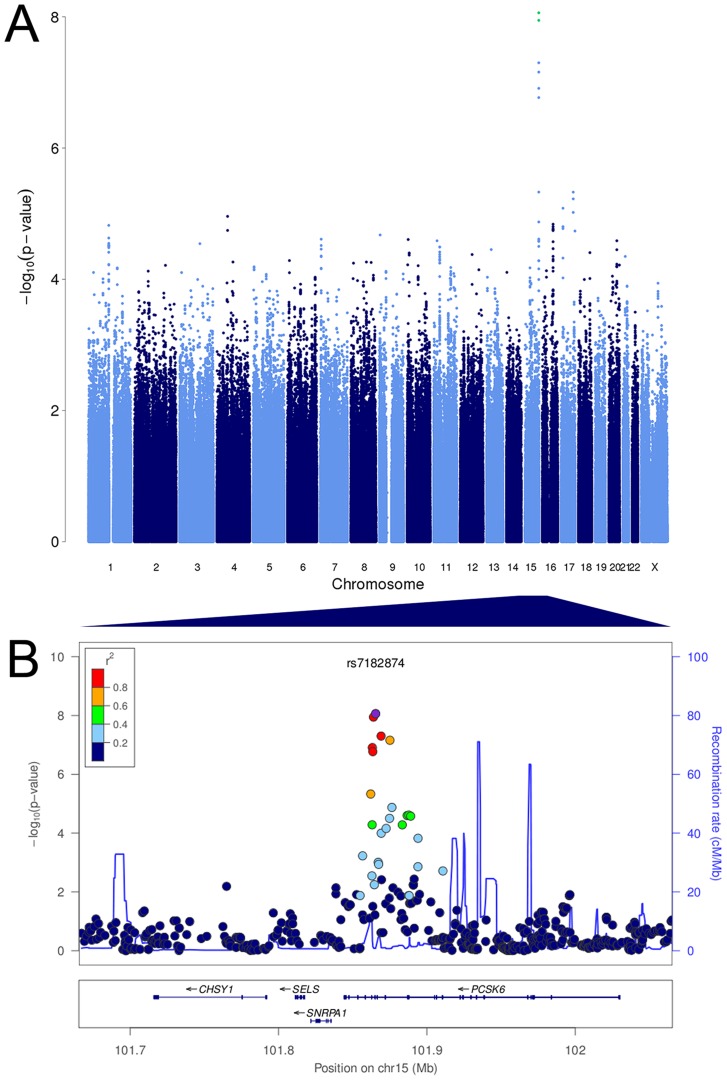
Humans display structural and functional asymmetries in brain organization, strikingly with respect to language and handedness. The molecular basis of these asymmetries is unknown. We report a genome-wide association study meta-analysis for a quantitative measure of relative hand skill in individuals with dyslexia [reading disability (RD)] (n = 728). The most strongly associated variant, rs7182874 (P = 8.68 × 10(-9)), is located in PCSK6, further supporting an association we previously reported. We also confirmed the specificity of this association in individuals with RD; the same locus was not associated with relative hand skill in a general population cohort (n = 2,666). As PCSK6 is known to regulate NODAL in the development of left/right (LR) asymmetry in mice, we developed a novel approach to GWAS pathway analysis, using gene-set enrichment to test for an over-representation of highly associated variants within the orthologs of genes whose disruption in mice yields LR asymmetry phenotypes. Four out of 15 LR asymmetry phenotypes showed an over-representation (FDR ≤ 5%). We replicated three of these phenotypes; situs inversus, heterotaxia, and double outlet right ventricle, in the general population cohort (FDR ≤ 5%). Our findings lead us to propose that handedness is a polygenic trait controlled in part by the molecular mechanisms that establish LR body asymmetry early in development.
人类大脑组织在结构和功能上存在不对称性,尤其是在语言和惯用手方面。这些不对称的分子基础尚不清楚。我们报告了一项针对阅读障碍(RD)个体相对手部技能的定量测量的全基因组关联研究荟萃分析(n = 728)。与该测量最显著相关的变体 rs7182874(P = 8.68 × 10(-9))位于 PCSK6 基因中,进一步支持了我们之前报道的关联。我们还在 RD 个体中证实了这种关联的特异性;相同的基因座与一般人群队列(n = 2,666)中相对手部技能没有关联。由于 PCSK6 已知在调节 NODAL 在小鼠左右(LR)不对称性发育中起作用,我们开发了一种新的 GWAS 途径分析方法,使用基因集富集来测试在破坏小鼠 LR 不对称性表型的基因的同源物中高度关联变体的过度表达。在 15 个 LR 不对称表型中,有 4 个表现出过度表达(FDR ≤ 5%)。我们在一般人群队列中复制了其中的 3 个表型;内脏反位、异位和右心室双出口(FDR ≤ 5%)。我们的发现使我们提出,惯用手是一种多基因特征,部分由早期发育中建立 LR 身体不对称的分子机制控制。