Northwest Academic Centre, Department of Medicine, The University of Melbourne, Victoria, Australia ; Barwon Biomedical Research, The Geelong Hospital, Geelong, Victoria, Australia.
PLoS One. 2013 Sep 12;8(9):e73266. doi: 10.1371/journal.pone.0073266. eCollection 2013.
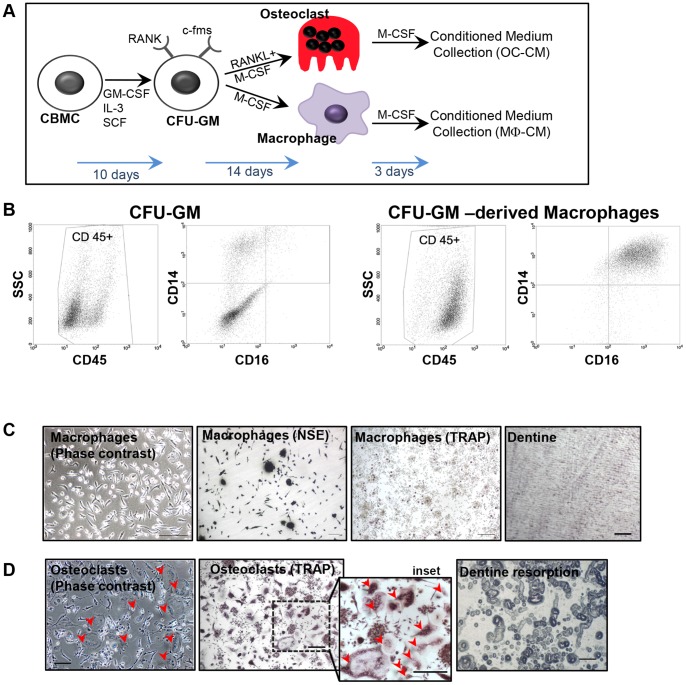
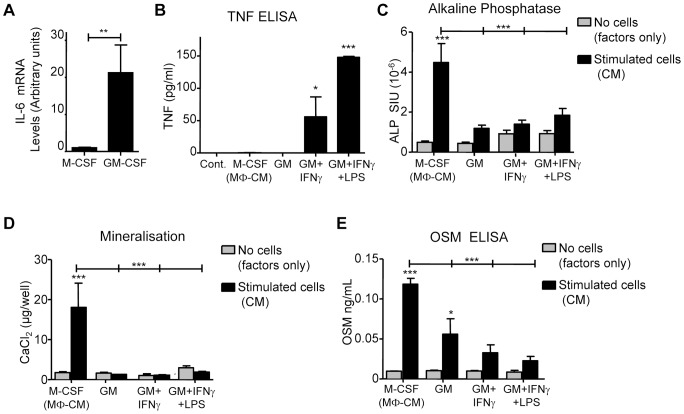
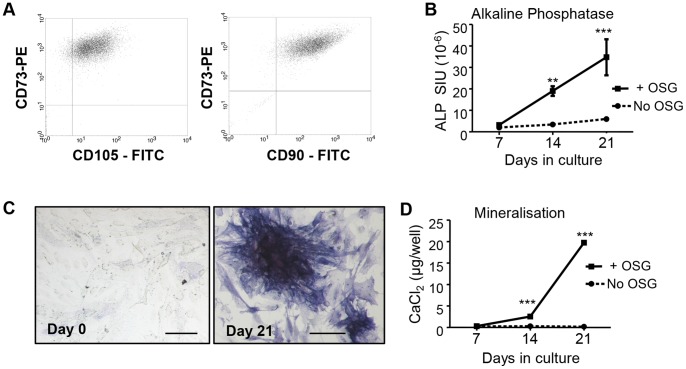
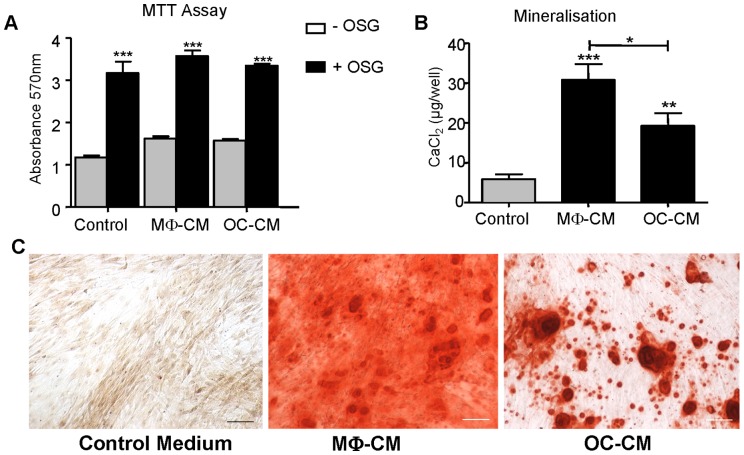
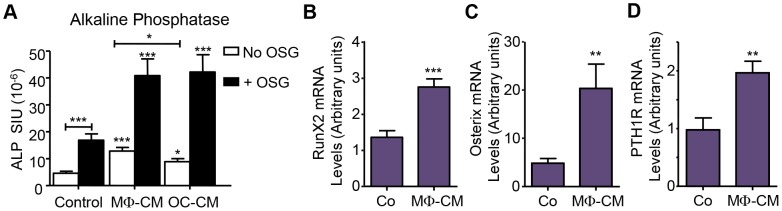
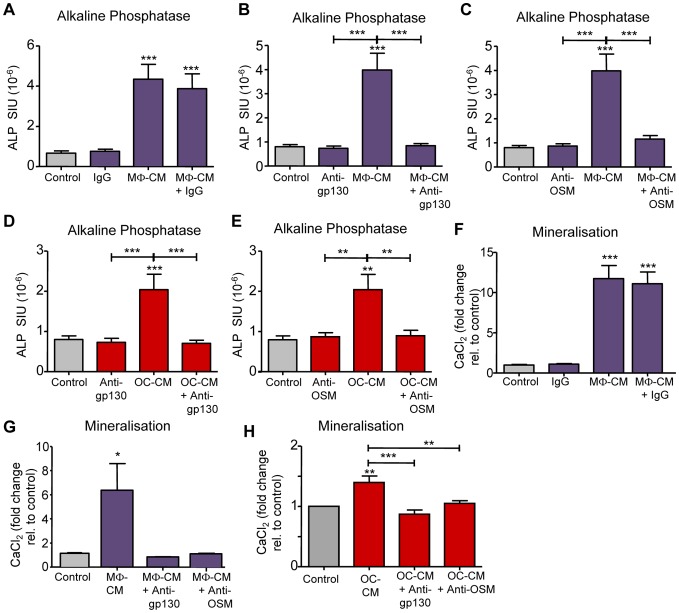
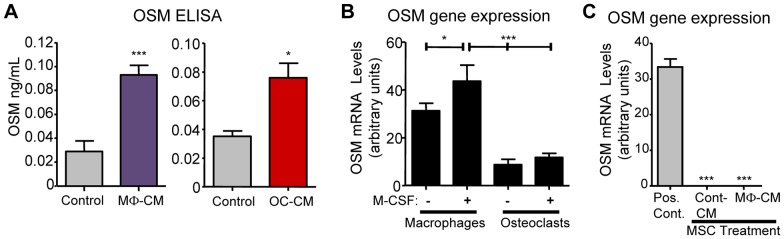
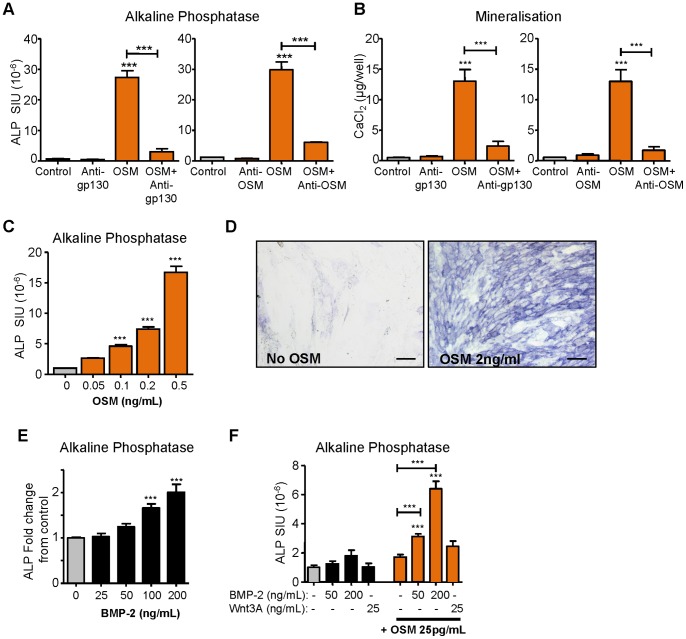
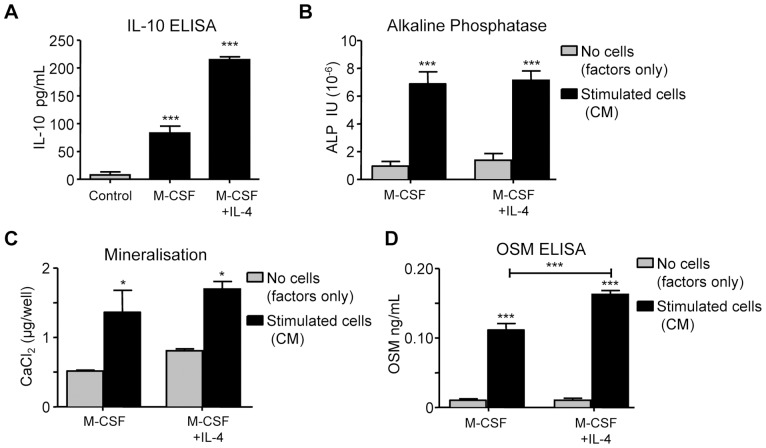
In bone, depletion of osteoclasts reduces bone formation in vivo, as does osteal macrophage depletion. How osteoclasts and macrophages promote the action of bone forming osteoblasts is, however, unclear. Since recruitment and differentiation of multi-potential stromal cells/mesenchymal stem cells (MSC) generates new active osteoblasts, we investigated whether human osteoclasts and macrophages (generated from cord blood-derived hematopoietic progenitors) induce osteoblastic maturation in adipose tissue-derived MSC. When treated with an osteogenic stimulus (ascorbate, dexamethasone and β-glycerophosphate) these MSC form matrix-mineralising, alkaline phosphatase-expressing osteoblastic cells. Cord blood-derived progenitors were treated with macrophage colony stimulating factor (M-CSF) to form immature proliferating macrophages, or with M-CSF plus receptor activator of NFκB ligand (RANKL) to form osteoclasts; culture medium was conditioned for 3 days by these cells to study their production of osteoblastic factors. Both osteoclast- and macrophage-conditioned medium (CM) greatly enhanced MSC osteoblastic differentiation in both the presence and absence of osteogenic medium, evident by increased alkaline phosphatase levels within 4 days and increased mineralisation within 14 days. These CM effects were completely ablated by antibodies blocking gp130 or oncostatin M (OSM), and OSM was detectable in both CM. Recombinant OSM very potently stimulated osteoblastic maturation of these MSC and enhanced bone morphogenetic protein-2 (BMP-2) actions on MSC. To determine the influence of macrophage activation on this OSM-dependent activity, CM was collected from macrophage populations treated with M-CSF plus IL-4 (to induce alternative activation) or with GM-CSF, IFNγ and LPS to cause classical activation. CM from IL-4 treated macrophages stimulated osteoblastic maturation in MSC, while CM from classically-activated macrophages did not. Thus, macrophage-lineage cells, including osteoclasts but not classically activated macrophages, can strongly drive MSC-osteoblastic commitment in OSM-dependent manner. This supports the notion that eliciting gp130-dependent signals in human MSC would be a useful approach to increase bone formation.
在骨骼中,破骨细胞的耗竭会减少体内的骨形成,骨巨噬细胞的耗竭也是如此。然而,破骨细胞和巨噬细胞如何促进成骨细胞的作用尚不清楚。由于多潜能基质细胞/间充质干细胞(MSC)的募集和分化产生新的活性成骨细胞,我们研究了人类破骨细胞和巨噬细胞(源自脐带血衍生的造血祖细胞)是否诱导脂肪组织衍生的 MSC 成骨细胞的成熟。当用成骨刺激物(抗坏血酸、地塞米松和β-甘油磷酸)处理时,这些 MSC 形成基质矿化、碱性磷酸酶表达的成骨细胞。脐带血衍生的祖细胞用巨噬细胞集落刺激因子(M-CSF)处理以形成未成熟增殖的巨噬细胞,或用 M-CSF 加核因子 κB 配体受体激活剂(RANKL)处理以形成破骨细胞;这些细胞的培养基被调节 3 天以研究它们产生的成骨因子。破骨细胞和巨噬细胞条件培养基(CM)都极大地增强了 MSC 在有或没有成骨培养基存在下的成骨细胞分化,这表现在 4 天内碱性磷酸酶水平增加和 14 天内矿化增加。这些 CM 效应完全被阻断 gp130 或肿瘤坏死因子(OSM)的抗体所消除,并且在两种 CM 中都可检测到 OSM。重组 OSM 非常有效地刺激这些 MSC 的成骨细胞成熟,并增强骨形态发生蛋白-2(BMP-2)对 MSC 的作用。为了确定巨噬细胞激活对这种 OSM 依赖性活性的影响,从用 M-CSF 加 IL-4(诱导替代激活)或用 GM-CSF、IFNγ 和 LPS 处理的巨噬细胞群体中收集 CM。用 IL-4 处理的巨噬细胞的 CM 刺激 MSC 的成骨细胞成熟,而经典激活的巨噬细胞的 CM 则没有。因此,包括破骨细胞在内的巨噬细胞谱系细胞,但不是经典激活的巨噬细胞,可以强烈地以 OSM 依赖的方式驱动 MSC-成骨细胞的承诺。这支持了这样一种观点,即在人 MSC 中引发 gp130 依赖性信号将是增加骨形成的有用方法。