Department of Biology, Centre for Social Evolution, University of Copenhagen, Universitetsparken 15, Copenhagen 2100, Denmark.
BMC Evol Biol. 2013 Sep 27;13:211. doi: 10.1186/1471-2148-13-211.
Organisms are predicted to behave more favourably towards relatives, and kin-biased cooperation has been found in all domains of life from bacteria to vertebrates. Cooperation based on genetic recognition cues is paradoxical because it disproportionately benefits individuals with common phenotypes, which should erode the required cue polymorphism. Theoretical models suggest that many recognition loci likely have some secondary function that is subject to diversifying selection, keeping them variable.
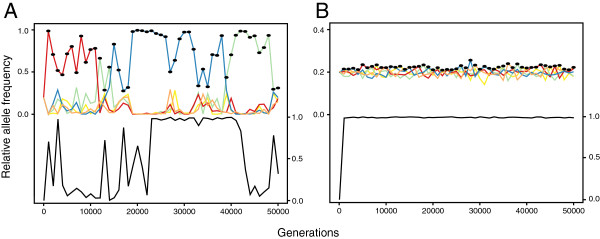
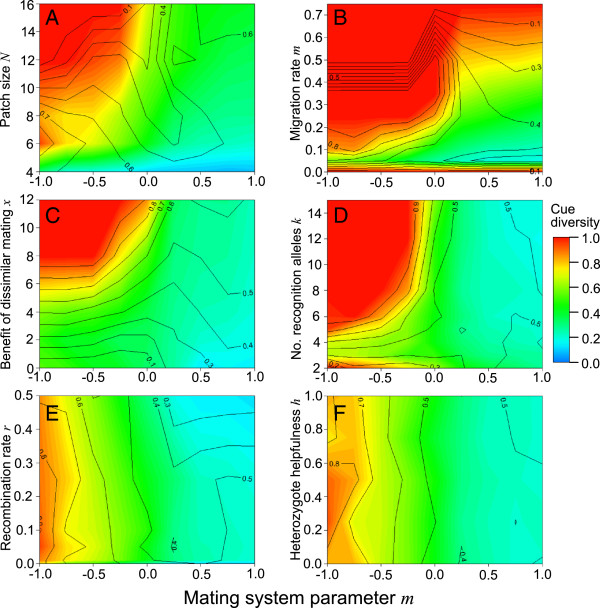
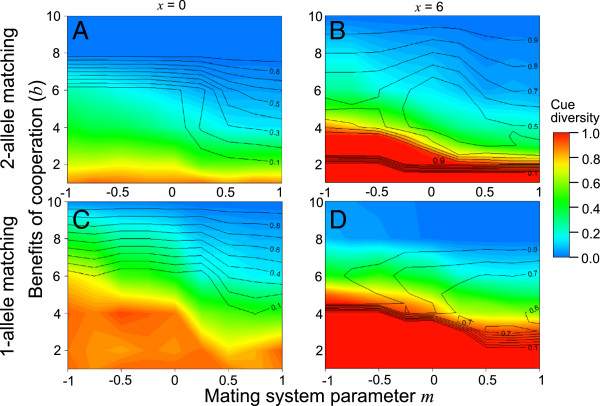
Here, we use individual-based simulations to investigate the hypothesis that the dual use of recognition cues to facilitate social behaviour and disassortative mating (e.g. for inbreeding avoidance) can maintain cue diversity over evolutionary time. Our model shows that when organisms mate disassortatively with respect to their recognition cues, cooperation and recognition locus diversity can persist at high values, especially when outcrossed matings produce more surviving offspring. Mating system affects cue diversity via at least four distinct mechanisms, and its effects interact with other parameters such as population structure. Also, the attrition of cue diversity is less rapid when cooperation does not require an exact cue match. Using a literature review, we show that there is abundant empirical evidence that heritable recognition cues are simultaneously used in social and sexual behaviour.
Our models show that mate choice is one possible resolution of the paradox of genetic kin recognition, and the literature review suggests that genetic recognition cues simultaneously inform assortative cooperation and disassortative mating in a large range of taxa. However, direct evidence is scant and there is substantial scope for future work.
生物被预测会更倾向于亲属,并且从细菌到脊椎动物的所有生命领域都发现了基于亲缘关系的合作。基于遗传识别线索的合作是矛盾的,因为它不成比例地使具有共同表型的个体受益,而这应该会侵蚀所需的线索多态性。理论模型表明,许多识别基因座可能具有一些次要功能,这些功能受到多样化选择的影响,从而保持其可变性。
在这里,我们使用基于个体的模拟来研究以下假设:即识别线索的双重用途(例如促进社交行为和避免近亲交配)可以维持识别线索的多样性,以适应进化时间的变化。我们的模型表明,当生物体根据其识别线索进行异质交配时,合作和识别基因座的多样性可以保持在较高水平,尤其是当异交交配产生更多存活后代时。交配系统通过至少四个不同的机制影响线索多样性,并且其效应与其他参数(如种群结构)相互作用。此外,当合作不需要精确的线索匹配时,线索多样性的衰减速度较慢。通过文献综述,我们表明有大量的经验证据表明,可遗传的识别线索同时用于社交和性行为。
我们的模型表明,选择配偶是解决遗传亲缘关系悖论的一种可能方法,文献综述表明,在许多类群中,遗传识别线索同时为趋同合作和异质交配提供信息。然而,直接证据很少,未来还有很大的工作空间。