Ribeiro Edson A, Poli-de-Figueiredo Luiz F, Vincenzi Rodrigo, Galvao Flavio H F, Margarido Nelson, Rocha-E-Silva Mauricio, Cruz Ruy J
Research Division, Heart Institute (InCor), University of Sao Paulo School of Medicine, 05403-900 Sao Paulo, SP, Brazil ; Hospital do Cancer de Muriae, Fundacao Cristiano Varella, 36880-000 Muriae, MG, Brazil.
HPB Surg. 2013;2013:689835. doi: 10.1155/2013/689835. Epub 2013 Aug 29.
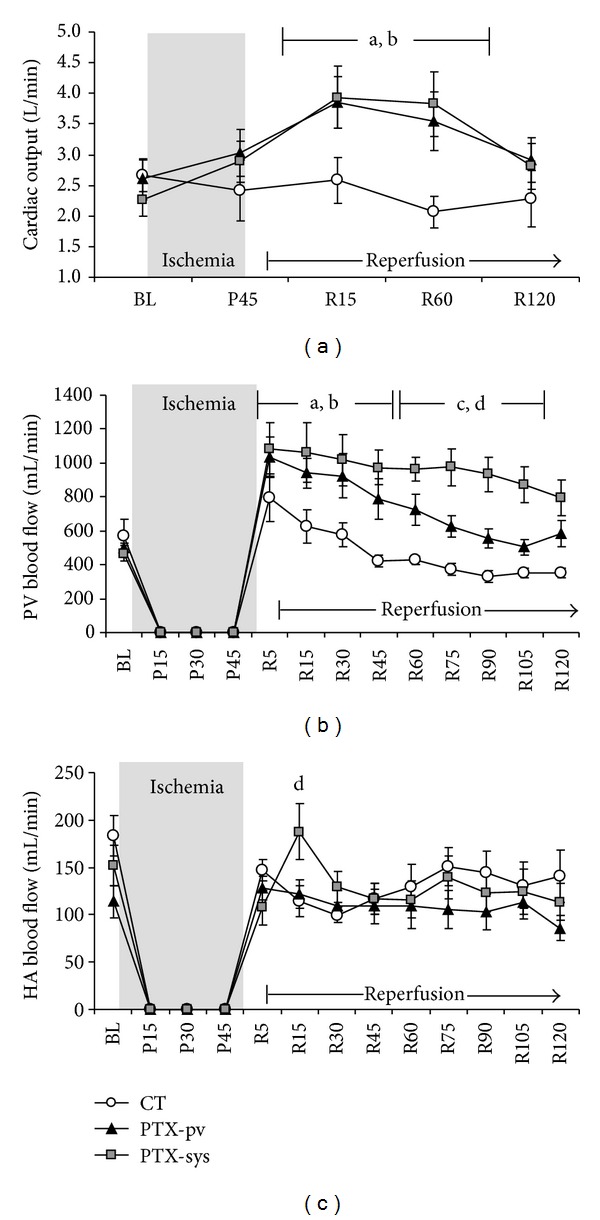
Pentoxifylline (PTX) has been shown to have beneficial effects on microcirculatory blood flow. In this study we evaluate the potential hemodynamic and metabolic benefits of PTX during hepatic ischemia. We also test the hypothesis that portal PTX infusion can minimize the I/R injury when compared to systemic infusion. Methods. Twenty-four dogs (18.1 ± 0.7 kg) were subjected to portal triad occlusion (PTO) for 45 min. The animals were assigned to 3 groups: CT (control, PTO, n = 8), PTX-syst (PTO + 25 mg/Kg of PTX IV, n = 8), and PTX-pv (PTO + 25 mg/Kg of PTX in the portal vein, n = 8). Animals were followed for 120 min. Systemic hemodynamics, gastrointestinal tract perfusion, oxygen-derived variables, and liver enzymes were evaluated throughout the experiment. Results. Animals treated with PTX presented significantly higher CO in the first hour after reperfusion, when compared to the CT (~3.7 vs. 2.1 L/min, P < 0.05). Alanine aminotransferase (ALT) was similar in the PTX groups two hours after reperfusion but significantly higher in the CT (227 vs. ~64 U/L, P < 0.05). Conclusion. PTX infusion was associated with hemodynamic benefits and was able to minimize liver injury during normothermic hepatic I/R. However, local PTX infusion was not associated with any significant advantage over systemic route.
己酮可可碱(PTX)已被证明对微循环血流有有益作用。在本研究中,我们评估了PTX在肝脏缺血期间潜在的血流动力学和代谢益处。我们还检验了这样一个假设,即与全身输注相比,门静脉输注PTX可使缺血/再灌注损伤最小化。方法。24只犬(18.1±0.7千克)接受门静脉三联阻断(PTO)45分钟。动物被分为3组:CT组(对照组,PTO,n = 8)、PTX-syst组(PTO + 25毫克/千克PTX静脉注射,n = 8)和PTX-pv组(PTO + 25毫克/千克PTX门静脉注射,n = 8)。对动物进行120分钟的随访。在整个实验过程中评估全身血流动力学、胃肠道灌注、氧衍生变量和肝酶。结果。与CT组相比,接受PTX治疗的动物在再灌注后的第一小时CO显著更高(3.7对2.1升/分钟,P < 0.05)。再灌注两小时后,PTX组的丙氨酸转氨酶(ALT)相似,但CT组显著更高(227对64 U/L,P < 0.05)。结论。输注PTX与血流动力学益处相关,并且能够在常温肝脏缺血/再灌注期间使肝损伤最小化。然而,局部PTX输注与全身途径相比没有任何显著优势。