Blizard Institute, Barts and the London School of Medicine and Dentistry, Queen Mary University of London, London, United Kingdom ; Bone & Joint Research Unit, John Vane Science Centre, Queen Mary University of London, London, United Kingdom.
PLoS One. 2013 Sep 20;8(9):e75091. doi: 10.1371/journal.pone.0075091. eCollection 2013.
Neuronal damage is the morphological substrate of persisting neurological disability. Neurofilaments (Nf) are cytoskeletal proteins of neurons and their release into cerebrospinal fluid has shown encouraging results as a biomarker for neurodegeneration. This study aimed to validate the quantification of the Nf light chain (NfL) in blood samples, as a biofluid source easily accessible for longitudinal studies.
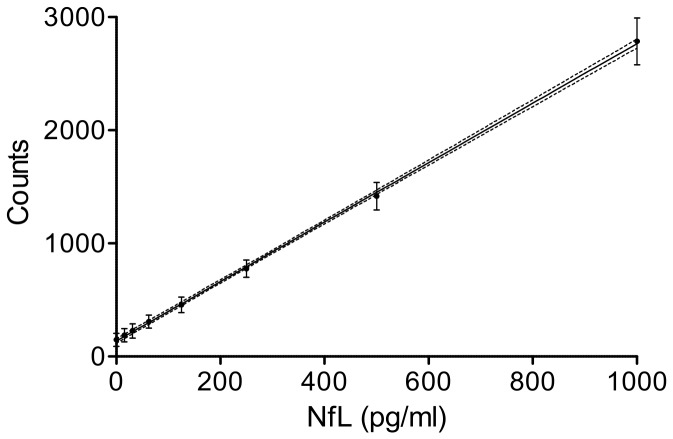
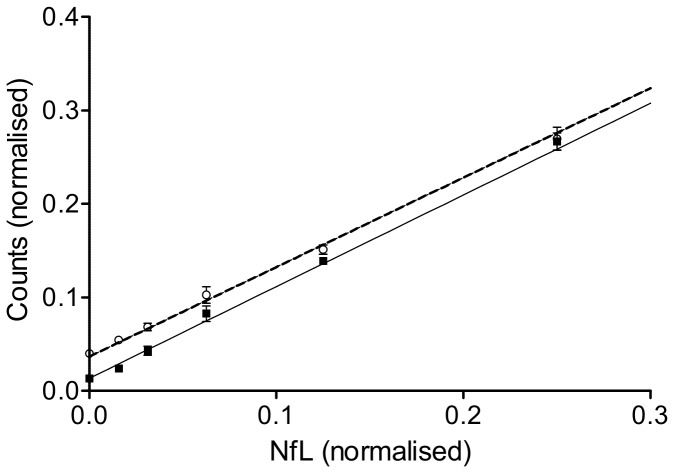
We developed and applied a highly sensitive electrochemiluminescence (ECL) based immunoassay for quantification of NfL in blood and CSF.
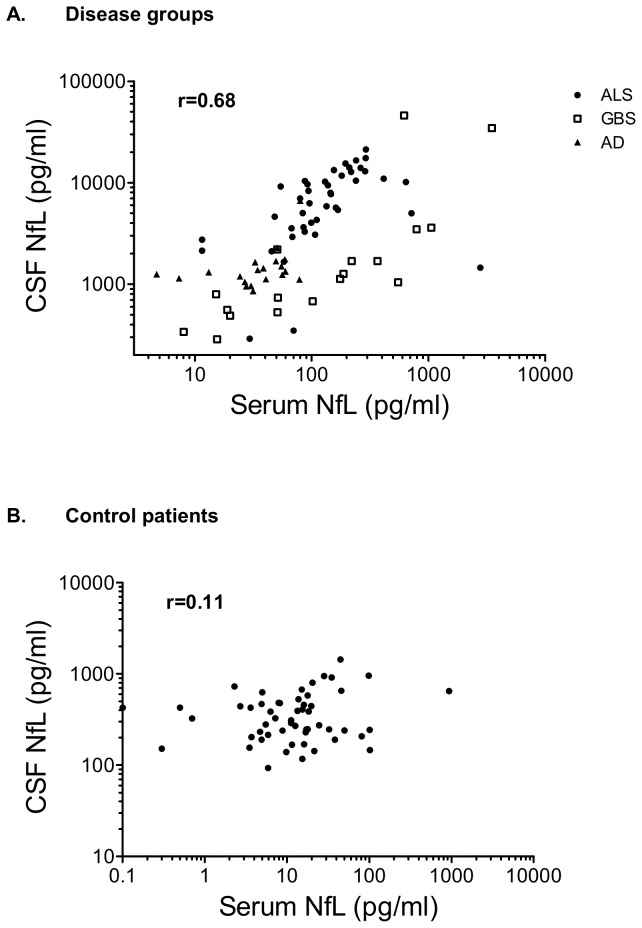
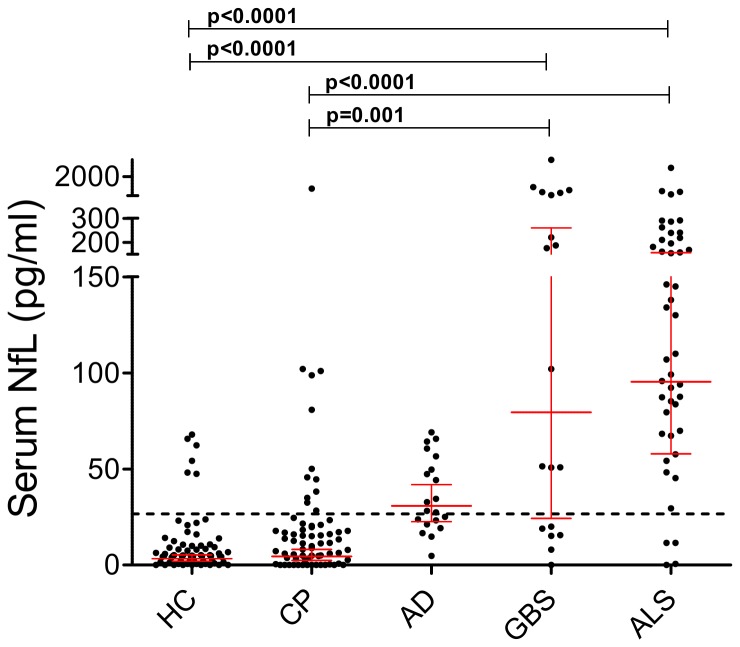
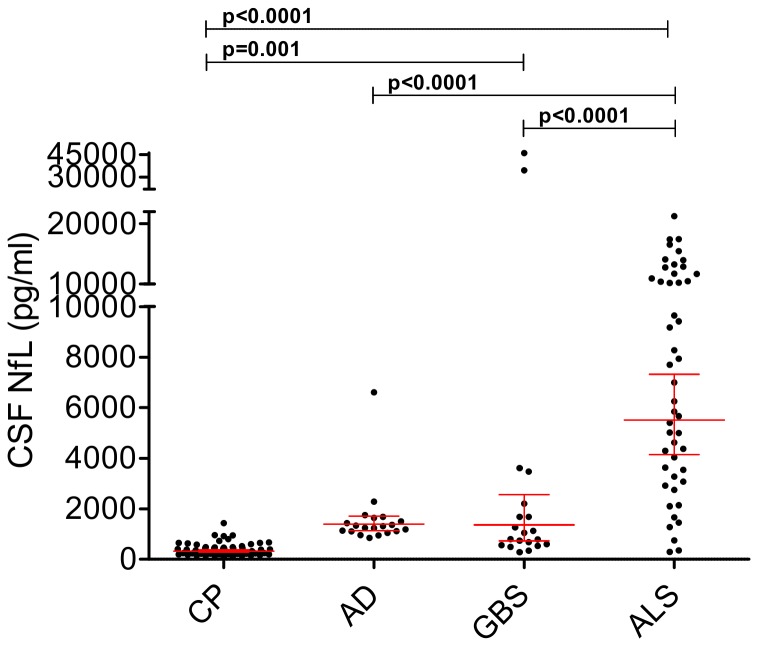
Patients with Alzheimer's disease (AD) (30.8 pg/ml, n=20), Guillain-Barré-syndrome (GBS) (79.4 pg/ml, n=19) or amyotrophic lateral sclerosis (ALS) (95.4 pg/ml, n=46) had higher serum NfL values than a control group of neurological patients without evidence of structural CNS damage (control patients, CP) (4.4 pg/ml, n=68, p<0.0001 for each comparison, p=0.002 for AD patients) and healthy controls (HC) (3.3 pg/ml, n=67, p<0.0001). Similar differences were seen in corresponding CSF samples. CSF and serum levels correlated in AD (r=0.48, p=0.033), GBS (r=0.79, p<0.0001) and ALS (r=0.70, p<0.0001), but not in CP (r=0.11, p=0.3739). The sensitivity and specificity of serum NfL for separating ALS from healthy controls was 91.3% and 91.0%.
We developed and validated a novel ECL based sandwich immunoassay for the NfL protein in serum (NfL(Umea47:3)); levels in ALS were more than 20-fold higher than in controls. Our data supports further longitudinal studies of serum NfL in neurodegenerative diseases as a potential biomarker of on-going disease progression, and as a potential surrogate to quantify effects of neuroprotective drugs in clinical trials.
神经元损伤是持续性神经功能障碍的形态学基础。神经丝(Nf)是神经元的细胞骨架蛋白,其在脑脊液中的释放已被证明作为神经退行性变的生物标志物具有令人鼓舞的结果。本研究旨在验证血液样本中神经丝轻链(NfL)的定量,作为一种易于进行纵向研究的生物流体来源。
我们开发并应用了一种基于高灵敏度电化学发光(ECL)的免疫分析法,用于定量血液和脑脊液中的 NfL。
阿尔茨海默病(AD)患者(30.8pg/ml,n=20)、吉兰-巴雷综合征(GBS)患者(79.4pg/ml,n=19)或肌萎缩侧索硬化症(ALS)患者(95.4pg/ml,n=46)的血清 NfL 值高于无结构中枢神经系统损伤证据的神经科患者对照组(对照组,CP)(4.4pg/ml,n=68,p<0.0001,每次比较均p=0.002,AD 患者)和健康对照组(HC)(3.3pg/ml,n=67,p<0.0001)。在相应的 CSF 样本中也观察到类似的差异。AD(r=0.48,p=0.033)、GBS(r=0.79,p<0.0001)和 ALS(r=0.70,p<0.0001)中 CSF 和血清水平相关,但 CP 中不相关(r=0.11,p=0.3739)。血清 NfL 用于将 ALS 与健康对照组区分的灵敏度和特异性分别为 91.3%和 91.0%。
我们开发并验证了一种新的基于电化学发光的血清 NfL 蛋白夹心免疫分析法(NfL(Umea47:3));ALS 患者的水平比对照组高出 20 多倍。我们的数据支持进一步对神经退行性疾病中血清 NfL 进行纵向研究,作为疾病进展的潜在生物标志物,以及作为临床试验中量化神经保护药物效果的潜在替代物。