Coleman Annabelle, Touzé Alexiane, Farag Mena, Pengo Marta, Murphy Michael J, Hassan Yara, Thackeray Olivia, Fayer Kate, Field Sophie, Nakajima Mitsuko, Broom Elizabeth L, Hobbs Nicola Z, Huxford Brook, Donkor Natalie, Camboe Ellen, Dey Kamalesh C, Zirra Alexandra, Ahmed Aisha, Gameiro Costa Ana Rita, Sorrell Harriet, Zampedri Luca, Lombardi Vittoria, Wade Charles, Mangion Sean, Fneich Batoul, Heslegrave Amanda, Zetterberg Henrik, Scahill Rachael, Noyce Alastair, Malaspina Andrea, Chataway Jeremy, Tabrizi Sarah J, Byrne Lauren M
UCL Huntington's Disease Centre, UCL Queen Square Institute of Neurology, Queen Square, London, WC1N 3BG, UK.
Department of Molecular and Translational Medicine, University of Brescia, 25123, Brescia, Italy.
J Neurol. 2025 Jul 10;272(8):501. doi: 10.1007/s00415-025-13232-8.
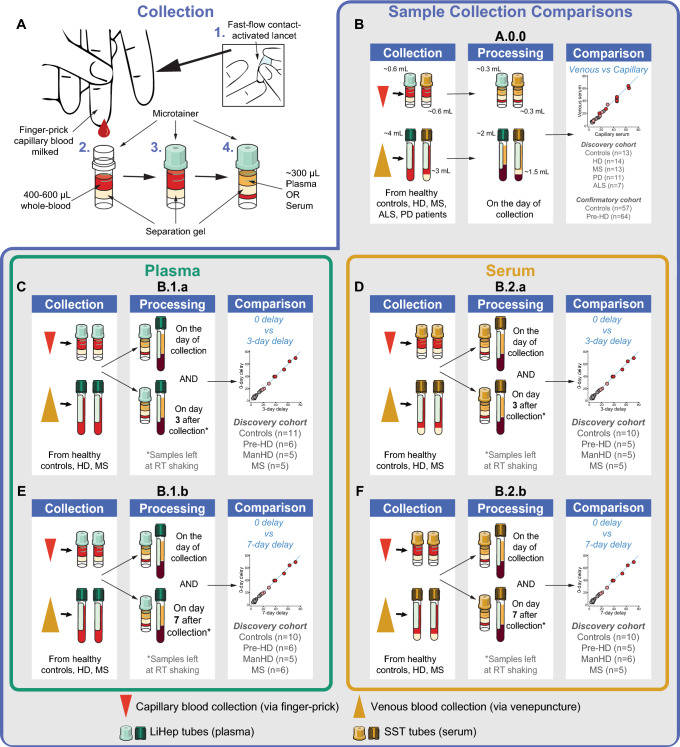
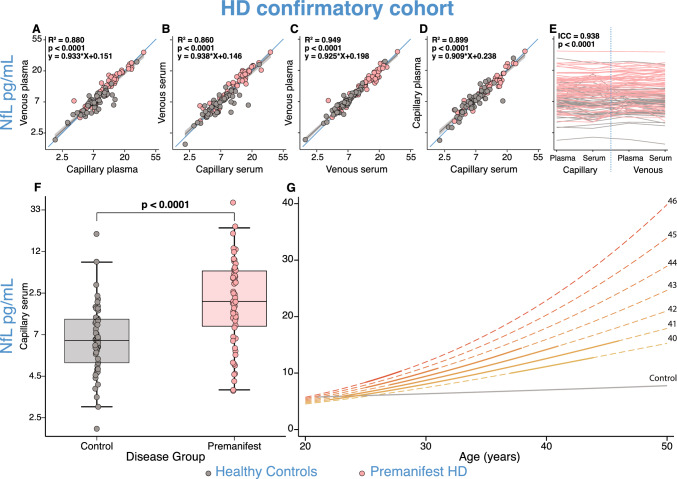
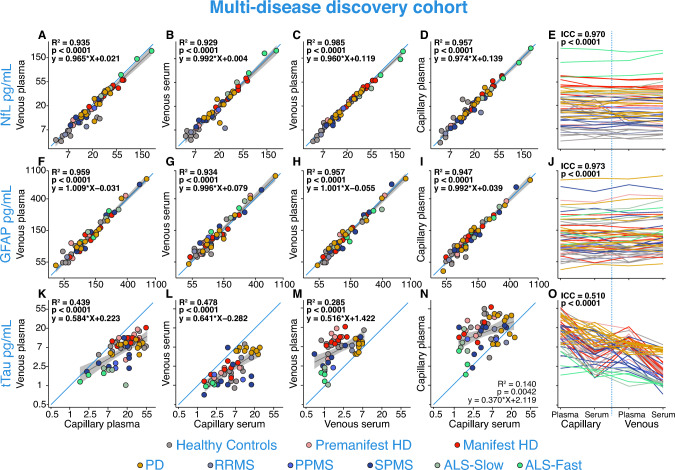
Promising blood-based biomarkers of neuropathology have emerged with potential for therapeutic development and disease monitoring. However, these tools will require specialist tertiary services for integration into clinical management. Remote sampling for biomarker assessment could reduce burden of in-person clinical visits for such tests as well as increasing the sampling frequency and patient geographical outreach. Here, we evaluated a finger-prick blood collection approach for remote quantification of neurofilament light (NfL), a candidate blood-based biomarker evident in various neurological disorders, and other exploratory markers of neuronal injury and neuroinflammation (GFAP, tau). Matched samples from venepuncture and finger-prick were collected and processed into plasma and/or serum to directly compare analyte levels from a multi-disease discovery cohort (n = 54 healthy controls; n = 57 Huntington's disease (HD); n = 34 multiple sclerosis; n = 7 amyotrophic lateral sclerosis; n = 11 Parkinson's disease), and a HD confirmatory cohort (n = 57 healthy controls; n = 64 HD). Two delayed processing conditions were compared, three- and seven-day delay, simulating ambient shipment. Capillary NfL and GFAP concentrations were equivalent to those in venous serum and plasma in the multi-disease discovery cohort and HD confirmatory cohort. Only NfL remained stable after a seven-day processing delay in both venous and capillary serum samples. Using NfL concentrations from capillary blood, we replicated previously published disease group differences measured in venous blood. This data supports our finger-prick approach for remote collection and quantification of NfL. With the widespread applications for NfL across the spectrum of neurological disorders, this has the potential to transform disease monitoring, prognosis, and therapeutic development within clinical practice and research.
有前景的基于血液的神经病理学生物标志物已出现,具有治疗开发和疾病监测的潜力。然而,这些工具需要专业的三级服务才能整合到临床管理中。用于生物标志物评估的远程采样可以减少此类检测的亲自临床就诊负担,同时提高采样频率并扩大患者地理覆盖范围。在此,我们评估了一种手指采血方法,用于远程定量神经丝轻链(NfL),这是一种在各种神经系统疾病中明显的基于血液的候选生物标志物,以及其他神经元损伤和神经炎症的探索性标志物(胶质纤维酸性蛋白(GFAP)、tau)。收集静脉穿刺和手指采血的匹配样本,并将其处理成血浆和/或血清,以直接比较来自多疾病发现队列(n = 54名健康对照;n = 57名亨廷顿舞蹈病(HD);n = 34名多发性硬化症;n = 7名肌萎缩侧索硬化症;n = 11名帕金森病)和HD验证队列(n = 57名健康对照;n = 64名HD)的分析物水平。比较了两种延迟处理条件,即三天和七天延迟,模拟常温运输。在多疾病发现队列和HD验证队列中,毛细血管NfL和GFAP浓度与静脉血清和血浆中的浓度相当。在静脉和毛细血管血清样本中,只有NfL在七天处理延迟后仍保持稳定。使用毛细血管血中的NfL浓度,我们复制了先前发表的在静脉血中测量的疾病组差异。这些数据支持我们用于远程采集和定量NfL的手指采血方法。随着NfL在整个神经系统疾病谱中的广泛应用,这有可能改变临床实践和研究中的疾病监测、预后和治疗开发。