Qingdao Institute of Bioenergy and Bioprocess Technology, Chinese Academy of Sciences, Qingdao, Shandong, China ; University of Chinese Academy of Sciences, Beijing, China.
PLoS One. 2013 Sep 20;8(9):e75554. doi: 10.1371/journal.pone.0075554. eCollection 2013.
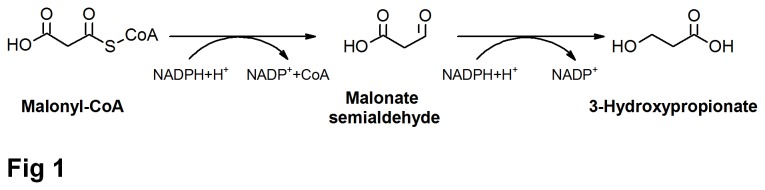
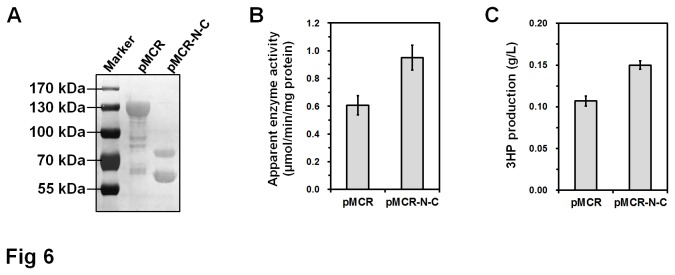
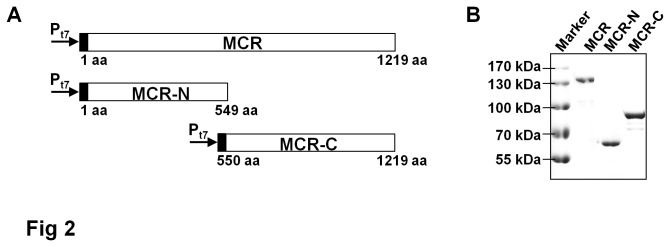
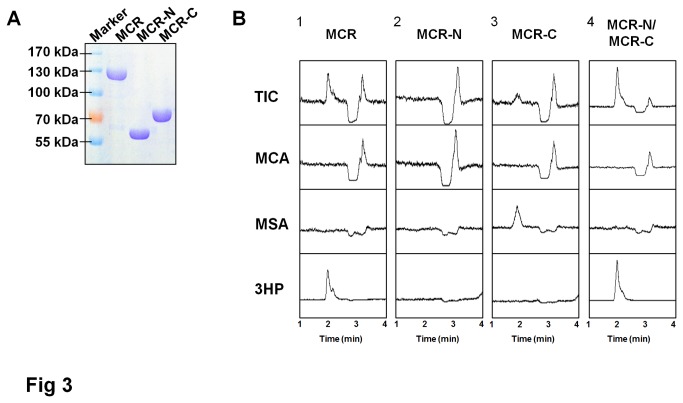
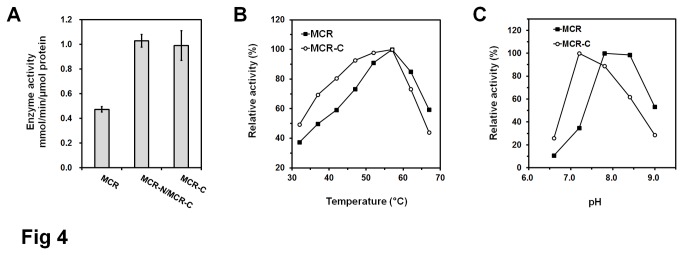
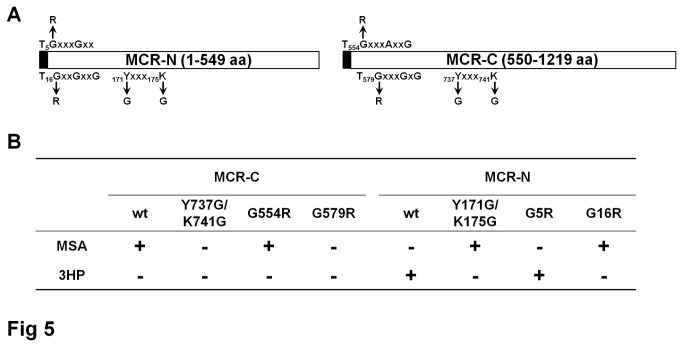
The formation of fusion protein in biosynthetic pathways usually improves metabolic efficiency either channeling intermediates and/or colocalizing enzymes. In the metabolic engineering of biochemical pathways, generating unnatural protein fusions between sequential biosynthetic enzymes is a useful method to increase system efficiency and product yield. Here, we reported a special case. The malonyl-CoA reductase (MCR) of Chloroflexus aurantiacus catalyzes the conversion of malonyl-CoA to 3-hydroxypropionate (3HP), and is a key enzyme in microbial production of 3HP, an important platform chemical. Functional domain analysis revealed that the N-terminal region of MCR (MCR-N; amino acids 1-549) and the C-terminal region of MCR (MCR-C; amino acids 550-1219) were functionally distinct. The malonyl-CoA was reduced into free intermediate malonate semialdehyde with NADPH by MCR-C fragment, and further reduced to 3HP by MCR-N fragment. In this process, the initial reduction of malonyl-CoA was rate limiting. Site-directed mutagenesis demonstrated that the TGXXXG(A)X(1-2)G and YXXXK motifs were important for enzyme activities of both MCR-N and MCR-C fragments. Moreover, the enzyme activity increased when MCR was separated into two individual fragments. Kinetic analysis showed that MCR-C fragment had higher affinity for malonyl-CoA and 4-time higher K cat/K m value than MCR. Dissecting MCR into MCR-N and MCR-C fragments also had a positive effect on the 3HP production in a recombinant Escherichia coli strain. Our study showed the feasibility of protein dissection as a new strategy in biosynthetic systems.
生物合成途径中融合蛋白的形成通常可以提高代谢效率,要么是通过将中间产物定向运输,要么是通过将酶共定位。在生化途径的代谢工程中,在连续的生物合成酶之间产生非天然的蛋白融合是提高系统效率和产物产量的一种有用方法。在这里,我们报告了一个特殊的例子。Orange 热袍菌的丙二酰辅酶 A 还原酶(MCR)催化丙二酰辅酶 A 转化为 3-羟基丙酸(3HP),是微生物生产 3HP 的关键酶,3HP 是一种重要的平台化学品。功能域分析表明,MCR 的 N 端区域(MCR-N;氨基酸 1-549)和 C 端区域(MCR-C;氨基酸 550-1219)具有不同的功能。MCR-C 片段将丙二酰辅酶 A 还原成与 NADPH 结合的游离中间产物丙二酰半醛,然后由 MCR-N 片段进一步还原为 3HP。在这个过程中,丙二酰辅酶 A 的初始还原是限速步骤。定点突变表明,TGXXXG(A)X(1-2)G 和 YXXXK 基序对于 MCR-N 和 MCR-C 片段的酶活性都很重要。此外,当 MCR 被分成两个单独的片段时,酶活性增加。动力学分析表明,MCR-C 片段对丙二酰辅酶 A 的亲和力更高,K cat/K m 值比 MCR 高 4 倍。将 MCR 分解为 MCR-N 和 MCR-C 片段也对重组大肠杆菌菌株中的 3HP 生产有积极影响。我们的研究表明,蛋白质切割作为生物合成系统中的一种新策略是可行的。