School of Life Sciences and Medicine, Shandong University of Technology, Zibo, 255000, China.
International Joint Laboratory on Extremophilic Bacteria and Biological Synthesis, Shandong University of Technology, Zibo, 255000, China.
Microb Cell Fact. 2024 Jul 5;23(1):194. doi: 10.1186/s12934-024-02470-6.
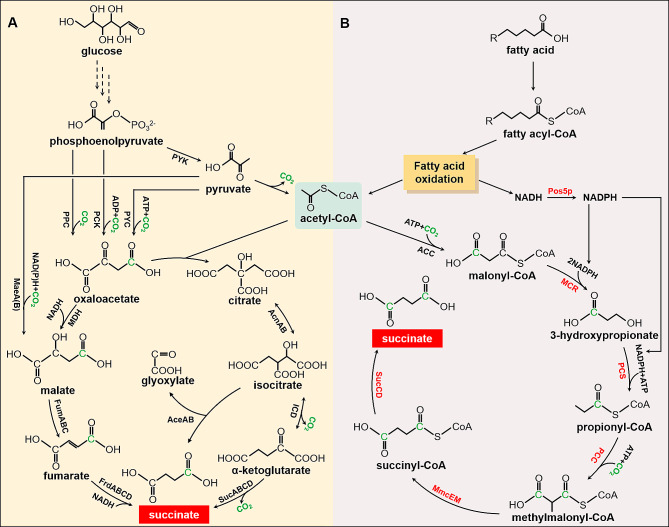
Biotransformation of CO into high-value-added carbon-based products is a promising process for reducing greenhouse gas emissions. To realize the green transformation of CO, we use fatty acids as carbon source to drive CO fixation to produce succinate through a portion of the 3-hydroxypropionate (3HP) cycle in Cupriavidus necator H16.
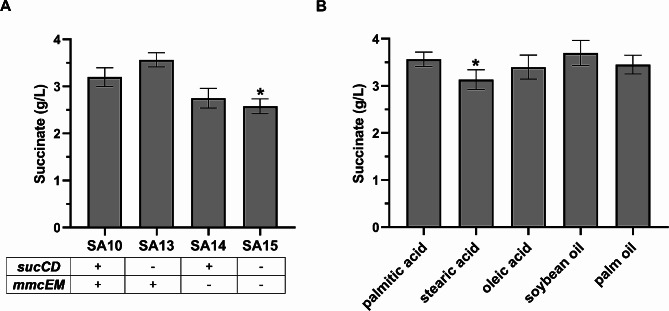
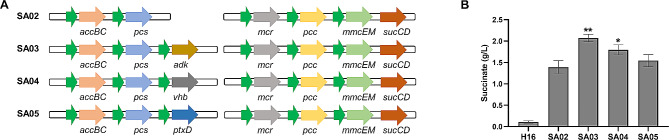
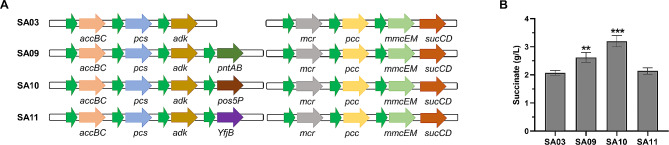
This work can achieve the production of a single succinate molecule from one acetyl-CoA molecule and two CO molecules. It was verified using an isotope labeling experiment utilizing NaHCO. This implies that 50% of the carbon atoms present in succinate are derived from CO, resulting in a twofold increase in efficiency compared to prior methods of succinate biosynthesis that relied on the carboxylation of phosphoenolpyruvate or pyruvate. Meanwhile, using fatty acid as a carbon source has a higher theoretical yield than other feedstocks and also avoids carbon loss during acetyl-CoA and succinate production. To further optimize succinate production, different approaches including the optimization of ATP and NADPH supply, optimization of metabolic burden, and optimization of carbon sources were used. The resulting strain was capable of producing succinate to a level of 3.6 g/L, an increase of 159% from the starting strain.
This investigation established a new method for the production of succinate by the implementation of two CO fixation reactions and demonstrated the feasibility of ATP, NADPH, and metabolic burden regulation strategies in biological carbon fixation.
将 CO 转化为高附加值的碳基产品是减少温室气体排放的一种很有前途的方法。为了实现 CO 的绿色转化,我们使用脂肪酸作为碳源,通过部分 3-羟基丙酸(3HP)循环来驱动 CO 的固定,从而生产琥珀酸。
这项工作可以实现从一个乙酰辅酶 A 分子和两个 CO 分子生产一个琥珀酸分子。利用 NaHCO 进行的同位素标记实验验证了这一点。这意味着琥珀酸中 50%的碳原子来自 CO,与以前依赖于磷酸烯醇丙酮酸或丙酮酸羧化的琥珀酸生物合成方法相比,效率提高了两倍。同时,使用脂肪酸作为碳源比其他原料具有更高的理论产率,并且在生产乙酰辅酶 A 和琥珀酸时避免了碳的损失。为了进一步优化琥珀酸的生产,我们使用了不同的方法,包括优化 ATP 和 NADPH 的供应、代谢负担的优化和碳源的优化。最终得到的菌株能够生产 3.6 g/L 的琥珀酸,比起始菌株提高了 159%。
本研究通过实施两个 CO 固定反应建立了生产琥珀酸的新方法,并证明了在生物固碳中调节 ATP、NADPH 和代谢负担策略的可行性。