Department of Cancer Biology, Mayo Clinic Cancer Center, Jacksonville, Florida, United States of America.
PLoS One. 2013 Sep 20;8(9):e75836. doi: 10.1371/journal.pone.0075836. eCollection 2013.
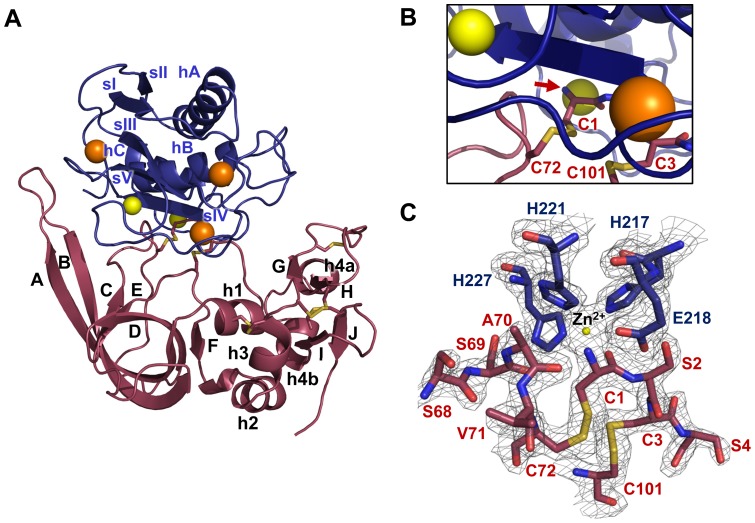
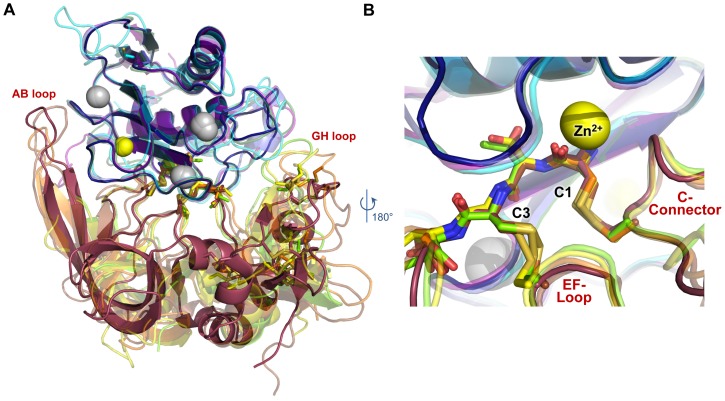
Matrix metalloproteinases (MMPs) play central roles in vertebrate tissue development, remodeling, and repair. The endogenous tissue inhibitors of metalloproteinases (TIMPs) regulate proteolytic activity by binding tightly to the MMP active site. While each of the four TIMPs can inhibit most MMPs, binding data reveal tremendous heterogeneity in affinities of different TIMP/MMP pairs, and the structural features that differentiate stronger from weaker complexes are poorly understood. Here we report the crystal structure of the comparatively weakly bound human MMP-10/TIMP-2 complex at 2.1 Å resolution. Comparison with previously reported structures of MMP-3/TIMP-1, MT1-MMP/TIMP-2, MMP-13/TIMP-2, and MMP-10/TIMP-1 complexes offers insights into the structural basis of binding selectivity. Our analyses identify a group of highly conserved contacts at the heart of MMP/TIMP complexes that define the conserved mechanism of inhibition, as well as a second category of diverse adventitious contacts at the periphery of the interfaces. The AB loop of the TIMP N-terminal domain and the contact loops of the TIMP C-terminal domain form highly variable peripheral contacts that can be considered as separate exosite interactions. In some complexes these exosite contacts are extensive, while in other complexes the AB loop or C-terminal domain contacts are greatly reduced and appear to contribute little to complex stability. Our data suggest that exosite interactions can enhance MMP/TIMP binding, although in the relatively weakly bound MMP-10/TIMP-2 complex they are not well optimized to do so. Formation of highly variable exosite interactions may provide a general mechanism by which TIMPs are fine-tuned for distinct regulatory roles in biology.
基质金属蛋白酶(MMPs)在脊椎动物组织发育、重塑和修复中发挥核心作用。金属蛋白酶的内源性组织抑制剂(TIMPs)通过紧密结合 MMP 的活性位点来调节蛋白水解活性。虽然四种 TIMP 中的每一种都可以抑制大多数 MMP,但结合数据显示不同 TIMP/MMP 对的亲和力存在巨大的异质性,并且区分强复合物和弱复合物的结构特征还知之甚少。在这里,我们报告了以 2.1 Å 分辨率的相对较弱结合的人 MMP-10/TIMP-2 复合物的晶体结构。与先前报道的 MMP-3/TIMP-1、MT1-MMP/TIMP-2、MMP-13/TIMP-2 和 MMP-10/TIMP-1 复合物的结构比较提供了对结合选择性的结构基础的深入了解。我们的分析确定了 MMP/TIMP 复合物核心的一组高度保守的接触,这些接触定义了保守的抑制机制,以及界面外围的第二类多样化的偶然接触。TIMP N 端结构域的 AB 环和 TIMP C 端结构域的接触环形成高度可变的外围接触,可视为单独的附加结合位点相互作用。在一些复合物中,这些附加结合位点很广泛,而在其他复合物中,AB 环或 C 端结构域的接触大大减少,似乎对复合物稳定性贡献不大。我们的数据表明,附加结合位点可以增强 MMP/TIMP 结合,尽管在相对较弱结合的 MMP-10/TIMP-2 复合物中,它们没有很好地优化以实现这种结合。高度可变的附加结合位点的形成可能为 TIMP 提供了一种通用的机制,使其在生物学中精细调节不同的调节作用。