Avram and Stella Goldstein-Goren Department of Biotechnology Engineering and the National Institute of Biotechnology in the Negev, Ben-Gurion University of the Negev, P.O.B. 653, 84105, Beer-Sheva, Israel.
Department of Cancer Biology, Mayo Clinic Comprehensive Cancer Center, Jacksonville, 310 Griffin Building, 4500 San Pablo Road, Jacksonville, FL, 32224, USA.
Sci Rep. 2023 Mar 30;13(1):5186. doi: 10.1038/s41598-023-32019-3.
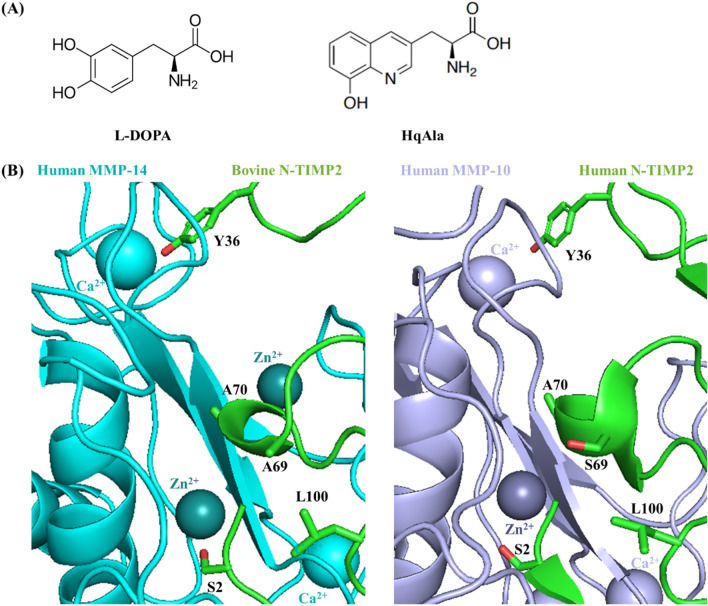
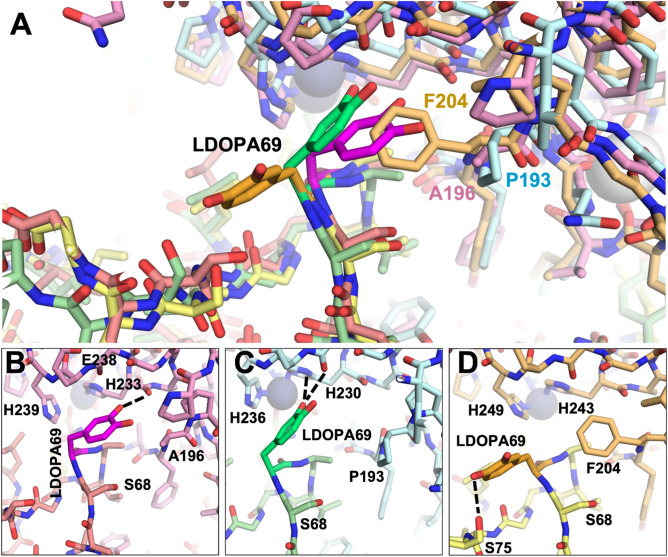
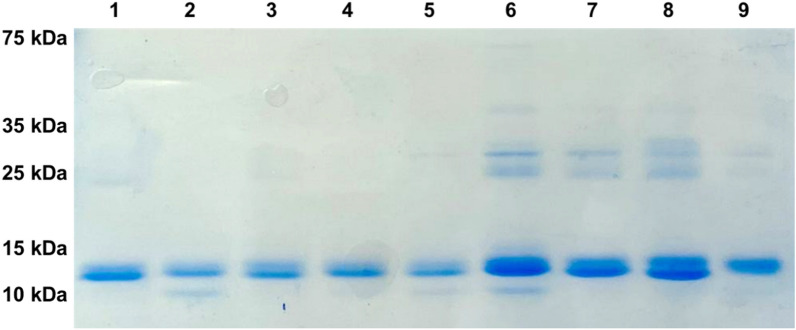
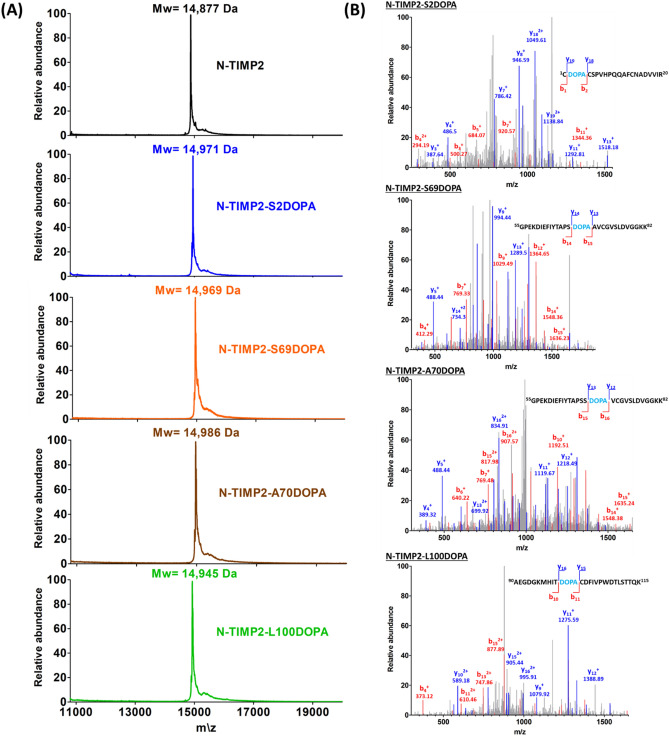
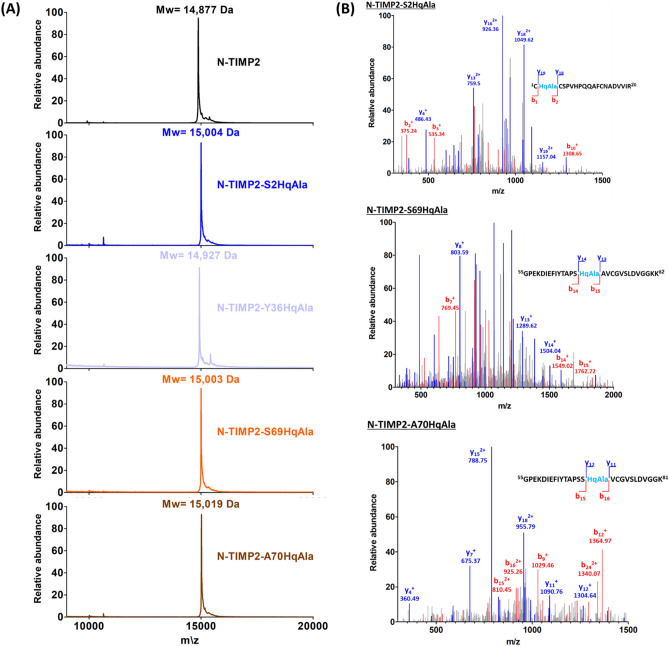
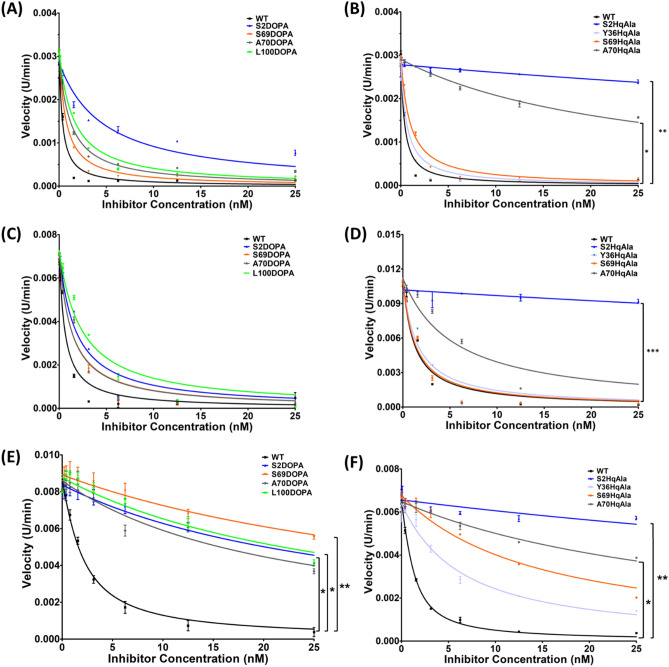
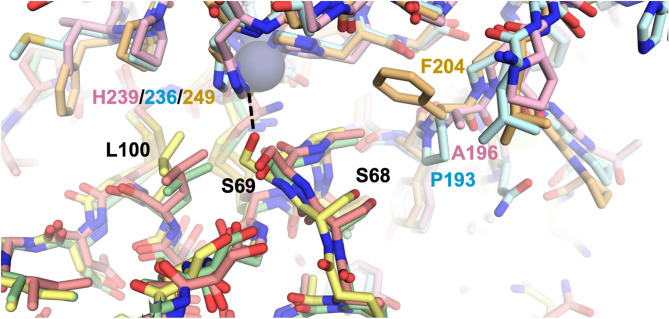
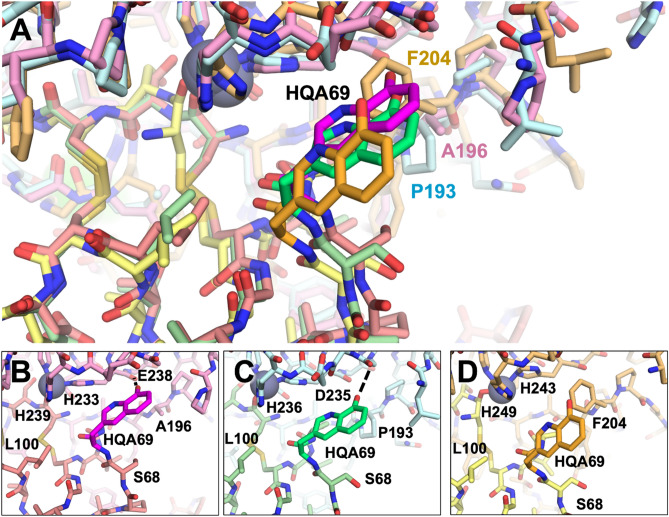
Matrix metalloproteinases (MMPs) regulate the degradation of extracellular matrix (ECM) components in biological processes. MMP activity is controlled by natural tissue inhibitors of metalloproteinases (TIMPs) that non-selectively inhibit the function of multiple MMPs via interaction with the MMPs' Zn-containing catalytic pocket. Recent studies suggest that TIMPs engineered to confer MMP specificity could be exploited for therapeutic purposes, but obtaining specific TIMP-2 inhibitors has proved to be challenging. Here, in an effort to improve MMP specificity, we incorporated the metal-binding non-canonical amino acids (NCAAs), 3,4-dihydroxyphenylalanine (L-DOPA) and (8-hydroxyquinolin-3-yl)alanine (HqAla), into the MMP-inhibitory N-terminal domain of TIMP2 (N-TIMP2) at selected positions that interact with the catalytic Zn ion (S2, S69, A70, L100) or with a structural Ca ion (Y36). Evaluation of the inhibitory potency of the NCAA-containing variants towards MMP-2, MMP-9 and MMP-14 in vitro revealed that most showed a significant loss of inhibitory activity towards MMP-14, but not towards MMP-2 and MMP-9, resulting in increased specificity towards the latter proteases. Substitutions at S69 conferred the best improvement in selectivity for both L-DOPA and HqAla variants. Molecular modeling provided an indication of how MMP-2 and MMP-9 are better able to accommodate the bulky NCAA substituents at the intermolecular interface with N-TIMP2. The models also showed that, rather than coordinating to Zn, the NCAA side chains formed stabilizing polar interactions at the intermolecular interface with MMP-2 and MMP-9. Our findings illustrate how incorporation of NCAAs can be used to probe-and possibly exploit-differential tolerance for substitution within closely related protein-protein complexes as a means to improve specificity.
基质金属蛋白酶(MMPs)调节生物过程中外源基质(ECM)成分的降解。MMP 活性受天然金属蛋白酶组织抑制剂(TIMPs)的控制,TIMPs 通过与 MMPs 的 Zn 含有催化口袋相互作用,非选择性地抑制多种 MMP 的功能。最近的研究表明,设计用于赋予 MMP 特异性的 TIMP 可以被用于治疗目的,但获得特异性 TIMP-2 抑制剂已被证明具有挑战性。在这里,为了提高 MMP 的特异性,我们在与催化 Zn 离子(S2、S69、A70、L100)或结构 Ca 离子(Y36)相互作用的选定位置将金属结合的非规范氨基酸(NCAA),3,4-二羟基苯丙氨酸(L-DOPA)和(8-羟基喹啉-3-基)丙氨酸(HqAla),引入 TIMP2 的 MMP 抑制性 N 端结构域(N-TIMP2)中。评估 NCAA 含有变体对 MMP-2、MMP-9 和 MMP-14 的体外抑制效力表明,大多数变体对 MMP-14 的抑制活性显著丧失,但对 MMP-2 和 MMP-9 没有,导致对后两种蛋白酶的特异性增加。S69 的取代赋予 L-DOPA 和 HqAla 变体最佳的选择性改善。分子建模提供了一个指示,说明 MMP-2 和 MMP-9 如何更好地适应 N-TIMP2 与 MMP-2 和 MMP-9 之间的分子间界面上的大 NCAA 取代基。该模型还表明,NCAA 侧链不是与 Zn 配位,而是在与 MMP-2 和 MMP-9 的分子间界面形成稳定的极性相互作用。我们的研究结果说明了如何将 NCAA 掺入到紧密相关的蛋白质-蛋白质复合物中,以探测和可能利用取代基的差异耐受性,作为提高特异性的一种手段。