Department of Biological Sciences, Graduate School of Science, University of Tokyo, 7-3-1 Hongo, Bunkyo-ku, Tokyo 113-0033, Japan.
BMC Plant Biol. 2013 Sep 28;13:143. doi: 10.1186/1471-2229-13-143.
Leaves are determinate organs; hence, precise control of cell proliferation and post-mitotic cell expansion is essential for their growth. A defect in cell proliferation often triggers enhanced post-mitotic cell expansion in leaves. This phenomenon is referred to as 'compensation'. Several lines of evidence from studies on compensation have shown that cell proliferation and post-mitotic cell expansion are coordinately regulated during leaf development. Therefore, compensation has attracted much attention to the mechanisms for leaf growth. However, our understanding of compensation at the subcellular level remains limited because studies of compensation have focused mainly on cellular-level phenotypes. Proper leaf growth requires quantitative control of subcellular components in association with cellular-level changes. To gain insight into the subcellular aspect of compensation, we investigated the well-known relationship between cell area and chloroplast number per cell in compensation-exhibiting lines, and asked whether chloroplast proliferation is modulated in response to the induction of compensation.
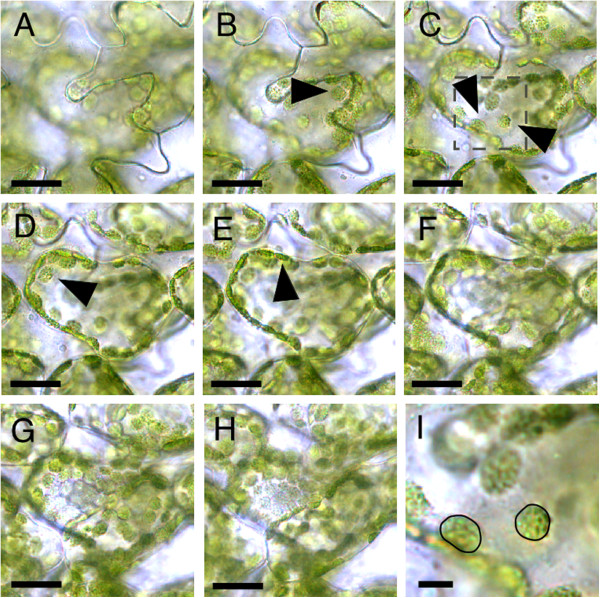
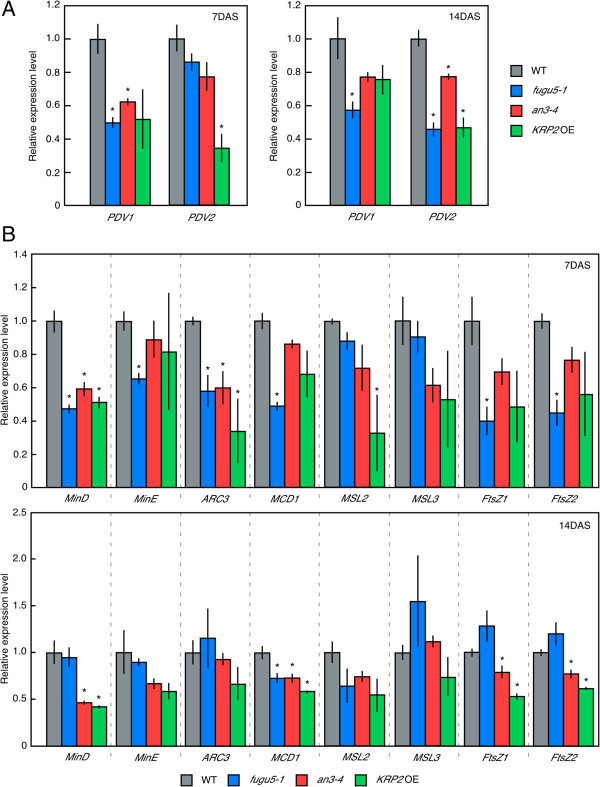
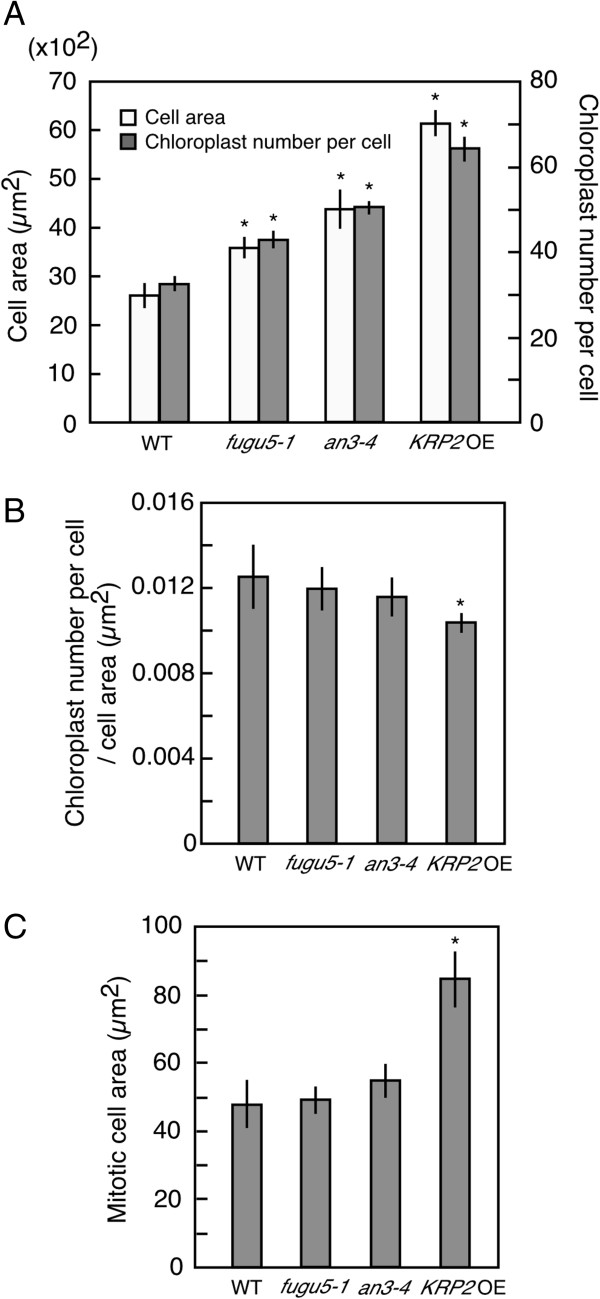
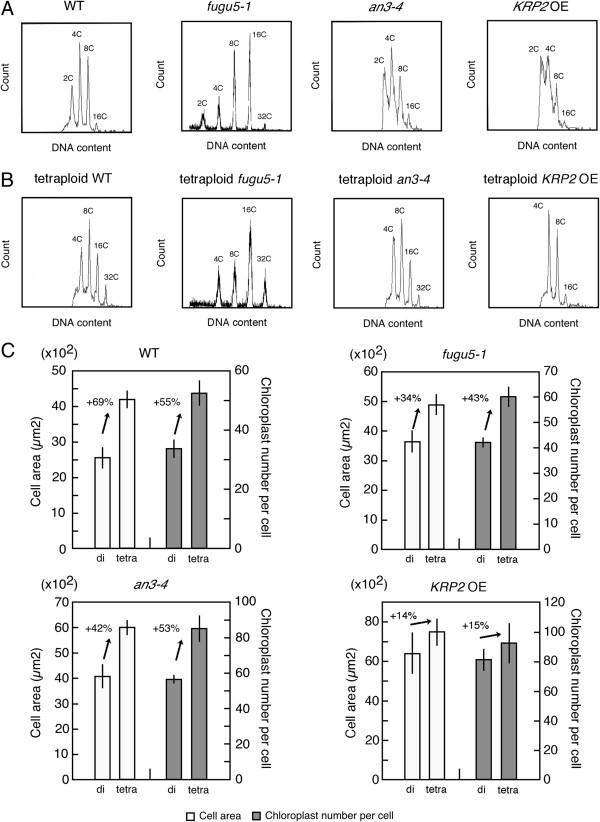
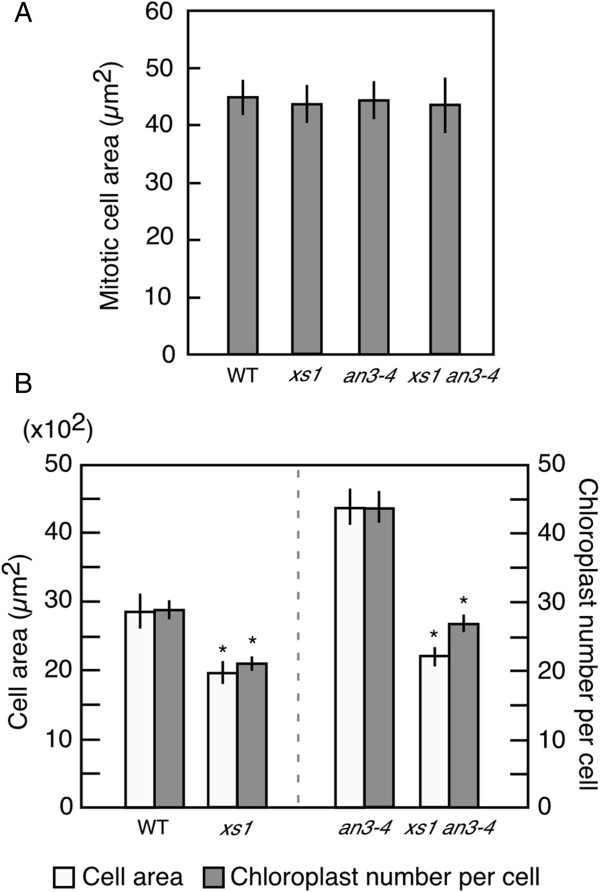
We first established a convenient and reliable method for observation of chloroplasts in situ. Using this method, we analyzed Arabidopsis thaliana mutants fugu5 and angustifolia3 (an3), and a transgenic line KIP-RELATED PROTEIN2 overexpressor (KRP2 OE), which are known to exhibit typical features of compensation. We here showed that chloroplast number per cell increased in the subepidermal palisade tissue of these lines. We analyzed tetraploidized wild type, fugu5, an3 and KRP2 OE, and found that cell area itself, but not nuclear ploidy, is a key parameter that determines the activity of chloroplast proliferation. In particular, in the case of an3, we uncovered that promotion of chloroplast proliferation depends on the enhanced post-mitotic cell expansion. The expression levels of chloroplast proliferation-related genes are similar to or lower than that in the wild type during this process.
This study demonstrates that chloroplast proliferation is promoted in compensation-exhibiting lines. This promotion of chloroplast proliferation takes place in response to cell-area increase in post-mitotic phase in an3. The expression of chloroplast proliferation-related genes were not promoted in compensation-exhibiting lines including an3, arguing that an as-yet-unknown mechanism is responsible for modulation of chloroplast proliferation in these lines.
叶片是有限生长的器官;因此,精确控制细胞增殖和有丝分裂后细胞的扩展对于叶片生长至关重要。细胞增殖的缺陷通常会引发叶片中过继分裂后细胞的扩展。这种现象被称为“补偿”。从补偿研究中获得的几条证据表明,细胞增殖和有丝分裂后细胞的扩展在叶片发育过程中是协调调控的。因此,补偿引起了人们对叶片生长机制的关注。然而,由于补偿研究主要集中在细胞水平的表型上,我们对亚细胞水平补偿的理解仍然有限。适当的叶片生长需要与细胞水平变化相关联的亚细胞成分的定量控制。为了深入了解补偿的亚细胞方面,我们研究了补偿表现型中细胞面积与每个细胞中的叶绿体数之间的已知关系,并询问了叶绿体增殖是否响应补偿的诱导而被调节。
我们首先建立了一种方便可靠的观察叶绿体原位的方法。使用该方法,我们分析了已知表现出典型补偿特征的拟南芥突变体 fugu5 和 angustifolia3(an3)以及 KIP-RELATED PROTEIN2 过表达系(KRP2 OE)。结果表明,这些系的表皮栅栏组织的每个细胞中的叶绿体数量增加。我们分析了四倍体野生型、fugu5、an3 和 KRP2 OE,发现细胞面积本身,而不是核倍性,是决定叶绿体增殖活性的关键参数。特别是,在 an3 的情况下,我们发现促进叶绿体增殖取决于过继分裂后细胞扩展的增强。在这个过程中,与野生型相比,叶绿体增殖相关基因的表达水平相似或更低。
本研究表明,补偿表现型中促进了叶绿体增殖。在 an3 中,这种叶绿体增殖的促进发生在有丝分裂后阶段细胞面积增加的情况下。在补偿表现型系中,包括 an3 在内,叶绿体增殖相关基因的表达没有被促进,这表明在这些系中,存在一种未知的机制来调节叶绿体增殖。