Department of Pharmacology, College of Medicine, University of Arizona, Tucson, AZ, USA.
Neurosci Lett. 2013 Dec 17;557 Pt A(0 0):52-9. doi: 10.1016/j.neulet.2013.08.003. Epub 2013 Sep 25.
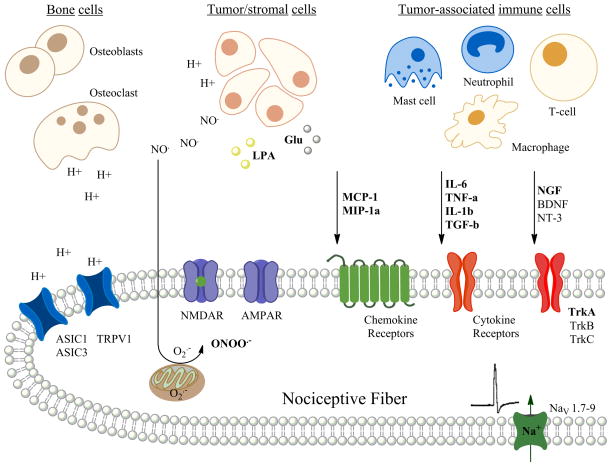
Cancerous cells can originate in a number of different tissues such as prostate, breast and lung, but often go undetected and are non-painful. Many types of cancers have a propensity to metastasize to the bone microenvironment first. Tumor burden within the bone causes excruciating breakthrough pain with properties of ongoing pain that is inadequately managed with current analgesics. Part of this failure is due to the poor understanding of the etiology of cancer pain. Animal models of cancer-induced bone pain (CIBP) have revealed that the neurochemistry of cancer has features distinctive from other chronic pain states. For example, preclinical models of metastatic cancer often result in the positive modulation of neurotrophins, such as NGF and BDNF, that can lead to nociceptive sensitization. Preclinical cancer models also demonstrate nociceptive neuronal expression of acid-sensing receptors, such as ASIC1 and TRPV1, which respond to cancer-induced acidity within the bone. CIBP is correlated with a significant increase in pro-inflammatory mediators acting peripherally and centrally, contributing to neuronal hypersensitive states. Finally, cancer cells generate high levels of oxidative molecules that are thought to increase extracellular glutamate concentrations, thus activating primary afferent neurons. Knowledge of the unique neuro-molecular profile of cancer pain will ultimately lead to the development of novel and superior therapeutics for CIBP.
癌细胞可以起源于许多不同的组织,如前列腺、乳房和肺部,但通常未被发现且无疼痛。许多类型的癌症首先倾向于转移到骨微环境。骨内的肿瘤负担会导致剧烈的突破性疼痛,其性质为持续性疼痛,目前的镇痛药无法充分缓解。这种失败部分归因于对癌症疼痛病因的理解不足。癌症诱导性骨痛(CIBP)的动物模型表明,癌症的神经化学具有与其他慢性疼痛状态不同的特征。例如,转移性癌症的临床前模型通常会导致神经营养因子(如神经生长因子和脑源性神经营养因子)的正调节,从而导致伤害感受敏化。临床前癌症模型还显示出酸感应受体(如 ASIC1 和 TRPV1)在伤害感受神经元上的表达,这些受体对骨内的癌症诱导性酸度做出反应。CIBP 与在外周和中枢起作用的促炎介质的显著增加相关,导致神经元超敏状态。最后,癌细胞产生高水平的氧化分子,这些分子被认为会增加细胞外谷氨酸浓度,从而激活初级传入神经元。对癌症疼痛独特的神经分子特征的了解将最终导致 CIBP 的新型和优越治疗方法的发展。