Division of Infectious Diseases, Department of Internal Medicine, Kaohsiung Chang Gung Memorial Hospital, Kaohsiung 833, Taiwan ; Chang Gung University Medical College, Tao-Yuan 333, Taiwan ; Infection Control Committee, Kaohsiung Chang Gung Memorial Hospital, Kaohsiung 833, Taiwan.
Biomed Res Int. 2013;2013:965853. doi: 10.1155/2013/965853. Epub 2013 Sep 2.
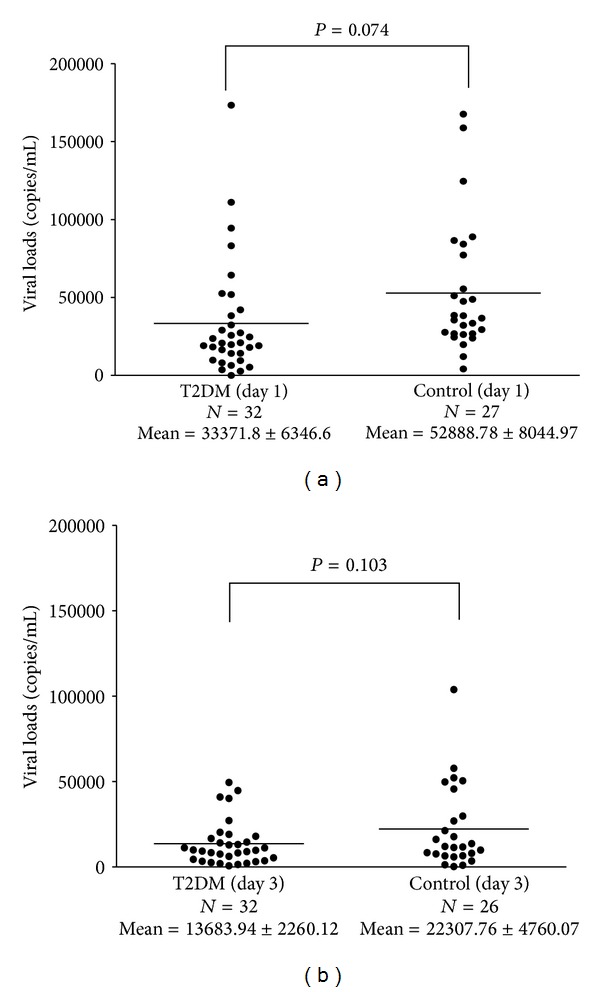
It has been reported that diabetes mellitus (DM) was an epidemiologically identified risk factor for development of dengue hemorrhagic fever (DHF)/severe dengue in dengue virus (DENV) affected patients, and T helper 2 (Th2) cytokines such as interleukin-4 (IL-4) and IL-10 each plays an important role in the immunopathogenesis of DHF in studies involving general population. To better understand the relationship between these epidemiological and immunological findings, we performed an in vitro study evaluating the sequential immunological reactions and viral load in the DENV infected mononuclear cells of adults with type 2 DM (T2DM group, n = 33) and normal adults (control group, n = 29). We found in the T2DM group significantly higher IL-4 level on the first (P = 0.049) and the third (P = 0.022) postinfection days, while higher IL-10 (P = 0.042) and granulocyte-macrophage colony-stimulating factor (GM-CSF) (P = 0.009) were detected on the third postinfection day. No significant difference in DENV viral load between the cultured mononuclear cells from both groups was found on the first and third post-infection days. These data immunologically suggest that patients with T2DM are at higher risk for development of DHF/severe dengue and strengthen the previously epidemiologically identified role of DM being a predictive risk factor for progressing into DHF/severe dengue in DENV-affected patients.
据报道,糖尿病(DM)是登革热病毒(DENV)感染患者发生登革出血热(DHF)/重症登革热的流行病学确定的危险因素,辅助性 T 细胞 2(Th2)细胞因子如白细胞介素-4(IL-4)和 IL-10 在涉及普通人群的研究中在 DHF 的免疫发病机制中均发挥重要作用。为了更好地理解这些流行病学和免疫学发现之间的关系,我们进行了一项体外研究,评估了成人 2 型糖尿病(T2DM 组,n = 33)和正常成年人(对照组,n = 29)的 DENV 感染单核细胞中的连续免疫反应和病毒载量。我们发现 T2DM 组在感染后的第 1 天(P = 0.049)和第 3 天(P = 0.022)IL-4 水平显著升高,而在第 3 天检测到更高水平的 IL-10(P = 0.042)和粒细胞-巨噬细胞集落刺激因子(GM-CSF)(P = 0.009)。在感染后的第 1 天和第 3 天,两组培养的单核细胞中的 DENV 病毒载量无显著差异。这些免疫学数据表明,T2DM 患者发生 DHF/重症登革热的风险更高,并加强了之前在流行病学上确定的 DM 是 DENV 感染患者进展为 DHF/重症登革热的预测危险因素的作用。